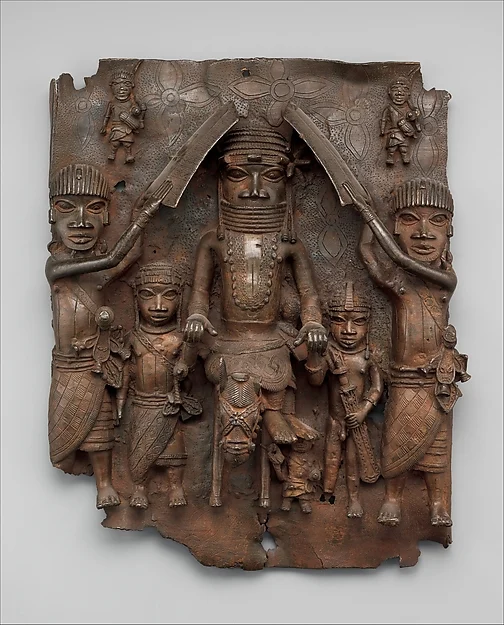
Brass plaque with an equestrian ọ́bà and attendants, attributed to Ìgùn Ẹ́rọ̀nwwọ̀n casting-guild artists at the Court of Benin, circa 1540–1570, Met 1978.412.309
This sixteenth-century court plaque presents an equestrian ọ́bà with attendants. The museum attributes its brass casting to Ìgùn Ẹ́rọ̀nwwọ̀n guild artists at Benin’s royal court. It is one historical artwork within Edo cultural history, rather than a portrait of contemporary Edo people or a general description of their appearance. The photograph retains the plaque’s damaged edges.
Overview
Edo cultural communities associated with Benin City in Nigeria are represented here through selected contemporary heritage work, rather than solely through artworks in overseas collections. The Smithsonian's exhibition introduction identifies the historic kingdom of Benin with Edo-speaking peoples in what is now south-central Nigeria. Its account describes consultation with Nigerian museum partners and distinguishes transferred ownership from objects physically returned or retained on loan. These distinctions matter when describing the afterlife of material removed during the British attack of 1897. A kingdom, a living community, a modern state and the institutions speaking about collections are related settings, not interchangeable identities.
The Horniman Museum's redisplay account documents contemporary contributors in Nigeria and London. Artist Osaru Obaseki created a sculpture representing an Edo woman and honouring women from Edo history and the present. Students at University Preparatory Secondary School in Benin City worked with artist 12th The Creator and museum partners on artwork for the display. The consultation panel includes British-Nigerian artist Freda Osayuki Igiogbe, whose Edo heritage informs her practice, and heritage-forum coordinator Pius Osemwegie. These named roles show cultural interpretation involving artists, younger participants and community perspectives, rather than presenting creativity as an activity belonging only to the historical royal court.
Digital Benin's public introduction describes a platform connecting museum documentation, provenance research, historical context and Edo-language object designations with oral histories. Its stated focus is material looted from the kingdom in February 1897 and dispersed afterwards. The platform presents separate spaces for institutions, maps, archives and Benin-authored historical accounts. This organisation makes the source and location of documentation part of interpretation, rather than treating a dispersed collection as a complete account of a people. The introduction establishes the project's scope; individual oral recordings, translated histories and manuscript files are not treated as having been inspected here.
The German Archaeological Institute's October 2024 Edo|cation report describes work with Nigerian colleagues and the Museum of West African Art on Benin's cultural landscape. Its account connects mapping of the Iya earthworks with dialogues involving communities living alongside them, including earlier community conservation initiatives. Nigerian and German researchers also worked on digital documentation and training. These are attributed project activities and preservation goals at a particular date. The report's hoped-for World Heritage recognition and later events remain proposals in this account. The archaeological features provide a setting for living cultural concerns; they are not used to infer biological ancestry.
History & identity
Historical collection events and modern project dates do not establish the origin of Edo communities.
Sources & representation
Scoped museum introductions, a complete partnership account, project introduction and archaeological report.
Selected bibliography
Documented works and useful reading. This is not a list of every appearance.
- 01
Benin Bronzes: Ambassadors of the Oba
Indexed introductory/transfer paragraphs read only; full exhibition body not read.
- 02
Benin Kingdom Display
Complete public project body read; artworks, film and soundscape not inspected.
- 03
Digital Benin: About the project
Complete indexed homepage/About body read; no individual recordings or archival files.
- 04
Edo|cation: Researching and Preserving the Cultural Heritage of Benin
Complete 21 October written report read; film, course and surveys not inspected.
Language & cultural connections
Source-supported language and cultural connections have not yet been compiled for this profile.
References
Sources supporting this profile. Linked pages have their own scope and editorial standards.
- Museum exhibition accountBenin Bronzes: Ambassadors of the ObaResearch access: 2026-10-05
- Museum partnership accountBenin Kingdom DisplayResearch access: 2026-10-05
- Cultural documentation projectDigital Benin: About the projectResearch access: 2026-10-05
- Institutional archaeological project reportEdo|cation: Researching and Preserving the Cultural Heritage of BeninResearch access: 2026-10-05
Image credits
Contextual cultural object photographBrass plaque with an equestrian ọ́bà and attendants, attributed to Ìgùn Ẹ́rọ̀nwwọ̀n casting-guild artists at the Court of Benin, circa 1540–1570, Met 1978.412.309
This sixteenth-century court plaque presents an equestrian ọ́bà with attendants. The museum attributes its brass casting to Ìgùn Ẹ́rọ̀nwwọ̀n guild artists at Benin’s royal court. It is one historical artwork within Edo cultural history, rather than a portrait of contemporary Edo people or a general description of their appearance. The photograph retains the plaque’s damaged edges.