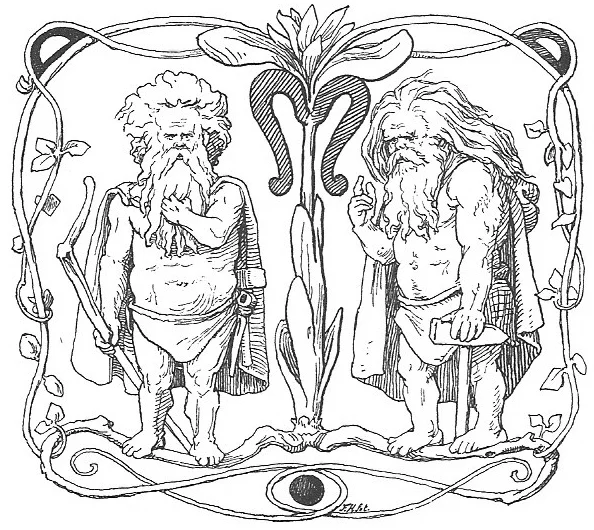
Dwarf
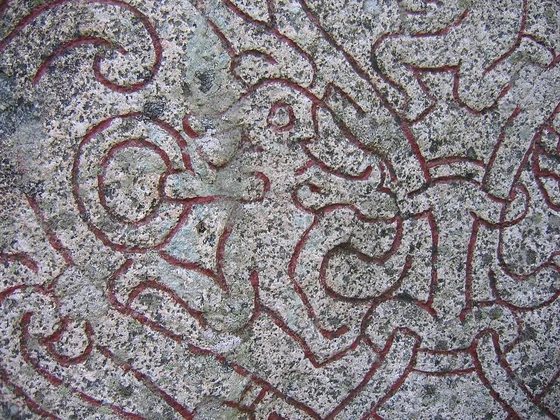
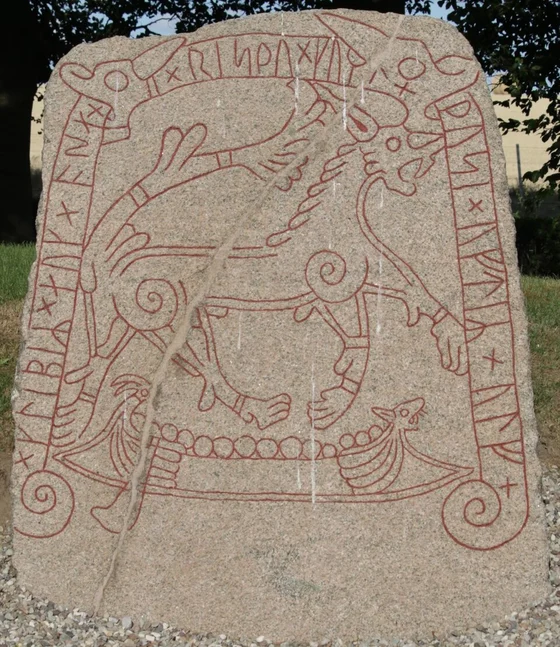
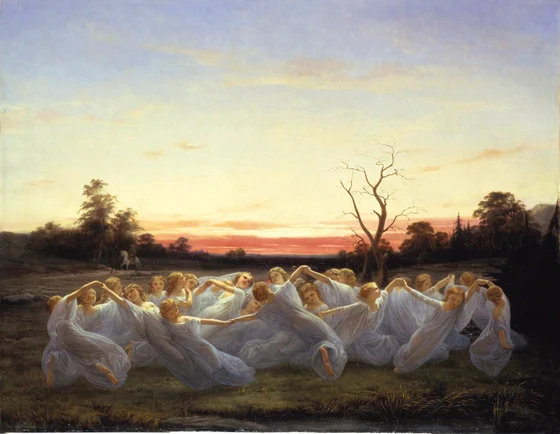
Image associated with the exact linked encyclopedia article; consult credited file description for its interpretation.
Overview
Gylfaginning’s creation account associates the dwarfs’ beginning with Ymir’s flesh and then describes the gods granting them human understanding and form. They continue to dwell in the earth and rocks. The ensuing name lists place individual beings within this cosmological scheme, but a name alone does not supply a separate biography. The passage is a medieval narrative about supernatural beings, not an account of an actual human population or of a medical condition. Its description of human likeness also does not establish all the familiar features of dwarfs in later illustrated fairy tales or fantasy.
In Gylfaginning §35, Odin sends Freyr’s messenger Skírnir to dwarfs in Svartálfaheimr after Fenrir breaks two heavier fetters. Their Gleipnir is smooth and soft like a silken string, but made from six extraordinary ingredients: a cat’s footfall, a woman’s beard, mountain roots, a bear’s sinews, a fish’s breath and a bird’s spittle. The speaker invokes absent beards, unheard footfalls and missing mountain roots to support his explanation. In §44, the sons of Ivaldi give Freyr Skíðblaðnir. It holds all the gods with their weapons and war gear, receives a favourable wind when its sails rise, and folds like a napkin into Freyr’s pocket. The account distinguishes this best-crafted ship from Naglfar, called the largest. These located craft episodes give the dwarfs concrete roles without assuming that every passage translated as dark or black elves defines the same group.
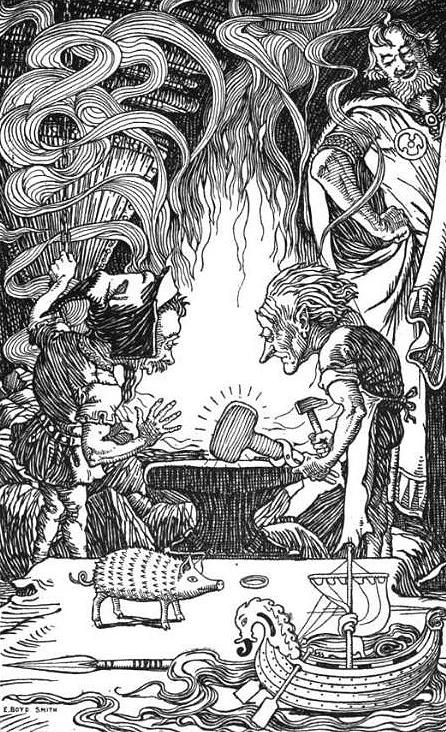
Anderson’s section headed Loke’s Wager with the Dwarfs gives the manufacture of treasures a competitive setting. After Loki cuts off Sif’s hair, Thor forces him to promise replacement hair of gold that will grow naturally. Ivaldi’s sons make it together with Skíðblaðnir and Odin’s spear. Loki then stakes his head against Brok’s claim that his brother Sindre can make three equally good objects. At the furnace Brok works the bellows while a fly repeatedly stings him. He keeps blowing through the first two distractions; blood in his eyes finally causes a momentary interruption during the last forging.
The resulting boar has shining golden bristles and can travel through air and sea; Draupnir produces eight equal rings every ninth night; Thor’s hammer returns to his hand and can shrink for concealment. Its short handle is the flaw connected with the disrupted forging. Odin, Thor and Freyr judge the hammer the most valuable protection against frost giants, so Brok wins the wager. Loki evades execution by distinguishing his pledged head from his unpledged neck. Brok instead sews his mouth shut using his brother’s awl, which appears when named. The account makes technical persistence, judgment, contested payment and retaliation part of dwarf craft, alongside the finished wonders.
Origins & earliest records
The Prose Edda supplies the selected thirteenth-century Icelandic compilation, read through Anderson’s 1901 edition of his 1879 English translation. Its cosmology incorporates older verse and named narrative material, without allowing a simple date for an oral beginning. This profile concerns dvergar in those passages rather than every later European dwarf story.
Records & interpretation
Anderson’s selected 1901 edition locates creation and dwelling in Gylfaginning §14, Gleipnir in §35, the folding ship in §44, and the full gold-hair and forging wager on pp. 189–192. These literary accounts describe named craftspeople and objects; they do not establish a uniform bodily size or costume.
In the literature
“they got the understanding and likeness of men, but still had to dwell in the earth and in rocks.”
“The Fooling of Gylfe”, Chapter VI, section 14, pp. 69–70 · Rasmus Björn Anderson
The gods give dwarfs human understanding and likeness; excerpt avoids modern fantasy extrapolations.
Selected bibliography
Documented works and useful reading. This is not a list of every appearance.
- 01
The Younger Edda, Gylfaginning §§14, 35 and 44, pp. 70–71, 93–96 and 112
Creation and name lists, six Gleipnir ingredients and binding episode, and Skíðblaðnir construction and folding directly located in the selected edition.
- 02
The Younger Edda: Loke’s Wager with the Dwarfs, pp. 189–192
Complete selected forging contest through adjudication and the sewn-mouth ending. Anderson uses Brok and Sindre; modern spellings vary.
- 03
The Younger Edda / Prose Edda
Exact contiguous excerpt checked against the linked primary e-text on 2026-10-05; only whitespace normalized. Chicago: Scott, Foresman, 1901; translation copyright 1879. Dates refer to this English edition, not composition of the Old Norse work.
Family & connections
A source-supported family tree or inspiration record has not yet been compiled for this profile. Related reading below indicates a connection in subject matter, not a proven lineage or creative influence.
Located primary passages
Specific passages supporting details in this entry, grouped by their published witness.
The Younger Edda, Gylfaginning §§14, 35 and 44, pp. 70–71, 93–96 and 112
Exact contiguous excerpt checked against the linked primary e-text on 2026-10-05; only whitespace normalized. Chicago: Scott, Foresman, 1901; translation copyright 1879. Dates refer to this English edition, not composition of the Old Norse work.
- The gods give dwarfs human understanding and likeness; excerpt avoids modern fantasy extrapolations.
This source represents its own literary or collected version. A novel or poem is evidence for depiction, not a universal definition or a zoological claim. Original source verification is preserved; attachment performed after exact generic profileID became available.
Encyclopedia background
An additional attributed reference, separate from the editorial profile above.
Read the open encyclopedia overview
A dwarf (pl. dwarfs or dwarves) is a type of supernatural human-shaped being in Germanic folklore. Accounts of dwarfs vary significantly throughout history. They are commonly, but not exclusively, presented as living in mountains or stones and being skilled craftsmen. In early literary sources, only males are explicitly referred to as dwarfs. However, they are described as having sisters and daughters, while male and female dwarfs feature in later saga literature and folklore. Dwarfs are sometimes described as short; however, scholars have noted that this is neither explicit, nor relevant to their roles in the earliest sources.
Dwarfs continue to feature in modern popular culture, such as in the works of J. R. R. Tolkien and Terry Pratchett, where they are often, but not exclusively, presented as distinct from elves.
Text from Wikipedia contributors, “Dwarf (folklore)”. CC BY-SA 4.0. Extracted introduction; formatting changed. Retrieved 5 October 2026. The source article may have changed since retrieval.
References
Sources supporting this profile. Linked pages have their own scope and editorial standards.
- Primary textThe Younger Edda, selected1901 Anderson editionResearch access: 2026-10-05
Image credits
Reference illustrationDwarf
Image associated with the exact linked encyclopedia article; consult credited file description for its interpretation.