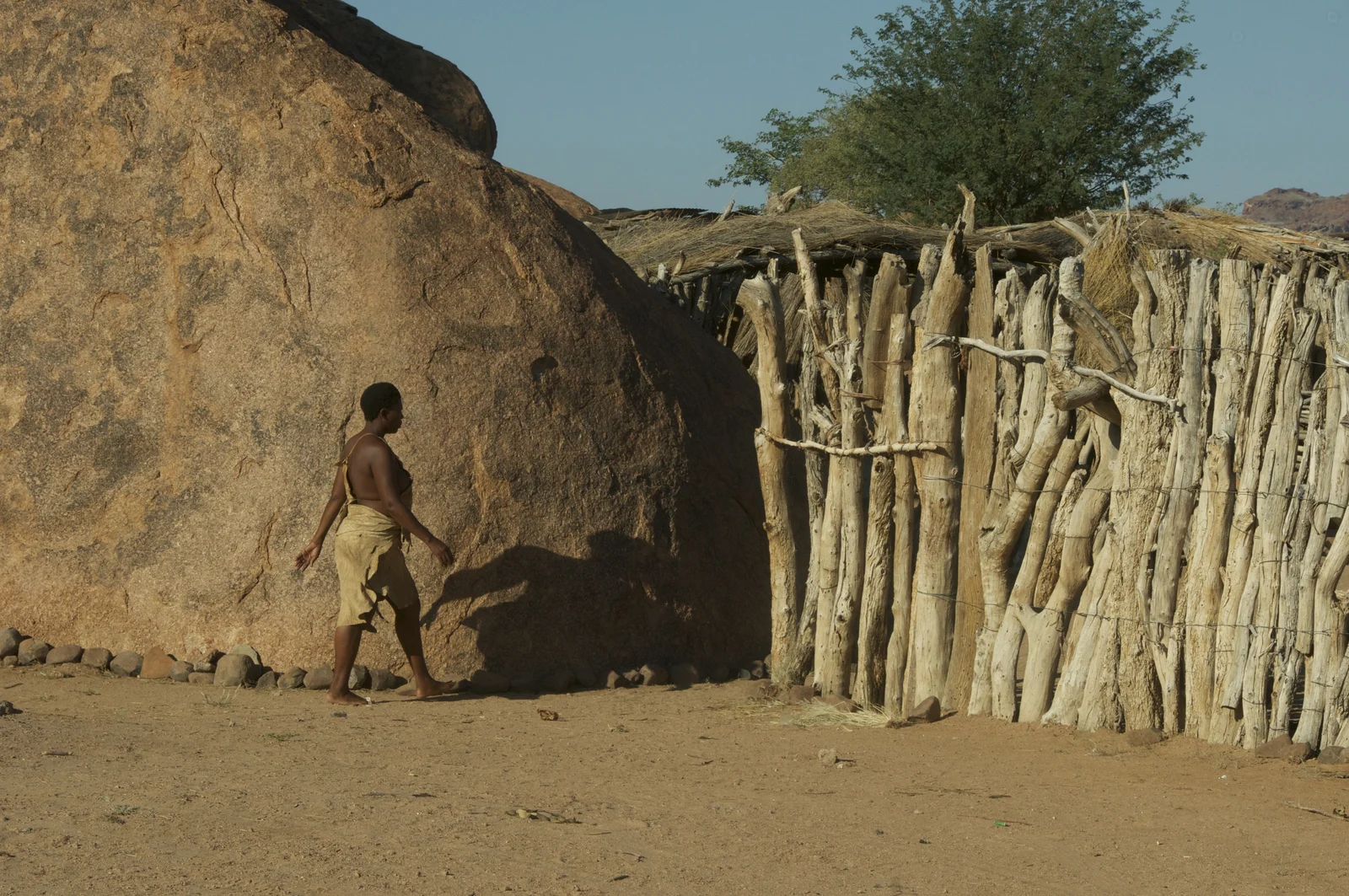
A person walks beside a large rock and a timber-and-thatch structure at the Damara Living Museum in Namibia.
The Damara Living Museum in Namibia, photographed on 27 April 2014. The photographer describes the museum as staging historical life for cultural interpretation. The scene is a museum presentation, rather than a record of universal contemporary Damara housing or dress.
Overview
Damara cultural identities in Namibia encompass regional communities and differences in speech. The 2022 pocket guide to the Helvi Mpingana Kondombolo Cultural Village associates its Damara homestead with south-central Namibia, including Otjozondupa, Kunene and Erongo. It credits Juliana Somses and Christophine Utale for the description, and Utale and Samora Cloete for translation. Its introductory framing explains that committee interviews and oral histories underlie the exhibits, which represent particular communities. The Damara display had been relocated and rebuilt and remained unfinished when described. Cement and wire were used for durability and local availability: the museum construction is therefore documented as a contemporary representation with particular material adaptations.
A separate project history attributes development of the Damara Living Museum to Hansbernhard Naobes working with the Living Culture Foundation Namibia. His 2004 visit to a Mafwe museum helped inspire the project, which opened in February 2010. The account identifies assistance from the Ju/’hoansi Living Museum in developing demonstrated techniques and skills. This is evidence of collaboration between specific cultural projects. It does not establish that Damara identity began with the museum, or that every community had lost the knowledge represented there. The institution’s reconstruction account belongs alongside other living community perspectives.
The museum’s programme separates demonstrations of earlier life from a guided visit to its contemporary home village, Louw-In. The advertised historical presentation includes blacksmithing, leather work, jewellery, crafts, music, dance and games. A separate landscape walk interprets food gathering and older hunting practices. The current-village programme addresses how people live today, rather than asking visitors to mistake an educational display for every household’s daily routine. The provider describes the museum as a private educational institution that pays its actors. These activities are curated work and livelihoods as well as cultural interpretation; the website is not an observation of all Damara life.
Contemporary museum authority is also being negotiated through exhibition review. The Museums Association of Namibia records 2023 consultations involving educators and community leaders before the 2024 revision of the Museum of Namibian Fashion. Damara contributors Welfriedtine Naobes and Jullenou Garises Kampanga proposed changes to gallery names and additions concerning Otjiwarongo Damara dress and cosmetics. An advisory board subsequently reviewed updates, and the new exhibition opened in October 2024. The museum continues to invite corrections and recommendations. This named participation shows cultural representation being revised through local expertise, rather than settled once and for all by an institution’s inherited labels.
History & identity
Selected regional community and museum accounts document Damara cultural representation in Namibia; museum foundation dates identify educational projects, not the origin of a people.
Sources & representation
Named guide contributors, a museum project history, contemporary programme and 2023–2024 exhibition consultation document distinct institutional settings.
Selected bibliography
Documented works and useful reading. This is not a list of every appearance.
- 01
Pocket Guide: Helvi Mpingana Kondombolo Cultural Village
Publication credits, project introduction, tour framing and Damara section printed7–8/PDF11 read; not the whole guide.
- 02
Museum development
Complete project history read; named founder, collaboration and February 2010 opening used; sweeping cultural-loss claim excluded.
- 03
Programs & Rates
Complete programme body read; historical demonstrations, contemporary Louw-In village and paid actor context distinguished.
- 04
Confronting Colonial Pasts, Envisioning Creative Futures: 2024 Update and Fashion Show
Complete Museum of Namibian Fashion section read; named Damara contributors and 2023–2024 review sequence retained.
Language & cultural connections
Source-supported language and cultural connections have not yet been compiled for this profile.
References
Sources supporting this profile. Linked pages have their own scope and editorial standards.
- Named community contributors and museum guidePocket Guide: Helvi Mpingana Kondombolo Cultural VillageResearch access: 2026-10-05
- Cultural museum project historyMuseum developmentResearch access: 2026-10-05
- Museum programme self-descriptionPrograms & RatesResearch access: 2026-10-05
- Named community exhibition consultationConfronting Colonial Pasts, Envisioning Creative Futures: 2024 Update and Fashion ShowResearch access: 2026-10-05
Image credits
Contextual community activity photographA person walks beside a large rock and a timber-and-thatch structure at the Damara Living Museum in Namibia.
The Damara Living Museum in Namibia, photographed on 27 April 2014. The photographer describes the museum as staging historical life for cultural interpretation. The scene is a museum presentation, rather than a record of universal contemporary Damara housing or dress.