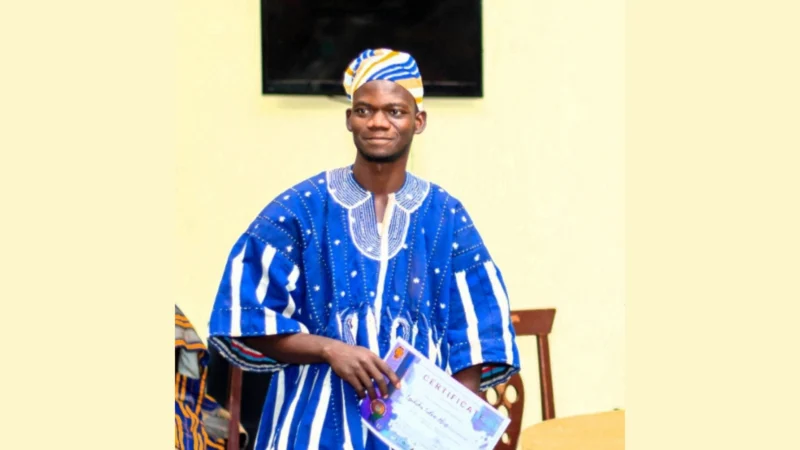
Issahaku Tidoo Abass, a Dagbana teacher and Dagbani Wikimedia contributor from Tamale, holding a certificate in the portrait accompanying his April 2025 interview
The interview identifies Abass as a teacher from Tamale who contributes to Dagbani Wikimedia projects. He describes himself as Dagbana and Dagbani as his mother tongue. This portrait documents one named participant in contemporary language work; it does not imply a single representative appearance of all Dagomba people. The photograph retains the framing published by Rising Voices.
Overview
Dagomba cultural communities are represented in this initial account through Dagbani language education and digital documentation in northern Ghana. The Dagbani Wikimedians User Group describes a collaborative network based in Tamale that supports Dagbani and other regional languages. Its stated activities include editor meetings, training, translation, structured language data and photographic documentation. Membership is open to interested contributors, making the network an organisational example rather than a definition of Dagomba identity. Its wider multilingual remit also matters: projects concerning Gurene, Dagaare, Kusaal or other languages retain their own community contexts, rather than becoming interchangeable parts of a single ethnic label.
Literacy and Development through Partnership gives a longer institutional history. Its public account dates its beginning as the Dagbani Literacy Project to 1985, under the Ghana Institute of Linguistics Literacy and Bible Translation, and its registration as an NGO to 2005. It describes an initial focus on Dagomba adults and later support for teachers and facilitators working in Dagbani and English. Collaboration with rural communities, functional reading materials and opportunities for girls and women are among its stated priorities. The organisation explicitly acknowledges Christian inspiration, a feature of its own history and values rather than a religious affiliation assigned to all participants or communities.
Teacher and editor Issahaku Tidoo Abass offers an individual perspective in Sadik Shahadu's April 2025 interview. Abass identifies himself as a Dagbana from Tamale and explains why accessible Dagbani information matters to him. His account describes technical-term translation, lexicographical editing and collaboration with teachers and language specialists. Internet costs, connectivity and the difficulty of finding written sources are practical obstacles he names. He also discusses volunteer recruitment through television-based education and his interest in leaving usable knowledge for later generations. These are a named participant's experiences and motivations, with the written interview distinct from the broadcasts, language datasets and recordings it describes.
A July 2026 community report by Sir Amugi and Sadik Shahadu documents training at Bimbico Wiki Hub. Alhaj Darajaati led work on article structure and navigation, while Achiri Bitamsimli addressed references, categories and relevant imagery. The account connects these activities with verifiability and the development of contributors' research skills. It also announces a later edit-a-thon involving three hubs, preserving the distinction between the reported session and the future programme. Together these witnesses show language work involving teachers, volunteer editors and education organisations, each with a different institutional setting. They document contemporary participation rather than providing a complete history of Dagbon or all Dagomba cultural life.
History & identity
Organisation dates concern literacy and volunteer networks, not the origins of Dagomba people.
Sources & representation
Four complete public written witnesses; named individual, organisational and community report perspectives separated.
Selected bibliography
Documented works and useful reading. This is not a list of every appearance.
- 01
Dagbani Wikimedians User Group
Complete self-account mission/objectives/activities read; organisational membership distinct from identity.
- 02
About Us
Complete public body read; organisational history and Christian provenance retained.
- 03
Q&A: Meet Issahaku Tidoo Abass
Complete 11 April written interview read; individual testimony, no recordings or broadcasts inspected.
- 04
Wikipedia Training at Bimbico Wiki Hub
Complete written community report read; 11 July session distinct from later edit-a-thon plans.
Language & cultural connections
Source-supported language and cultural connections have not yet been compiled for this profile.
References
Sources supporting this profile. Linked pages have their own scope and editorial standards.
- Community self-account or named participant testimonyDagbani Wikimedians User GroupResearch access: 2026-10-05
- Community self-account or named participant testimonyAbout UsResearch access: 2026-10-05
- Community self-account or named participant testimonyQ&A: Meet Issahaku Tidoo AbassResearch access: 2026-10-05
- Community self-account or named participant testimonyWikipedia Training at Bimbico Wiki HubResearch access: 2026-10-05
Image credits
Contemporary photograph of a named community memberIssahaku Tidoo Abass, a Dagbana teacher and Dagbani Wikimedia contributor from Tamale, holding a certificate in the portrait accompanying his April 2025 interview
The interview identifies Abass as a teacher from Tamale who contributes to Dagbani Wikimedia projects. He describes himself as Dagbana and Dagbani as his mother tongue. This portrait documents one named participant in contemporary language work; it does not imply a single representative appearance of all Dagomba people. The photograph retains the framing published by Rising Voices.