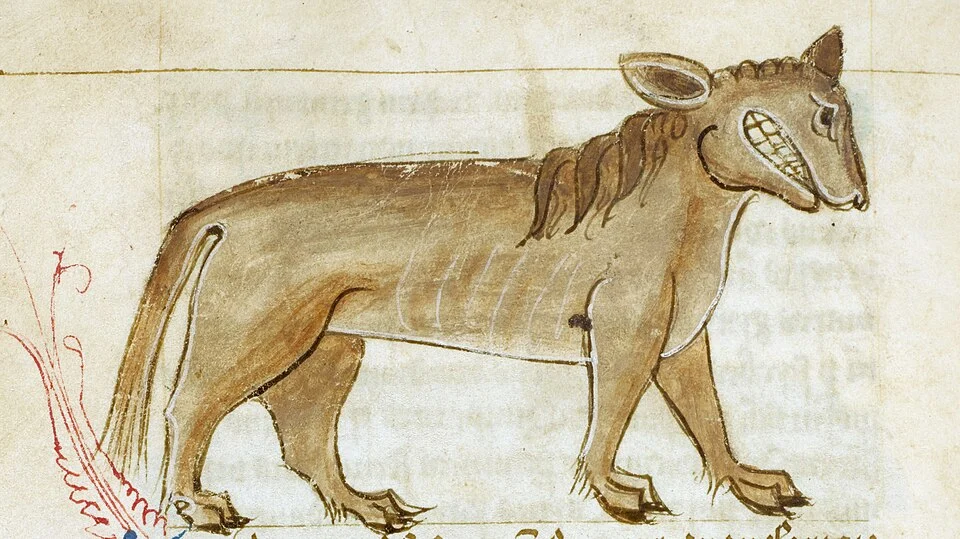
Leucrocotta
Image associated with the exact linked encyclopedia article; consult credited file description for its interpretation.
Overview
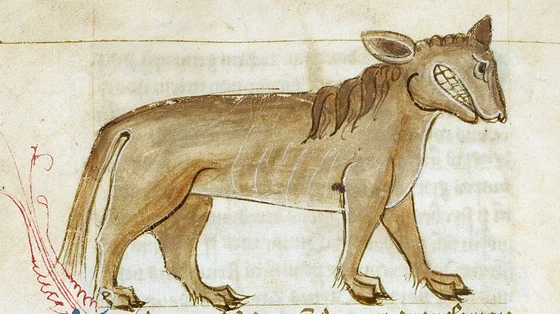
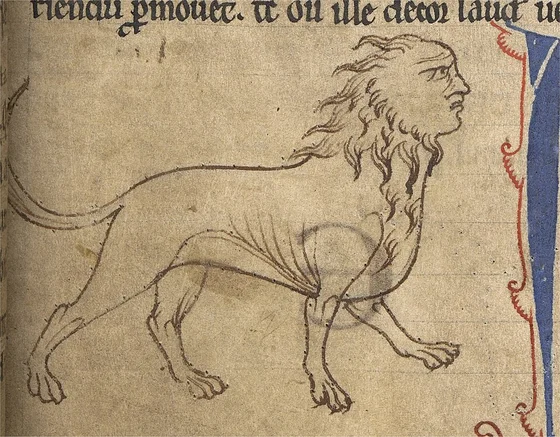
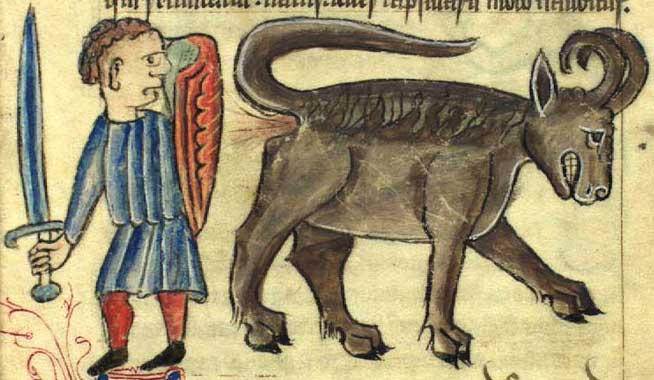
The selected passage occurs within discussion of the hyena and places the crocotta’s birth in a distant African setting. It says a hyena mates with a lioness, producing a creature that can imitate human voices. The mouth has a single continuous tooth structure rather than a usual set of separate teeth. Its unusual glance and jaw description extend the account beyond a simple statement of mixed ancestry.
Elsewhere in the same manuscript, leucrota has its own entry, though part of that text is missing. Keeping these passages separately situated avoids both automatic merger and an unsupported claim that all historical writers distinguished the names in exactly this way. This profile follows the crocote passage on folio12r. Its genealogy and mimicking ability are bestiary claims, not a demonstration of actual cross-species reproduction or evidence of an observed talking animal.
Two passages in Pliny complicate the name’s history. Book VIII, chapter 30 in Bostock–Riley 1855 describes a crocotta resembling a combination of wolf and dog, with formidable teeth and rapid digestion. The wording is comparative. Editorial note 1716 draws attention to that qualification, so the passage should not automatically become a literal wolf-and-dog pedigree or be merged with the hyena–lioness account.
Book VIII, chapter 45 uses the spelling corocotta and explicitly presents the creature as the offspring of a hyena and an Ethiopian lioness. This account gives it imitation of both human and cattle voices, a fixed gaze, and jaws without gums. Its teeth form continuous bone protected as though inside a box. Those details provide an earlier comparison for the crocote passage within Aberdeen’s hyena discussion, while preserving the particular spelling and setting of each text.
The preceding Pliny chapter concerns the hyena itself. Among its reports are human-voice imitation, learning a shepherd’s name, and calling a person away from safety. Chapter 45 refers back to a shared imitative faculty, but this does not mean every extraordinary hyena claim is restated as a separate corocotta ability. Likewise, the following sentence attributes human speech to the manticore on Juba’s authority. Its presence beside the corocotta does not identify the two animals as one.
The nineteenth-century commentary rejects the account as a description of an actual hybrid and reports Cuvier’s explanation in terms of distorted reports of animals such as the hyena. This is an interpretive proposal rather than recovered evidence of the original narrator’s inspiration. The article therefore records the wolf-and-dog comparison, the asserted hyena–lioness birth and the medieval reception as distinct textual claims. Any family diagram based on the latter birth belongs to the narrative witness, not zoological taxonomy.
Origins & earliest records
The inspected witness is folio12r of Aberdeen MS24, an English manuscript of around1200. It uses crocote within the hyena account. That location provides a precise medieval attestation but does not establish the earliest occurrence of the name. Relationships with crocotta and leucrocotta in other ancient or medieval texts remain source-specific. Pliny VIII.30 and VIII.45 now supply earlier located comparisons, using crocotta and corocotta respectively in the inspected translation. Their differing wording and attributed parentage remain explicit.
Records & interpretation
The Latin passage and institutional translation support the stated parentage, voice imitation and continuous tooth description. The separate damaged leucrota entry helps document this manuscript’s organization. These are textual witnesses with an editorial boundary, not biological confirmation of lion-hyena offspring or proof of a predator speaking in human language. Complete Pliny VIII.30 and VIII.44–45, with notes 1716 and 1799, were read; Aberdeen 12r’s complete crocote paragraph and Latin were reread. The hyena’s preceding claims and the manticore’s following sentence are kept attached to their own subjects.
Selected bibliography
Documented works and useful reading. This is not a list of every appearance.
- 01
Aberdeen Bestiary, MS24, folio12r: hyena account’s crocote passage
Selected inspected passage; original-work dates are distinguished from later translation and transmission.
- 02
Natural History — Book VIII, chapters 30 and 44–45
Distinct crocotta and corocotta passages, preceding hyena context, and editorial notes 1716 and 1799. Translation date does not date the ancient account.
Family & connections
A source-supported family tree or inspiration record has not yet been compiled for this profile. Related reading below indicates a connection in subject matter, not a proven lineage or creative influence.
Encyclopedia background
An additional attributed reference, separate from the editorial profile above.
Read the open encyclopedia overview
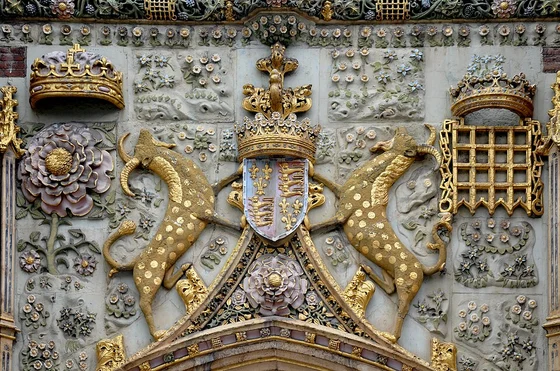
The crocotta or corocotta, crocuta, leucrocotta, or leucrotta is a mythical dog-wolf of India or Aethiopia, linked to the hyena and said to be a deadly enemy of men and dogs.
Text from Wikipedia contributors, “Crocotta”. CC BY-SA 4.0. Extracted introduction; formatting changed. Retrieved 5 October 2026. The source article may have changed since retrieval.
References
Sources supporting this profile. Linked pages have their own scope and editorial standards.
- Primary textAberdeen Bestiary, MS24, folio12r: hyena account’s crocote passageResearch access: 2026-10-05
- Primary ancient accounts and separately attributed later commentaryPliny/Bostock–Riley 1855: VIII.30, VIII.44–45, notes 1716 and 1799Research access: 2026-10-05
Image credits
Reference illustrationLeucrocotta
Image associated with the exact linked encyclopedia article; consult credited file description for its interpretation.