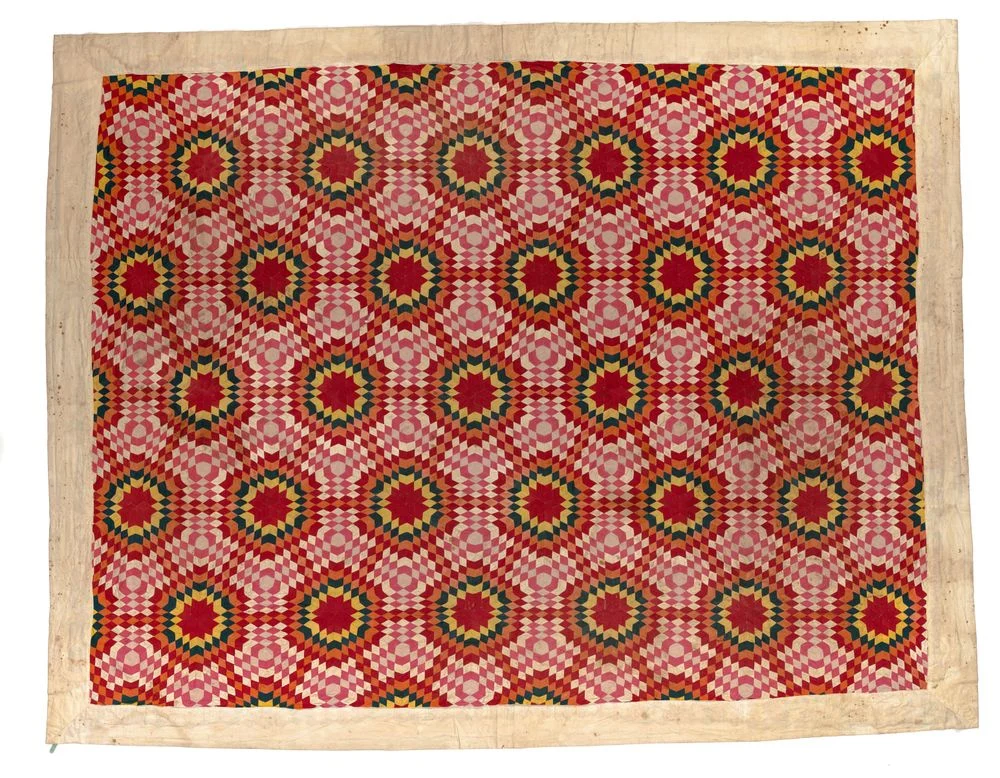
Cook Islands Māori tīvaevae ta’ōrei quilt with hand-sewn coloured diamond patches and white border, circa 1900, Te Papa FE011982
Hundreds of hand-sewn diamond-shaped cloth patches form this tīvaevae ta’ōrei, bordered with white material. Te Papa dates it to around 1900 and leaves its maker unidentified. This particular quilt provides historical context for Cook Islands textile practice; it does not stand for every island, maker or contemporary style.
Overview
Cook Islands Māori identity includes relationships with particular islands, languages and communities, in the islands and abroad. Te Papa’s overview recognises both island and Aotearoa New Zealand settings and linguistic variation. This collective profile keeps those relationships distinct from the identity of Māori in Aotearoa and from residence or citizenship in the Cook Islands. It does not require one uniform dialect or personal experience. The examples here concern named makers, language organisers and documented cultural institutions, rather than a complete account of every island community or every person with Cook Islands heritage.
The Cook Islands Prime Minister’s Office described cultural policy as an active part of education and development in July 2025. Its account identifies the 2017 national culture policy and the role of Te Maeva Nui in bringing island and diaspora participants into public performance. It also records language weeks drawing attention to island-specific forms, including Mangaia, Atiu and Pukapuka-Nassau, and curriculum work supporting language and identity. These are reported policies and initiatives, not a claim that every planned goal has been realised. The same account names Kōrero o te ‘Ōrau’s youth-focused intergenerational work and outer-island festivals as further forms of community participation.
Language learning abroad is illustrated by Janet Akai’s account in a 2019 ministry interview. Raised across Aitutaki, Atiu and Rarotonga before moving to New Zealand, she described retaining cultural relationships even after ceasing to speak the language as a child. Her work with Cook Islands Development Agency New Zealand involved different groups over successive years: Auckland youth, Hamilton women, Christchurch fathers and the Tokoroa community. These encounters informed her emphasis on people taking part in speaking, teaching and learning, rather than assigning responsibility solely to institutions. The interview supplies a particular organiser’s recollections and programme perspective, not current employment verification or a statistical measure of language maintenance.
Tīvaevae quilts also record social relationships and individual creative choices. Te Papa’s account identifies Tapaeru Skinnon’s stylised hibiscus design, used in several colours for gifts, and documents a quilt acquired in 1995. Its discussion describes women’s groups sharing knowledge and preparing quilts for gifts or fundraising, with experienced makers helping others. Such work links aesthetic skill, relationships and community activity. The object’s museum acquisition is distinct from the history of the art as a whole, and the source’s tentative missionary-origin suggestion is not converted into a settled first date. Named makers and specific objects offer starting points for further cultural research.
History & identity
Living island and diaspora identities; policy dates and museum acquisitions describe specific institutions and objects. This collective profile is distinct from Māori of Aotearoa.
Sources & representation
Government policy reporting, a named organiser interview and museum documentation provide scoped examples. Programme aims are not completion evidence, and tentative craft-origin suggestions remain unsettled.
Selected bibliography
Documented works and useful reading. This is not a list of every appearance.
- 01
Cook Islands
Complete landing overview read; island/diaspora and linguistic variety. Old population figures omitted.
- 02
A cultural legacy in motion
Safeguarding and collaboration sections fully read; named initiatives distinguished from measured outcomes.
- 03
Taking ownership of your language
Complete indexed interview read; dated island upbringing and distinct programme groups retained.
- 04
Tīvaevae quilts
Complete topic read; Skinnon quilt and group learning. Tentative origin and craft instructions not adopted.
Language & cultural connections
Source-supported language and cultural connections have not yet been compiled for this profile.
References
Sources supporting this profile. Linked pages have their own scope and editorial standards.
- Museum regional overviewCook IslandsResearch access: 2026-10-05
- Government cultural-policy accountA cultural legacy in motionResearch access: 2026-10-05
- Named community organiser interviewTaking ownership of your languageResearch access: 2026-10-05
- Museum object and community accountTīvaevae quiltsResearch access: 2026-10-05
Image credits
Contextual cultural object photographCook Islands Māori tīvaevae ta’ōrei quilt with hand-sewn coloured diamond patches and white border, circa 1900, Te Papa FE011982
Hundreds of hand-sewn diamond-shaped cloth patches form this tīvaevae ta’ōrei, bordered with white material. Te Papa dates it to around 1900 and leaves its maker unidentified. This particular quilt provides historical context for Cook Islands textile practice; it does not stand for every island, maker or contemporary style.