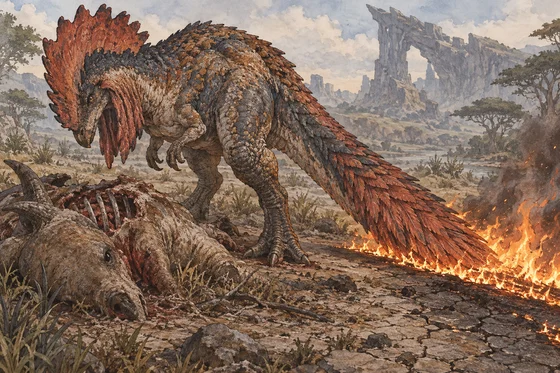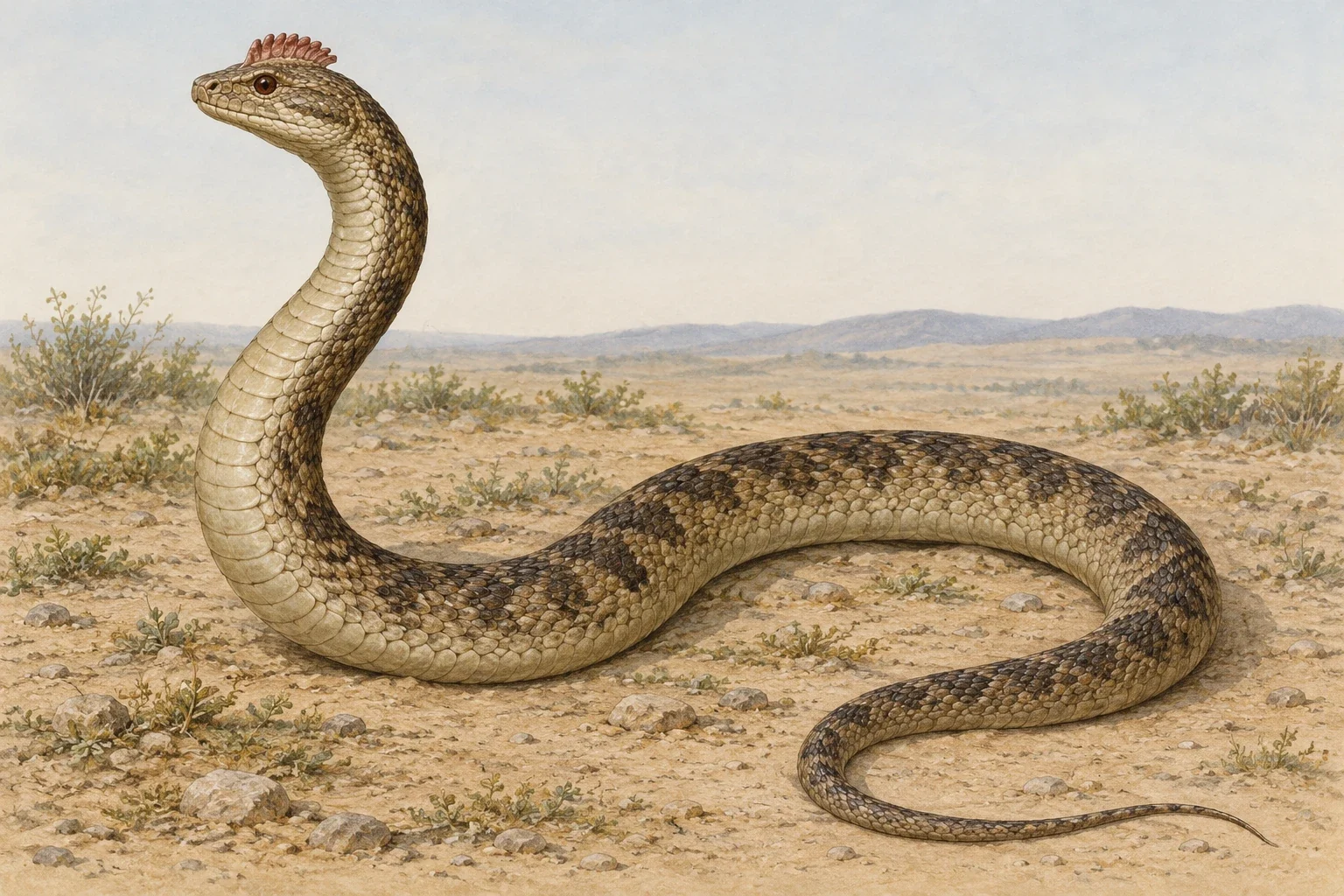
AI-generated interpretation of Topsell’s principal wingless crested serpent; composition and colours imagined. Other cockatrice forms in his chapter differ.
Principal crested serpent from Topsell’s1608 chapter only. Colour, scale pattern, comb shape and landscape are artistic interpretation. Other reported cockatrice forms differ. No D&D, Nesbit or game artwork used.
Overview
In Edward Topsell’s The Historie of Serpents, the cockatrice is a reported poisonous serpent whose names and properties overlap with the basilisk. The complete 1608 chapter does not offer one consistent bird-and-reptile anatomy. Its opening describes a creature moving partly upright, distinguished by a comb or crown and a commanding presence among other serpents. Topsell explains its royal title through its bearing and dangerous power rather than exceptional size. His account compiles inherited authorities, reported encounters and arguments; it is not an authenticated observation of an animal.
The famous birth story is explicitly disputed. Topsell records claims that an old cock produces an unusual egg which a snake or toad incubates. In that report, the resulting creature is half a foot long, with a snake-like rear and a cock-like front marked by a triple comb. He also relays a different claim that the cock itself incubates the egg. His ensuing argument allows such an egg to produce a venomous worm, but distinguishes that possibility from the African serpent he principally discusses, which he says reproduces like other serpents. These alternatives should not be collapsed into a universal origin story.
Wings are another disputed feature. After considering competing scriptural translations, Topsell declines to give his cockatrice wings because he finds insufficient authority. He separately reports a two-legged, featherless and wingless creature from Milan, tentatively assigning it to the same kind. That particular description cannot simply be added to every other form in the chapter. Thomas Browne’s later discussion likewise distinguishes the commonly pictured winged, legged cockatrice from the small serpent attributed to ancient writers; the relationship between the names was itself contested.
Topsell attributes death to poisoned air, sight, hissing and contact, including contamination passed through a weapon. His account gives the weasel, protected by eating rue, and the cock as counteragents. He nevertheless doubts self-destruction by reflection and mocks a story about an Englishman travelling inside glass to kill cockatrices with their reflected images. The chapter presents lethal poison rather than petrification. These are historical claims within its natural philosophy, not biological facts or practical protective measures. This profile follows that particular English textual witness; later game creatures and the use of cockatrice in Quematrice’s name do not establish that their designers consulted Topsell.
Origins & earliest records
Edward Topsell’s English compilation, The Historie of Serpents (1608), complete chapter Of the Cockatrice, pp.119–125; not claimed as the earliest cockatrice tradition.
Records & interpretation
Complete selected Topsell chapter, including final Nicander verses and English rendering, read in university-hosted transcription. Complete Browne III.vii body read as a separate historical critical witness; modern editorial notes excluded from creature claims.
In the literature
“He was supposed to be produced from the egg of a cock hatched under toads or serpents.”
Chapter XXIX, “The Cockatrice, or Basilisk”, opening paragraph
Bulfinch conflates these names in this heading. Use as a historical literary example; do not imply all traditions identify the creatures.
Selected bibliography
Documented works and useful reading. This is not a list of every appearance.
- 01
The Historie of Serpents — Of the Cockatrice, pp.119–125
1608 English historical text, university-hosted electronic transcription; not the 1658 combined edition.
- 02
Pseudodoxia Epidemica, III.vii, pp.130–134
Work first published1646; selected electronic witness identifies sixth edition1672. Historical disagreement, not modern zoological confirmation.
Family, evolution & connections
Quematrice
In RPG Spain’s published interview, Yuya Tokuda explicitly explains the name as combining cockatrice with a Spanish fire-related quema element. This documents naming inputs, not descent from a folklore creature. The interviewer’s separate Lala Barina flamenco premise is not confirmed as its design origin.
Cockatrice (The Witcher)
These entries share the cockatrice name. Topsell's historical witness and The Witcher's game creature remain distinct accounts; the cited evidence does not establish that the game designers consulted Topsell.
Cockatrice (Dungeons & Dragons)
Topsell’s 1608 chapter Of the Cockatrice treats a royal serpent under cockatrice and basilisk names, reports competing accounts of its generation and declines to depict wings because he finds the authority insufficient. This particular historical treatment supplies context for the later fictional namesake. It does not fix the appearance or rules of every cockatrice, identify the fictional creature with Topsell’s account or show that its creator consulted his book.
Cockatrice (Kind Little Edmund)
Topsell’s 1608 chapter Of the Cockatrice treats a royal serpent under cockatrice and basilisk names, reports competing accounts of its generation and declines to depict wings because he finds the authority insufficient. This particular historical treatment supplies context for the later fictional namesake. It does not fix the appearance or rules of every cockatrice, identify the fictional creature with Topsell’s account or show that its creator consulted his book.
References
Sources supporting this profile. Linked pages have their own scope and editorial standards.
- Primary historical compilationTopsell — Of the Cockatrice (1608), complete chapterResearch access: 2026-10-24
- Primary historical critical contextBrowne — Of the Basilisk, III.vii (1672 sixth edition)Research access: 2026-10-24
Image credits
AI-generated historical interpretationAI-generated interpretation of Topsell’s principal wingless crested serpent; composition and colours imagined. Other cockatrice forms in his chapter differ.
Principal crested serpent from Topsell’s1608 chapter only. Colour, scale pattern, comb shape and landscape are artistic interpretation. Other reported cockatrice forms differ. No D&D, Nesbit or game artwork used.