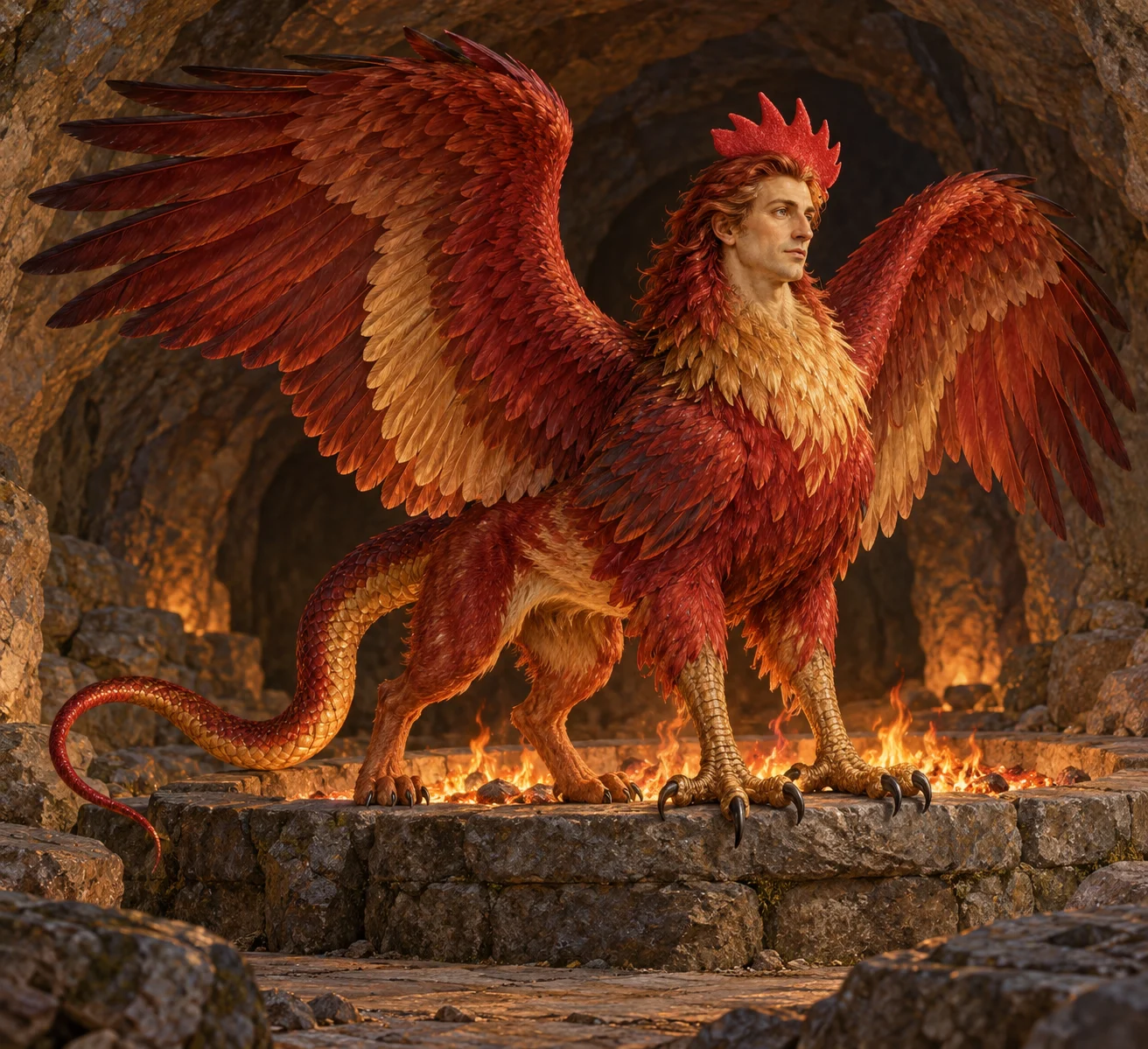
AI-generated interpretation of Edmund’s cockatrice beside its sustaining fire basin.
Original AI interpretation of Nesbit’s composite creature. Exact face, colours beyond the scarlet comb and red recovery, body proportions, feet, standing pose and cave staging are imagined; the text specifies no killing gaze.
Overview
Edmund discovers the cockatrice by following a crowing and clucking sound through the mountain caves. Beyond a partly open stone door, a large pale figure sits in a basin-shaped hollow at the centre of a round chamber. The narrator specifies a man’s face, a griffin’s body, large feathered wings, a snake’s tail, and a cock’s comb and neck feathers. These are the elements of Nesbit’s particular composite being. The passage does not give it a cock’s face or an independently described ability to kill with its gaze.
It is pale and weak because its fire has gone out. According to the creature, that fire must be stirred seven times with its tail once each hundred years; it blames its watch for missing the duty. Edmund collects sticks and burns some neglected schoolbooks to rekindle the flame around it. Something like a combustible liquid catches in the basin. The cockatrice stirs with its tail and beats its wings, accidentally splashing burning material onto the boy’s hand. As it recovers it grows red and strong, its comb turns scarlet and its feathers become glossy. The fire is therefore its sustaining environment, not simply a weapon discharged from its mouth.
In return for the help, the creature offers a favour. Edmund asks for stories about things not taught at school, and it tells him about treasures, geological formations, magical beings and the beginnings of the world. He repeatedly returns to listen. His schoolmaster refuses to believe his account, interpreting the burn on his hand only as evidence that he has been playing with fire. The contrast is part of the story’s satire of the adults’ certainty; the cockatrice’s tales are not presented here as real-world geological instruction.
When an enormous yellow dragon swallows the town, the cockatrice initially fails to understand Edmund’s distress, even offering him a home in its cave. Once the boy explains that his grandmother is among those swallowed, it directs him to fetch the dragon’s young. It insists on practical obedience instead of answering every question. After Edmund brings the drakling, it whispers a plan to him and later joins in the laughter used to draw the mother to the cave. It falsely announces that she has swallowed her own baby, provoking her to cough the town out so that she can search it.
The remainder of the scheme draws the mother and drakling down toward the subterranean fire and allows Edmund to close the iron opening above them. The town remains on the hillside where it was disgorged. The cockatrice’s help does not lead to public proof of the boy’s adventure: when Edmund returns with witnesses, it has bolted its door and will not open it. His wish to learn more eventually leads him toward locksmithing, but the closing sentence says that even as an old man he has not reopened that door. The knowledgeable ally thus remains a private, inaccessible presence rather than a creature successfully exhibited to the town.
First appearances & development
An individual in E. Nesbit’s original English story Kind Little Edmund, or The Caves and the Cockatrice, collected in The Book of Dragons.
Canon & continuity
Complete original story preserved, including the full restorative-fire scene, rescue scheme and refusal to admit later witnesses. Physical features follow this narrative alone.
Selected bibliography
Documented works and useful reading. This is not a list of every appearance.
- 01
The Book of Dragons
Original English narrative; no modern catalogue-summary prose used.
Family & connections
A source-supported family tree or inspiration record has not yet been compiled for this profile. Related reading below indicates a connection in subject matter, not a proven lineage or creative influence.
References
Sources supporting this profile. Linked pages have their own scope and editorial standards.
- Primary literary textThe Book of Dragons — original narrativeResearch access: 2026-10-17
Image credits
AI-generatedAI-generated interpretation of Edmund’s cockatrice beside its sustaining fire basin.
Original AI interpretation of Nesbit’s composite creature. Exact face, colours beyond the scarlet comb and red recovery, body proportions, feet, standing pose and cave staging are imagined; the text specifies no killing gaze.