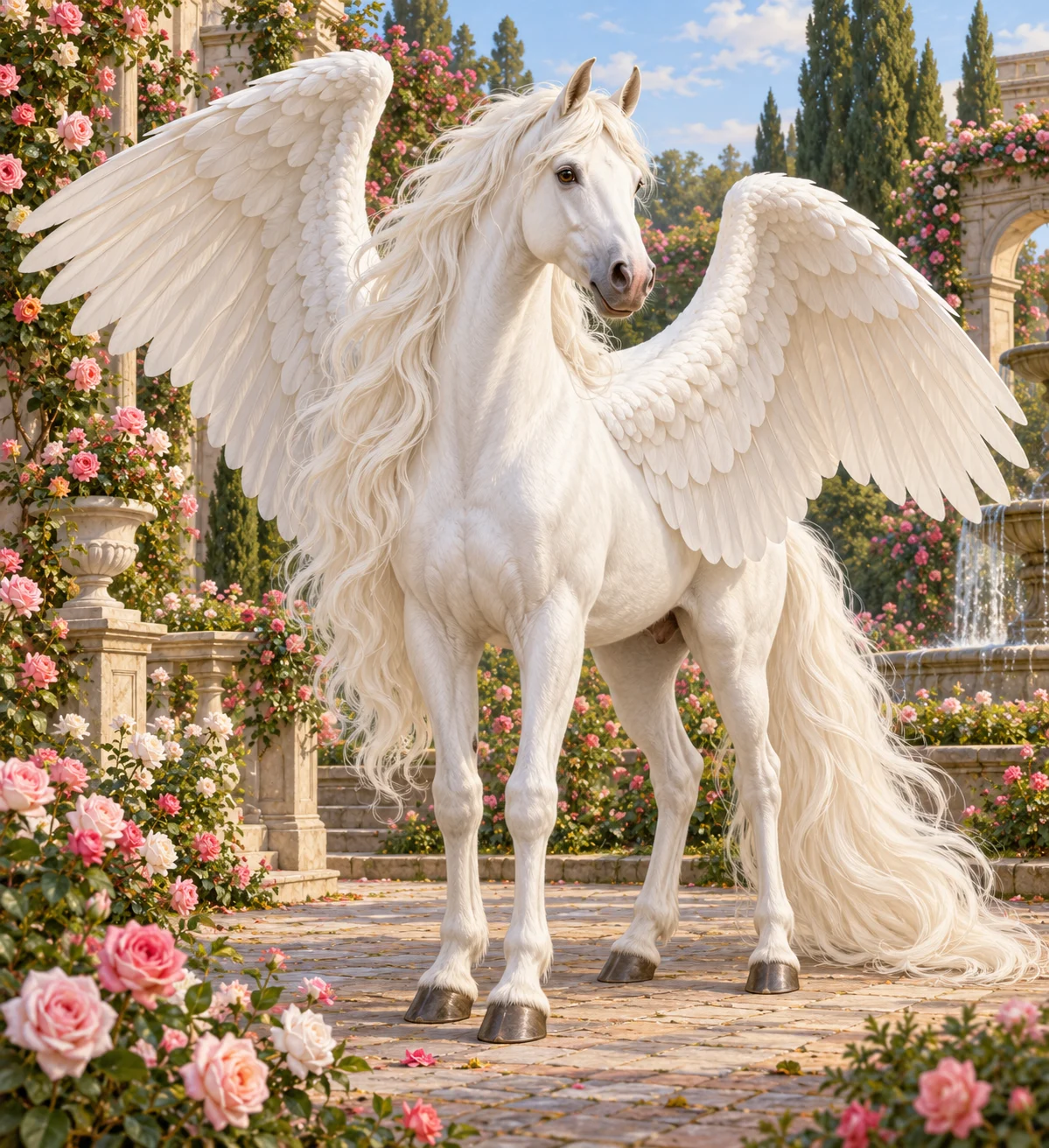
AI-generated interpretation of Nesbit’s white, swan-winged Hippogriff in the rose garden.
Original AI interpretation of Nesbit’s explicitly horse-shaped Hippogriff. Precise anatomy, eye colour, pose and garden arrangement are imagined; no conventional eagle-headed form or copied illustration is used.
Overview
The Book of Beasts gives the creature the printed name Hippogriff, but describes a beautiful white horse rather than supplying an eagle-headed hybrid. Its mane and tail are both exceptionally long and white; its great wings resemble a swan’s wings. It neighs, stamps its hooves and has kind eyes. Its nose is soft and milky white, and it rubs that nose against King Lionel’s shoulder when it emerges from the book among the roses. Lionel thinks it resembles his lost wooden rocking horse except for the wings. The text’s own bodily description governs this particular character; another tradition’s use of the name should not replace it.
Lionel releases the Hippogriff after other attempts to undo the damage caused by his magical book have failed. The Red Dragon has been eating people and has carried off his beloved rocking horse. The king has spent days crying before deciding that he must try again to save the people. When the new creature emerges, the dragon is already approaching. Lionel mounts the gentle horse, takes the book and asks it to fly to the Pebbly Waste. The dragon gives chase, but its larger red wings are weaker than the Hippogriff’s white ones, and it cannot catch them.
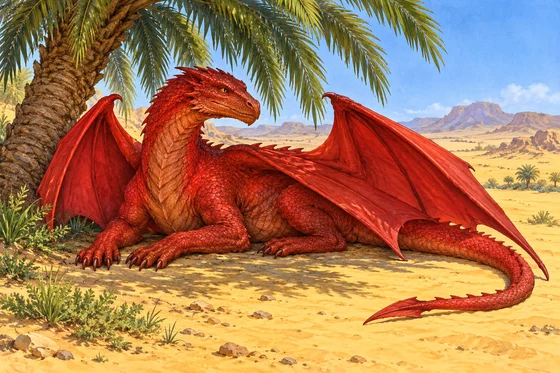
The destination is essential to the rescue. The Pebbly Waste has loose rounded stones and no tree within a hundred miles. The dragon must rest beneath a tree at noon or its own heat and the sunlight will make it catch fire. Lionel lays the book open on the stones and remounts; the Hippogriff circles the overheated pursuer while the dragon struggles. With no other shade available, the dragon returns to the palm tree pictured on its own page. Lionel closes and clasps the book. The horse’s speed and dependable response allow the king’s plan to work without requiring the Hippogriff to bite, claw or kill its opponent.
When Lionel begins praising his companion, the Hippogriff quietly reminds him that they are not alone. The people and creatures the dragon swallowed have been left outside the book, since they could not fit through the picture with it. The rescued rocking horse later asks to live on the Hippogriff’s page, safely away from dragons, and the winged horse shows it the way. The Hippogriff itself accepts the post of the King’s Own Rocking Horse. That final position is an affectionate court role for a living magical horse; the narrator does not say it turns into a wooden toy.
First appearances & development
An individual in E. Nesbit’s original English story The Book of Beasts, collected in The Book of Dragons. No first-publication date or unverified design influence is asserted.
Canon & continuity
Complete original story preserved. The name Hippogriff and the expressly equine body are retained together; no borrowed generic hippogriff anatomy is added.
Selected bibliography
Documented works and useful reading. This is not a list of every appearance.
- 01
The Book of Dragons
Original English narrative; no modern catalogue-summary prose used.
Family & connections
A source-supported family tree or inspiration record has not yet been compiled for this profile. Related reading below indicates a connection in subject matter, not a proven lineage or creative influence.
References
Sources supporting this profile. Linked pages have their own scope and editorial standards.
- Primary literary textThe Book of Dragons — original narrativeResearch access: 2026-10-17
Image credits
AI-generatedAI-generated interpretation of Nesbit’s white, swan-winged Hippogriff in the rose garden.
Original AI interpretation of Nesbit’s explicitly horse-shaped Hippogriff. Precise anatomy, eye colour, pose and garden arrangement are imagined; no conventional eagle-headed form or copied illustration is used.