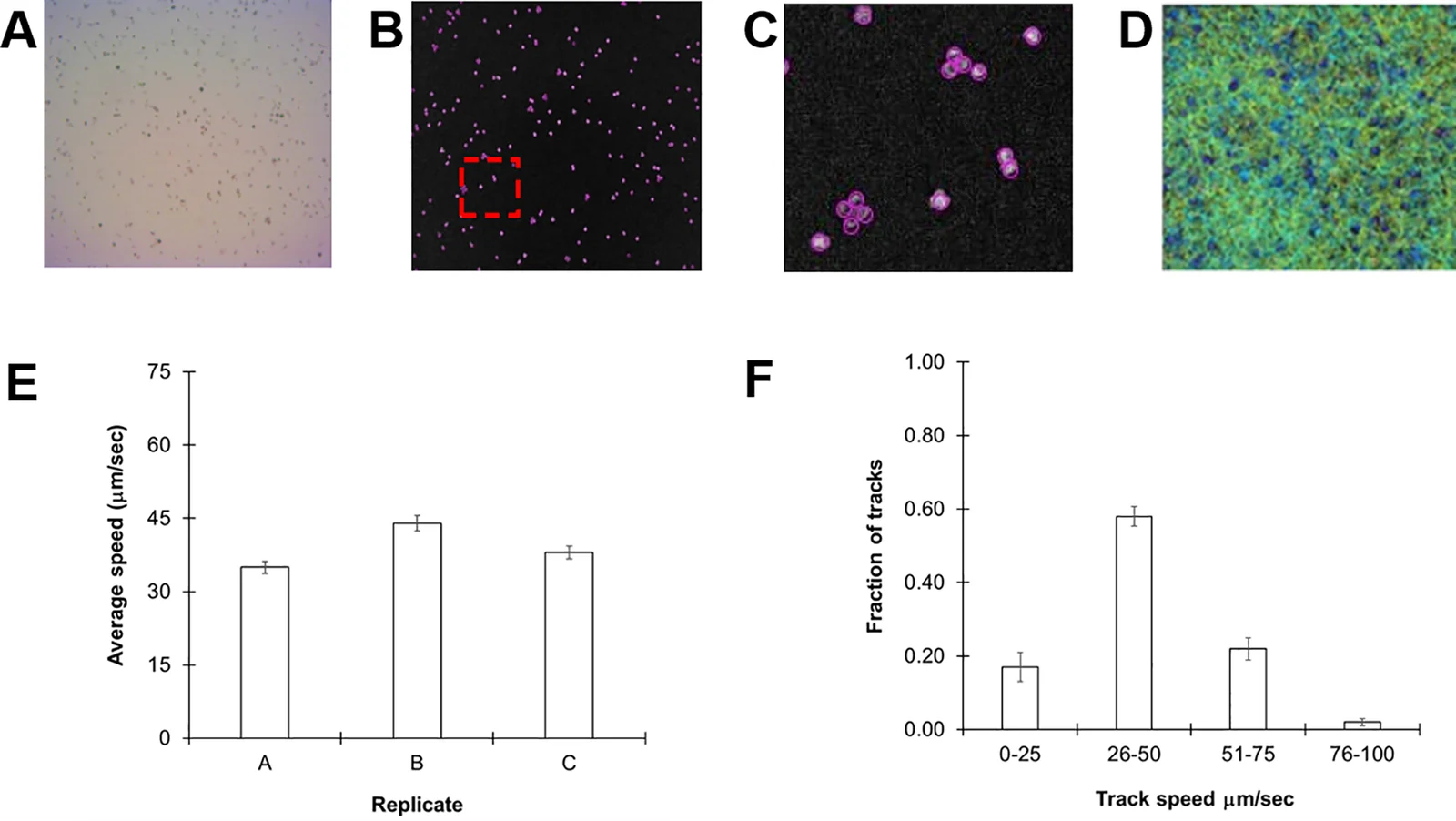
Chlamydomonas reinhardtii CC124 culture images, software cell tracking and motility measurements in Folcik and colleagues’ 2020 figure 1
The upper panels show images from a 72-hour Chlamydomonas reinhardtii CC124 culture and the software processing used to identify individual cells, including cells in small aggregates. The coloured tracks encode movements during a 30-second recording, rather than natural pigmentation. The lower graphs report replicate measurements and track speeds. This is a particular experimental culture, not the CC5816 genome-assembly strain.
Overview
Chlamydomonas reinhardtii is a unicellular green alga widely used for experimental work on photosynthesis, cilia and sexual reproduction. Payne and colleagues' reference-genome study examines laboratory strain CC-5816, a mating-type plus strain derived from crosses involving CC-124 and CC-125 and three subsequent backcrosses to CC-124. It is not a newly collected wild individual. The study's routine cultures used Sager and Granick medium supplemented with acetate. Genomic differences among related laboratory lines are important because a mutation, rearrangement or assembly error in one reference can obscure the biological interpretation of another strain.
The researchers combined PacBio high-accuracy reads with longer Oxford Nanopore reads, comparing alternative assemblies and checking sequence coverage. Their final nuclear assembly contains 113,900,589 base pairs in 17 chromosome scaffolds with no intervening sequence gaps. Many regions poorly represented in earlier assemblies were repetitive, particularly on chromosomes 11 and 15. Sequence accuracy was estimated through computational quality metrics and supporting reads, not by independently verifying every nucleotide. The nuclear assembly also does not replace the separate mitochondrial and chloroplast genomes. An apparent duplicated mitochondrial contig in an intermediate assembly was rejected as a misassembly after read inspection.
No gaps does not mean that every repeated sequence has its full natural copy number. The assembled long ribosomal arrays were shorter than the authors expected from sequencing coverage. They estimated substantially more ribosomal units than the copies represented in those arrays, even though chromosome ends and intervening sequence had been joined. This distinction matters for interpreting a telomere-to-telomere resource: continuous chromosome representation and complete recovery of a difficult repeat array are different achievements. The study also identified 33 short chloroplast-derived and 23 mitochondrial-derived insertions within nuclear sequence, with read support and random-sequence controls. These are evidence of organellar DNA in this strain's nuclear genome, not a direct observation of the transfer events.
Nanopore-based methylation estimates were higher around centromeres and other repetitive regions than across ordinary chromosome arms. The authors inferred a mean nuclear cytosine-methylation frequency of 2.13% in their gametic material. They explicitly compared this with differing earlier estimates and discussed both biological differences and sequencing or analysis methods as possible causes. It would therefore be misleading to treat one percentage as a fixed species-wide property. Their related editing experiments also motivate checking chromosome structure after genetic manipulation, but the genome resource is useful beyond that experiment: it allows researchers to distinguish sequence representation, strain history and actual biological function.
Origins & earliest records
The documented CC-5816 reference is a laboratory descendant of specified crosses and backcrosses. The species' evolutionary origin and full environmental range are not dated by this genome project.
Evidence & interpretation
Selected complete assembly, repeat-content, organellar-insertion and ribosomal-array Results, full Discussion and corresponding sequencing/assembly/analysis Methods document the profile. A continuous assembly can still underrepresent repeat copy numbers; methylation is method- and material-dependent.
Selected bibliography
Documented works and useful reading. This is not a list of every appearance.
- 01
A gap-free genome assembly of Chlamydomonas reinhardtii and detection of translocations induced by CRISPR-mediated mutagenesis
Plant Communications 4(2):100493; online 17 November 2022. Selected complete genomic Results, full Discussion and corresponding Methods.
Family, evolution & connections
Sampled green-algal genome branching (Hanschen et al., 2016)
All eleven genome terminals displayed in Supplementary Figure 20. Historical Micromonas pusilla strain names and Ostreococcus sp. RCC809 are preserved as printed; no modern taxonomic reassignment is inferred.
Scroll sideways to see all branches. With a keyboard, focus the tree and use the arrow keys.
- Sampled chlorophyte genomes
- Sampled volvocine and Coccomyxa / Chlorella branch
- Three sampled volvocines
- Volvox / Gonium pair
- Volvox carteri, genome version 2
- Coccomyxa / Chlorella pair
- Coccomyxa subellipsoidea C-169
- Chlorella variabilis
- Sampled Micromonas and Bathycoccus / Ostreococcus branch
- Historical Micromonas pusilla genome labels
- Micromonas pusilla CCMP1545
- Micromonas pusilla RCC299
- Bathycoccus and Ostreococcus samples
- Bathycoccus prasinos
- Three sampled Ostreococcus genomes
- Ostreococcus RCC809 / lucimarinus pair
- Ostreococcus sp. RCC809
- Ostreococcus lucimarinus
- Ostreococcus tauri
A concatenation of 1,457 single-copy OrthoMCL gene families, selected with inflation 1.5, aligned independently in MUSCLE 3.8.31. RAxML 8.0.20 used protein gamma models, automatic model selection for each gene partition and 100 rapid bootstrap replicates. The caption reports bootstrap 100 for every node; numerical labels are not separately redrawn or recalculated. A limited genome-sampling species hypothesis. Present-day Chlamydomonas, Gonium and Volvox are relatives, not successive ancestors or a compulsory ladder of increasing complexity. This retains the Supplementary Figure 20 species topology rather than midpoint-rooted pathway gene trees or gene-family gain/loss diagrams. No divergence ages or branch-length scale is inferred. Adapted from Hanschen et al. (2016), CC BY 4.0: all tips retained, layout redrawn, colour and branch lengths omitted, genome-label qualifiers added.
Selected green-algal coalescent branching (Hou et al., 2022)
Eight selected terminals pruned from the 69-species coalescent tree in Figure 2A. Tetraselmis chui represents the sampled Chlorodendrophyceae outgroup; Chlorella variabilis represents Trebouxiophyceae. Most species and all other sampled orders are omitted. Proterocladus is not a terminal in this tree.
Scroll sideways to see all branches. With a keyboard, focus the tree and use the arrow keys.
- Selected coalescent sample tree
- Selected core chlorophytes
- Chlorella variabilis
- Selected ulvophycean and chlorophycean branches
- Selected Ulvophyceae sensu stricto
- Selected UUOI / DS branch (local posterior 0.76 / multi-locus bootstrap 49)
- Ulva mutabilis
- Acetabularia calyculus
- Cladophora glomerata
- Sampled Bryopsidales / Chlorophyceae branch (local posterior 0.55 / multi-locus bootstrap 33)
- Bryopsis plumosa
- Sampled Chlamydomonas / Volvox pair
- Volvox carteri
- Tetraselmis chui — selected outgroup
The authors selected 884 nuclear orthologue groups, aligned amino-acid sequences with MAFFT and filtered them with Gblocks and trimAl. IQ-TREE gene trees used gene-specific models and 1,000 ultrafast bootstrap replicates; branches below 20% were collapsed before ASTRAL 5.7.3 species-tree inference. Retained original node values are local posterior probability and multi-locus bootstrap, not divergence ages. Other support labels and branch lengths are omitted; none are recalculated. This retains Figure 2A only. The weak UUOI/DS and Bryopsidales/Chlorophyceae stems show extensive gene conflict: quartet alternatives are nearly equally frequent, and a heterotachy concatenation model changes the DS position. Simulations support incomplete lineage sorting as a plausible explanation, without proving it is the sole process. Ulvophyceae is paraphyletic in this study. Figure 4 uses alternative fossil calibrations; it does not establish Proterocladus as an ancestor, and no calibrated ages are imported here. Adapted from Hou et al. (2022), CC BY 4.0: eight tips retained, omitted branches suppressed, layout redrawn, pies and lengths omitted; two original support pairs retained.
Taxonomic classification
A hierarchy of classified groups, not a chain of direct ancestors.
- genusChlamydomonas
- speciesChlamydomonas reinhardtii
References
Sources supporting this profile. Linked pages have their own scope and editorial standards.
- ResearchPayne et al. — Chlamydomonas CC-5816 genomeResearch access: 2026-10-05
Image credits
Scientific organism microscopy and movement figureChlamydomonas reinhardtii CC124 culture images, software cell tracking and motility measurements in Folcik and colleagues’ 2020 figure 1
The upper panels show images from a 72-hour Chlamydomonas reinhardtii CC124 culture and the software processing used to identify individual cells, including cells in small aggregates. The coloured tracks encode movements during a 30-second recording, rather than natural pigmentation. The lower graphs report replicate measurements and track speeds. This is a particular experimental culture, not the CC5816 genome-assembly strain.