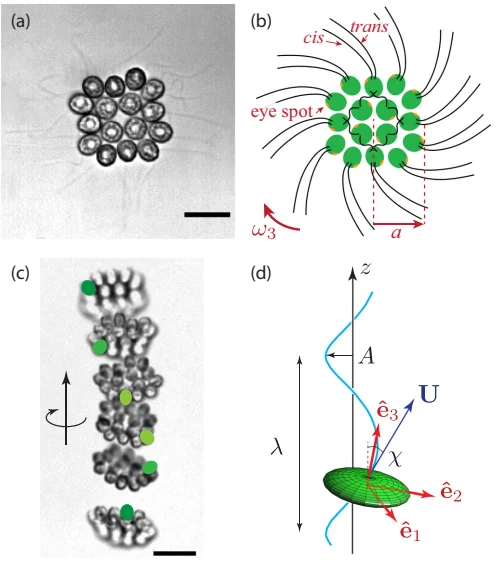
Sixteen-cell Gonium pectorale colony and swimming microscopy with explanatory flagellar and trajectory diagrams in de Maleprade and colleagues’ 2020 figure 1
Panel A shows a sixteen-cell Gonium pectorale colony; its scale bar is ten micrometres. Panel C combines frames taken 0.4 seconds apart, with coloured markers tracking one cell; its bar is twenty micrometres. Panels B and D are explanatory diagrams, not photographs or natural colours. The study used wild-type strain CCAC 3275 B. The complete four-panel figure was extracted from the published PDF.
Overview
Gonium pectorale typically forms colonies of eight or sixteen cells. In Hanschen and colleagues' 2016 comparison, its cells are undifferentiated: the colony does not divide into the terminally specialized body cells and larger reproductive cells characteristic of the compared Volvox carteri. Growth and division are separated in its life cycle. A juvenile colony grows without adding cells through division; later, repeated divisions produce daughter colonies whose cells remain attached, and the daughter colonies hatch. This makes Gonium useful for investigating group formation and coordinated reproduction before studying the added problem of specialized cell types.
The genome project used mating-type minus strain K3-F3-4, held as NIES-2863 by Japan's National Institute for Environmental Studies culture collection. Cultures were grown at 20 °C on a fourteen-hour light and ten-hour dark schedule. The study reports a roughly 148.8-million-base-pair assembly and 17,984 predicted protein-coding loci. These are properties of the reported assembly and gene-prediction procedure, rather than verified functions for every locus. Comparison with Chlamydomonas and Volvox found substantial genomic similarity despite different body organization. The authors distinguish changes associated with group formation from later expansions associated with larger bodies and extracellular material; morphological complexity does not simply track a larger number of genes.
A focused experiment tested Gonium's retinoblastoma-pathway regulator, RB. The researchers expressed its gene in a Chlamydomonas strain lacking its own functional RB, using Chlamydomonas regulatory sequences. The Gonium gene corrected the small-cell defect and produced attached groups of two to sixteen normal-sized cells. The Chlamydomonas RB control corrected cell size without the same colonial result. Four independent Gonium-gene transformants were examined. Further crosses involving a missing DP1 pathway component suppressed the colonial phenotype, supporting a role for the regulatory pathway rather than attachment alone. The manipulated organism was Chlamydomonas: the experiment neither converted it into the species Gonium nor directly observed the ancient evolutionary transition.
The authors interpret these results as evidence that modifications to existing cell-cycle machinery can help establish coordinated groups, without requiring wholesale invention of new protein families. Their broader evolutionary reconstruction combines gene-family comparisons, sequence relationships and the experimental result. It remains a source-specific account of volvocine algae, not a demonstrated recipe for every origin of multicellularity in animals, fungi or plants. Proposed changes in chromatin binding and timing of particular target genes go beyond the directly observed colony phenotype. The living species serve as comparative relatives with different organizations; they are not successive surviving ancestors arranged on an inevitable ladder of complexity.
Origins & earliest records
The sequenced NIES-2863 strain is a culture-collection sample. Comparative branching and gene-family histories do not identify this living species as a direct ancestor of other colonial algae.
Evidence & interpretation
Complete main genome comparisons, transformation experiments, Discussion and Methods document the account. Predicted loci, observed transformant colonies and proposed ancient regulatory changes are separate evidence categories.
Selected bibliography
Documented works and useful reading. This is not a list of every appearance.
- 01
The Gonium pectorale genome demonstrates co-option of cell cycle regulation during the evolution of multicellularity
Nature Communications 7, 11370; complete main text, Methods, main table and caption text. Sequencing strain NIES-2863; experimental host Chlamydomonas.
Family, evolution & connections
Sampled green-algal genome branching (Hanschen et al., 2016)
All eleven genome terminals displayed in Supplementary Figure 20. Historical Micromonas pusilla strain names and Ostreococcus sp. RCC809 are preserved as printed; no modern taxonomic reassignment is inferred.
Scroll sideways to see all branches. With a keyboard, focus the tree and use the arrow keys.
- Sampled chlorophyte genomes
- Sampled volvocine and Coccomyxa / Chlorella branch
- Three sampled volvocines
- Volvox / Gonium pair
- Volvox carteri, genome version 2
- Coccomyxa / Chlorella pair
- Coccomyxa subellipsoidea C-169
- Chlorella variabilis
- Sampled Micromonas and Bathycoccus / Ostreococcus branch
- Historical Micromonas pusilla genome labels
- Micromonas pusilla CCMP1545
- Micromonas pusilla RCC299
- Bathycoccus and Ostreococcus samples
- Bathycoccus prasinos
- Three sampled Ostreococcus genomes
- Ostreococcus RCC809 / lucimarinus pair
- Ostreococcus sp. RCC809
- Ostreococcus lucimarinus
- Ostreococcus tauri
A concatenation of 1,457 single-copy OrthoMCL gene families, selected with inflation 1.5, aligned independently in MUSCLE 3.8.31. RAxML 8.0.20 used protein gamma models, automatic model selection for each gene partition and 100 rapid bootstrap replicates. The caption reports bootstrap 100 for every node; numerical labels are not separately redrawn or recalculated. A limited genome-sampling species hypothesis. Present-day Chlamydomonas, Gonium and Volvox are relatives, not successive ancestors or a compulsory ladder of increasing complexity. This retains the Supplementary Figure 20 species topology rather than midpoint-rooted pathway gene trees or gene-family gain/loss diagrams. No divergence ages or branch-length scale is inferred. Adapted from Hanschen et al. (2016), CC BY 4.0: all tips retained, layout redrawn, colour and branch lengths omitted, genome-label qualifiers added.
Taxonomic classification
A hierarchy of classified groups, not a chain of direct ancestors.
- genusGonium
- speciesGonium pectorale
Chlamydomonas reinhardtii
Hanschen and colleagues expressed Gonium’s retinoblastoma regulator in Chlamydomonas mutants lacking their own regulator. Cells formed colonies of two to sixteen; removing DP1 suppressed that phenotype. This engineered experiment supports a regulatory mechanism, not a claim that either living species directly gave rise to the other.
References
Sources supporting this profile. Linked pages have their own scope and editorial standards.
- ResearchHanschen et al. 2016 — Gonium genome and cell-cycle experimentsResearch access: 2026-10-05
Image credits
Scientific organism microscopy and locomotion figureSixteen-cell Gonium pectorale colony and swimming microscopy with explanatory flagellar and trajectory diagrams in de Maleprade and colleagues’ 2020 figure 1
Panel A shows a sixteen-cell Gonium pectorale colony; its scale bar is ten micrometres. Panel C combines frames taken 0.4 seconds apart, with coloured markers tracking one cell; its bar is twenty micrometres. Panels B and D are explanatory diagrams, not photographs or natural colours. The study used wild-type strain CCAC 3275 B. The complete four-panel figure was extracted from the published PDF.