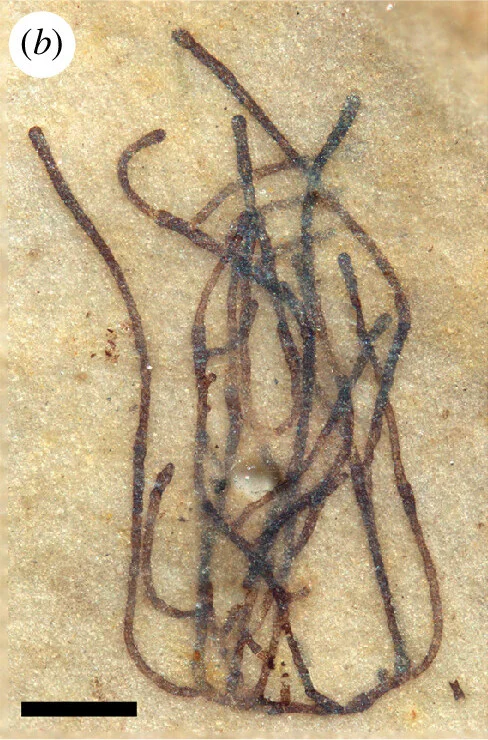
Dark branching Proterocladus antiquus fossil filaments on a pale matrix, with panel b and a 200-micrometre scale bar.
Proterocladus antiquus fossil from the Nanfen Formation, photographed by Qing Tang and reproduced in Anderson, Mughal and Wedlake’s 2024 Figure 2b. The branching filaments are fossil remains, not a living alga or a reconstruction.
Overview
Tang and colleagues described Proterocladus antiquus from carbonaceous fossils in the Nanfen Formation. Bodies measured 0.3–3.3 mm high, with lateral branches, cellular partitions and occasional small holdfasts. Their analysis of 1,028 specimens favors upright seafloor algae resembling living Cladophora and Rhizoclonium. Enlarged cells and lateral pores suggest differentiated resting or reproductive structures; nuclei and released gametes are not directly preserved. The authors acknowledge an alternative extinct lineage with independently evolved similarities, and possible synonymy with fragmentary Proterocladus major material.
A subsequent 2022 study by Hou and colleagues tested the consequences of that uncertainty rather than treating the fossil as a securely placed ancestor. Its molecular dataset compared 884 nuclear genes across 69 green-algal species. Different approaches recovered largely similar relationships but disagreed at several short internal branches, illustrating why even extensive sequence data do not produce an entirely unambiguous history. The fossil supplied a dating constraint, not a sequenced member of the living-species sample.
The researchers ran three distinct clock scenarios: Proterocladus assigned to the stem lineage of Cladophorales, placed more conservatively on the stem of Ulvophyceae sensu stricto, or excluded. These choices yielded substantially different estimated ages for the latter group: 1,382.3–1,122.7 Ma, 1,148.0–917.5 Ma and 1,081.7–797.2 Ma respectively, expressed as 95% credibility intervals. These are model estimates for a broader evolutionary node, not alternative radiometric dates of the fossil itself.
The distinction matters because a recognizable branching body can evolve independently in different organisms. Hou and colleagues consider the close comparison with modern cladophoraleans credible but cannot rule out another ulvophycean lineage, or a more distant extinct lineage. They therefore present the different calibrated histories as plausible scenarios. Their work supports an ancient diversification of green seaweeds while showing how the identity assigned to a single old fossil changes the inferred timetable. Proterocladus is evidence bearing on that history, rather than proof that any particular living seaweed descended directly from this named species.
Origins & earliest records
Tang et al. named this species in 2020. Neighboring formations bracket Nanfen deposition between approximately 1,056 and 947.8 Ma; 1,000 Ma is an approximation, not a direct specimen date.
Evidence & interpretation
Holotype VPIGM-4762 and paratype VPIGM-4799 are deposited at Virginia Polytechnic Institute Geoscience Museum. Hou et al. (2022), Results, Discussion and Fossil constraints, explicitly compare three phylogenetic assignments and their dating consequences.
Selected bibliography
Documented works and useful reading. This is not a list of every appearance.
- 01
A one-billion-year-old multicellular chlorophyte
Nature Ecology & Evolution4,543–549; complete systematic description, stratigraphy, Discussion and Methods read through author manuscript PMC8668152. Concise original summary; no figure reuse authorized here.
- 02
Phylotranscriptomic insights into a Mesoproterozoic–Neoproterozoic origin and early radiation of green seaweeds (Ulvophyceae)
Nature Communications13,1610; Results, Discussion and divergence-time methods. Original adaptation of CC BY4.0 article; https://creativecommons.org/licenses/by/4.0/.
Family, evolution & connections
Taxonomic classification
A hierarchy of classified groups, not a chain of direct ancestors.
- GenusProterocladus
- SpeciesProterocladus antiquus
Cladophorales and alternative algal placements
Hou and colleagues tested stem-Cladophorales placement, broader stem-Ulvophyceae placement, and exclusion of this fossil from clock calibration. Similar branching and cellular organization favor the first interpretation, but convergence cannot be excluded. The fossil is not a sequenced terminal or an established direct ancestor.
References
Sources supporting this profile. Linked pages have their own scope and editorial standards.
- ResearchTang et al.2020 primary description, author manuscriptResearch access: 2026-10-05
- ResearchHou et al.2022 phylogenomics and fossil-calibration comparisonResearch access: 2026-10-05
Image credits
Exact fossil photomicrograph, published Figure2bDark branching Proterocladus antiquus fossil filaments on a pale matrix, with panel b and a 200-micrometre scale bar.
Proterocladus antiquus fossil from the Nanfen Formation, photographed by Qing Tang and reproduced in Anderson, Mughal and Wedlake’s 2024 Figure 2b. The branching filaments are fossil remains, not a living alga or a reconstruction.