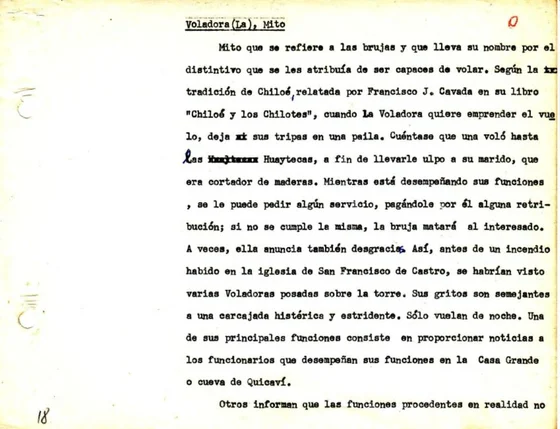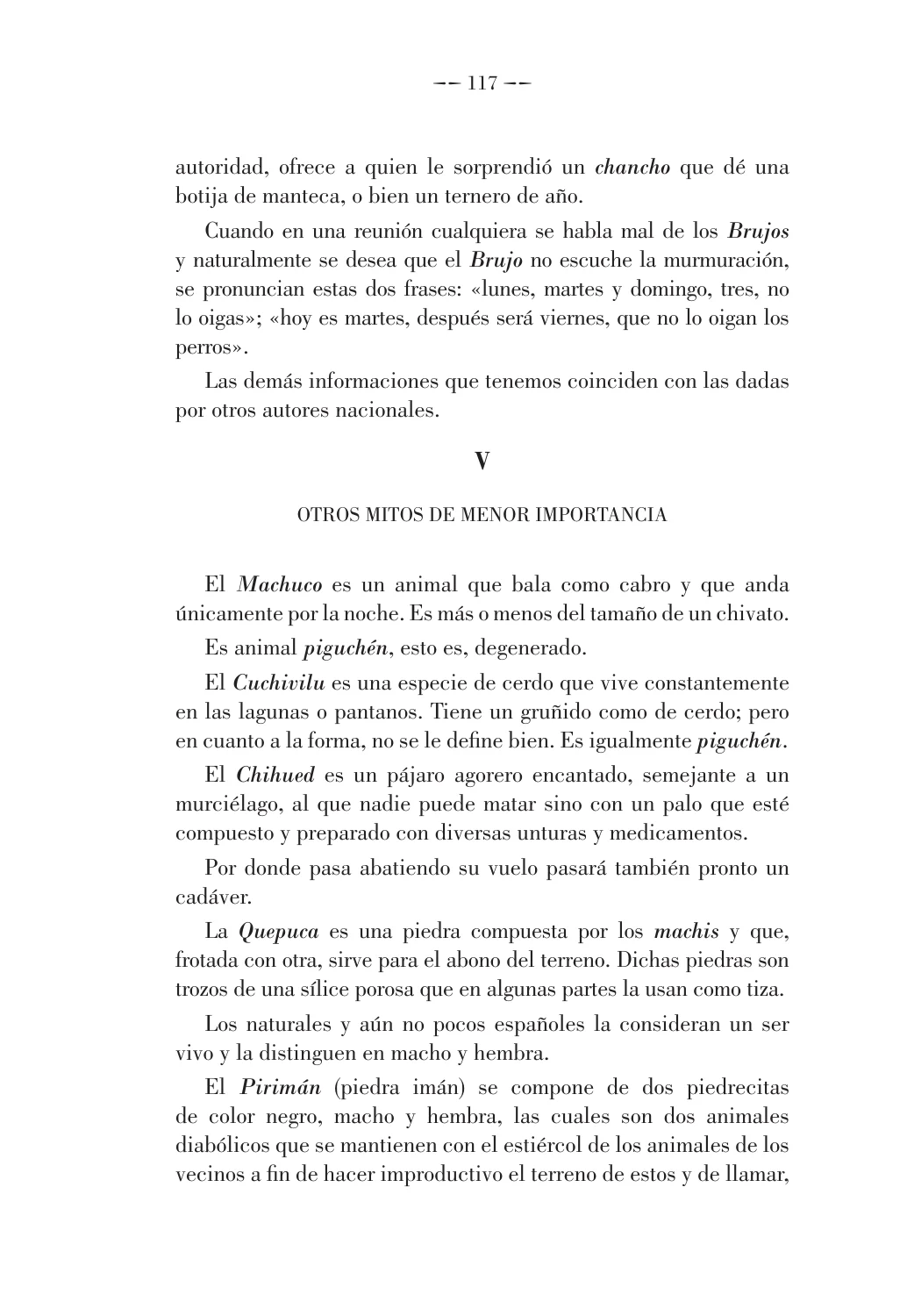
chihued, named printed passage in Cavada museum edition, page117; documentary source-page facsimile
Exact documentary text facsimile of the named being, not creature artwork. Original1914 source reprinted in the2016 museum edition; page contains historical terminology and collector interpretations.
Overview
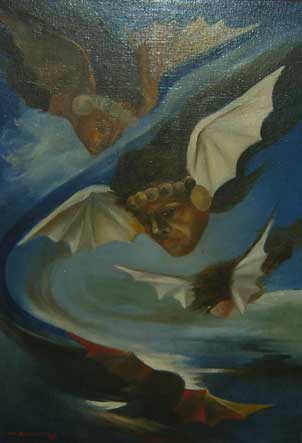
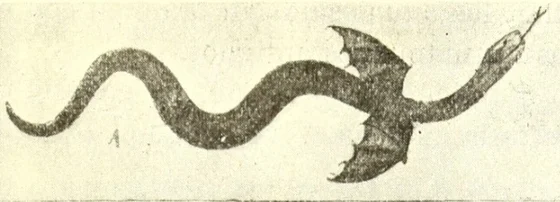
Cavada's short account resembles a bat. Low flight over a place predicts that a corpse will later pass along that route, rather than describing the creature directly killing someone. Ordinary weapons fail against it; the reported special weapon is a wooden stick prepared with unspecified substances. The text provides neither the ingredients nor an extended encounter, so its documentary content is an omen and exceptional vulnerability.
Vicuña Cifuentes quotes a different description from Cañas's Vocabulario: a black nocturnal bird the size of a thrush, with a harsh call, carrying a transformed sorcerer. It lies on travelled paths and pretends to be dead. The call announces the approaching death of someone who hears it. Vicuña says that he collected no oral information about this figure himself and did not know whether it occurred beyond Chiloé. That explicit limitation makes the bird account a quoted lexical witness, not an additional field interview. Batlike body, feigned-death behaviour and death call are retained with their separate sources.
Origins & earliest records
Cavada's 1914 publication supplies the short batlike witness. Vicuña's 1915 section quotes a previously published Cañas description but explicitly reports no oral collection of his own for Chihued. These dates and routes of transmission document historical writing about the figure; the earliest oral telling and its original local community remain unknown.
Records & interpretation
The museum edition's p. 117 and Vicuña's printed p. 42 were inspected. The texts differ in appearance and emphasis: batlike low-flight omen versus black bird, transformed sorcerer and feigned death. A shared name is sufficient for comparison here, but does not establish that every narrator treated these descriptions as interchangeable.
In the literature
“Por donde pasa abatiendo su vuelo pasará también pronto un cadáver.”
V: Otros mitos de menor importancia; printed p.117; paragraph beginning “El Chihued es un pájaro agorero…”
The bird resembles a bat, is killable only with a specially treated stick, and its low flight presages a corpse following the same route.
Selected bibliography
Documented works and useful reading. This is not a list of every appearance.
- 01
Chiloé y los chilotes
Historical folklore witness; cited printed pages 117. The museum edition updates orthography.
- 02
Mitos y supersticiones recogidos de la tradición oral chilena
Printed p. 42 quotes Cañas's Vocabulario and states the collector's lack of oral data.
- 03
Chiloé y los chilotes (1914) de Francisco J. Cavada: un estudio glotopolítico
Critical context for the collector's linguistic authority and national modernisation project.
Family & connections
A source-supported family tree or inspiration record has not yet been compiled for this profile. Related reading below indicates a connection in subject matter, not a proven lineage or creative influence.
Located primary passages
Specific passages supporting details in this entry, grouped by their published witness.
Chiloé y los chilotes
Underlying work1914; inspected fourth museum edition, Ancud, November2016 (ISBN978-956-9172-04-5); modern typography, pagination and annotations.
- The bird resembles a bat, is killable only with a specially treated stick, and its low flight presages a corpse following the same route.
This is Cavada’s historical collected account reproduced in2016, with its Christian and colonial framing; source criticism does not endorse its judgments or alleged practices. Exact inspected2016 pages, not assumed original1914 pagination. Spanish passage retained without an invented translation.
References
Sources supporting this profile. Linked pages have their own scope and editorial standards.
- Primary textChiloé y los chilotes — Museo Regional de Ancud edition, pp. 117Research access: 2026-10-05
- Primary textMemoria Chilena: Vicuña Cifuentes, Mitos y supersticiones (1915), p. 42Research access: 2026-10-05
- ResearchCritical study of Cavada's collectionResearch access: 2026-10-05
Image credits
Historical text facsimilechihued, named printed passage in Cavada museum edition, page117; documentary source-page facsimile
Exact documentary text facsimile of the named being, not creature artwork. Original1914 source reprinted in the2016 museum edition; page contains historical terminology and collector interpretations.