Peuchen
Image associated with the exact linked encyclopedia article; consult credited file description for its interpretation.
Overview
Cavada’s Chilote discussion uses Piuchén or Piguchén for more than one extraordinary being. An old red rooster changes after laying the basilisk’s egg; a failed witchcraft initiate thrown into a river becomes a creature that cannot be recognized as an ordinary person or animal. The author also lists serpent, bird, quadruped, frog, and batlike designs. Exceptional longevity links the transformations, and the name can even be applied jokingly to an unusually old person. His inability to settle the appearance is part of the record itself. It leaves room for accounts in which transformation matters more than a particular set of wings or scales. The rooster example joins this entry to the household basilisk, while the river episode places another form outside domestic space. Neither account supplies a sequence that every Piguchén must pass through.
Vicuña Cifuentes’s 1915 collection preserves additional regional contrasts. In Talagante, a serpent eventually becomes a large, fine-haired, frog-shaped blood-drinker with short wings and strong legs. In Melipilla, an old serpent becomes a bird roughly the size of a young turkey; red material dripping from its tree refuge betrays it. Coinco’s version is about the size of a hen, with a long narrow beak, pale grey eyes, and stiff bristles along the back. It attacks mules. Other reports emphasize an unseen bird’s piercing cry or a great snake eating sheep. A passage quoted from Molina gives an especially different picture: a rabbit-sized winged quadruped with cinnamon-coloured fur, a pointed muzzle, membranous wings, and an insect diet. That harmless feeding description differs sharply from the livestock blood-drinkers. Keeping the locality and author beside each design makes the variations readable without combining them into one invented composite.
Origins & earliest records
The profile uses Cavada's 1914 written discussion, which itself refers readers to earlier authors including Molina, Lenz and Guevara. That reference establishes a scholarly conversation, not a securely verified earliest origin. The entry does not date oral invention or impose one modern spelling on every regional use of the name.
Records & interpretation
Cavada’s printed page 109 and Vicuña Cifuentes’s printed pages 80–82 directly preserve competing designs and uses of the name. Locality labels are the historical collectors’ attributions, rather than proof of exclusive regional distribution. Molina and Guevara appear as quotations in the inspected collection; their originals were not independently inspected for this expansion.
In the literature
“no es ni hombre ni ningún animal determinado.”
IV: Mitos / El Piuchén o Piguchén; printed p.109; paragraph beginning “Parece que la acepción que tiene en Chiloé…”
Cavada treats Piguchén as transformation rather than one fixed zoological form, illustrating it with the old rooster and an unsuccessful witch candidate thrown into a river; accounts range from mixed serpent-bird-quadruped to frog, snake or bat.
Selected bibliography
Documented works and useful reading. This is not a list of every appearance.
- 01
Chiloé y los chilotes
Historical folklore witness; cited printed pages 109. The museum edition updates orthography.
- 02
Chiloé y los chilotes (1914) de Francisco J. Cavada: un estudio glotopolítico
Critical context for the collector's linguistic authority and national modernisation project.
- 03
Mitos y supersticiones recogidos de la tradición oral chilena
Printed pp80–82; separately labelled Talagante, Melipilla and Coinco accounts, with quotations from earlier authors.
Family & connections
A source-supported family tree or inspiration record has not yet been compiled for this profile. Related reading below indicates a connection in subject matter, not a proven lineage or creative influence.
Located primary passages
Specific passages supporting details in this entry, grouped by their published witness.
Chiloé y los chilotes
Underlying work1914; inspected fourth museum edition, Ancud, November2016 (ISBN978-956-9172-04-5); modern typography, pagination and annotations.
- Cavada treats Piguchén as transformation rather than one fixed zoological form, illustrating it with the old rooster and an unsuccessful witch candidate thrown into a river; accounts range from mixed serpent-bird-quadruped to frog, snake or bat.
This is Cavada’s historical collected account reproduced in2016, with its Christian and colonial framing; source criticism does not endorse its judgments or alleged practices. Exact inspected2016 pages, not assumed original1914 pagination. Spanish passage retained without an invented translation.
Encyclopedia background
An additional attributed reference, separate from the editorial profile above.
Read the open encyclopedia overview
The Piuchén (Peuchén, Pihuchén, Piwuchén) or Piguchen (Piguchén), from Mapuche: piwichen for “to dry people” (transliterations: Pihuichéñ, Pihuichen, Pihuichén, Pihuychen) is a vampiric creature from the Mapuche mythology and Chilote mythology known in much of Chile.
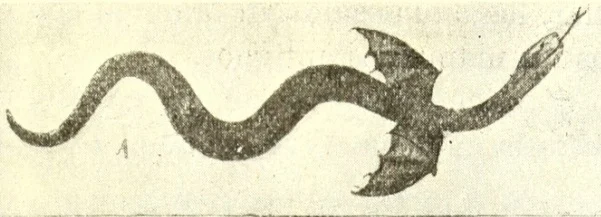
This blood-sucker often assumes the guise of a flying snake, or a large lizard with bat wings, that emits strange whistling sounds or hisses that stun or kill its enemy or prey. It is also described as an avian-piscine-human composite, or a shapeshifter taking on the form of animals.
The lore may have derived from encounters with the common vampire bat.
Text from Wikipedia contributors, “Piuchén”. CC BY-SA 4.0. Extracted introduction; formatting changed. Retrieved 5 October 2026. The source article may have changed since retrieval.
References
Sources supporting this profile. Linked pages have their own scope and editorial standards.
- Primary textChiloé y los chilotes — Museo Regional de Ancud edition, pp. 109Research access: 2026-10-05
- ResearchCritical study of Cavada's collectionResearch access: 2026-10-05
- Primary textVicuña Cifuentes 1915, Piguchén variants, pp80–82Research access: 2026-10-05
Image credits
Reference illustrationPeuchen
Image associated with the exact linked encyclopedia article; consult credited file description for its interpretation.