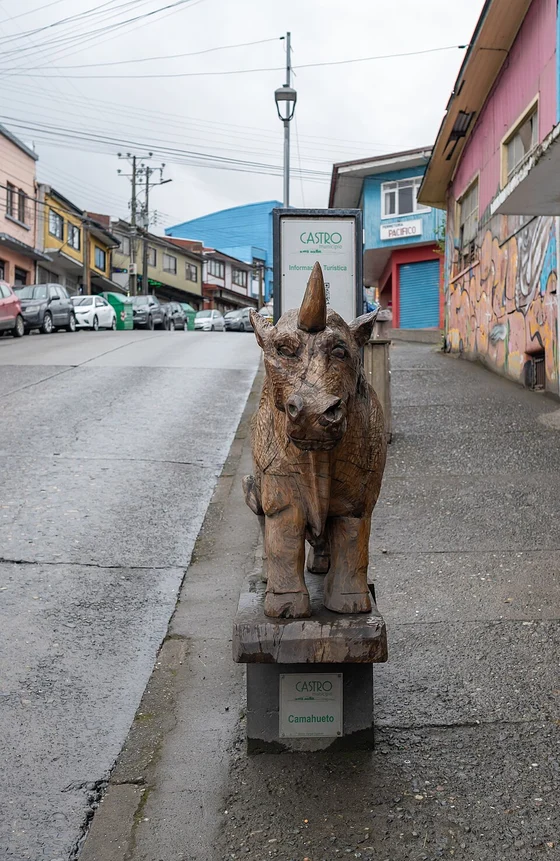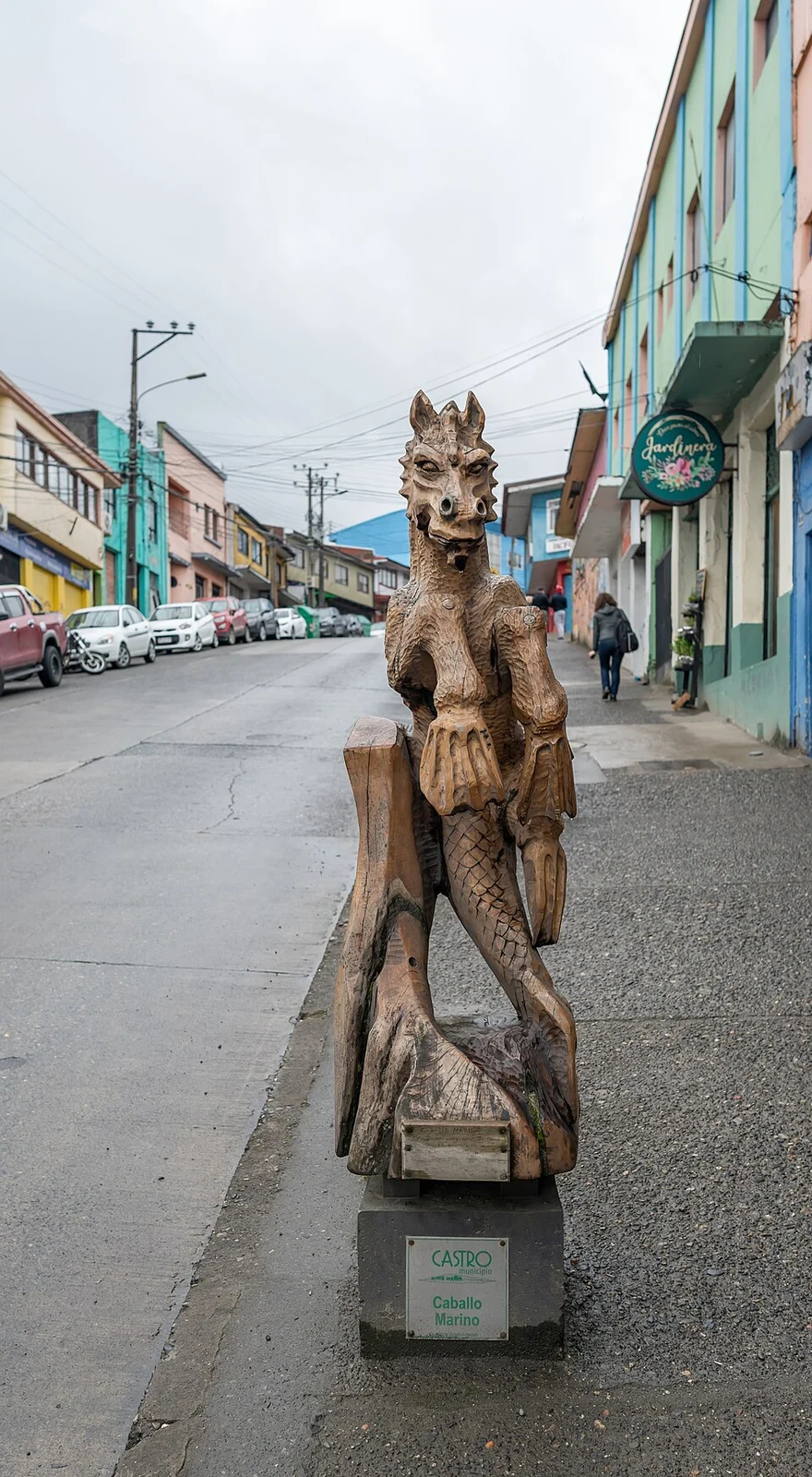
Caballo Marino municipal wood carving in Castro, Chiloe
Modern public sculpture photographed in Castro, Chiloe. Inspected label reads Caballo Marino and Castro municipio; carved horse head and fish tail. Not ancient artwork or an observed animal. Commons licenses the photograph; individual sculptor is not credited in the record.
Overview
This Caballo Marino belongs to Chiloé's supernatural seascape rather than to the zoological seahorses. Cavada says witches use it for journeys over the sea and to board the Caleuche. It can carry as many as twelve people and moves faster than the legendary vessel. When it comes ashore, its dimensions are compared with a large fence rather than specified through precise measurements.
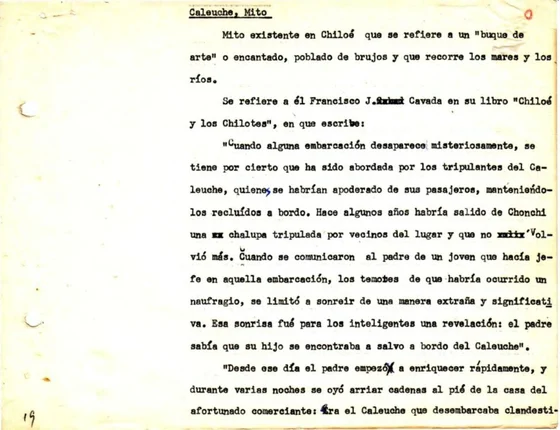
The mouth throws out sea foam, and reins made of sargasso seaweed are the means of control. Cavada interprets the animal as a personification of waves, an explanation that should be recognised as the collector's reading. The mount remains distinct from the Camahueto, whose river life and destructive passage to the ocean form a different narrative. Keeping those roles apart clarifies the connections between island travel, witches and dangerous waters.
Nicasio Tangol’s 1976 dictionary gives a more detailed Chilote form: an elongated muzzle, fin-like legs and a fish-like tail, with the animal living on the seabed and feeding on luche and cochayuyo. His account makes it large enough for the thirteen members of the witches’ governing group. Travelling to the Caleuche on its back is compulsory under their rules, despite their separate capacity for flight. A sargassum rope serves as both means of capture and rein; without it the rider cannot control the creature. These particulars belong to Tangol’s synthesis, whose entry does not identify an individual teller, and need not apply to Cavada’s earlier account.
Origins & earliest records
A dated account appears in Cavada's 1914 collection, now available through the Ancud museum edition. This written witness shows the sea horse already connected with Caleuche narratives, but cannot establish which story came first or when either arose. Its name is a local narrative label rather than evidence of a described animal species.
Records & interpretation
Printed pages 109–110 support the transport function, twelve riders, unusual speed, foam and seaweed reins. Page 111 explicitly warns against confusing Camahueto with this mount. The wave-personification explanation is attributed interpretation. Neither the collector's comparison of size nor later illustrations supplies a measured body plan for an allegedly observed creature.
In the literature
“puede llevar hasta doce personas sobre su lomo”
IV: Mitos / El Caballo Marino; printed p.109; paragraph beginning “No es el hipopótamo…”
The horse carries witches across seas or to Caleuche, can bear twelve people and travels faster than the ship; Cavada distinguishes it from the hippopotamus.
Selected bibliography
Documented works and useful reading. This is not a list of every appearance.
- 01
Chiloé y los chilotes
Historical folklore witness; cited printed pages 109–111. The museum edition updates orthography.
- 02
Chiloé y los chilotes (1914) de Francisco J. Cavada: un estudio glotopolítico
Critical context for the collector's linguistic authority and national modernisation project.
- 03
Diccionario Etimológico Chilote
El Caballo Marino, pp.111–112; complete entry and title page visually inspected. Editorial Nascimento, Santiago.
Family & connections
A source-supported family tree or inspiration record has not yet been compiled for this profile. Related reading below indicates a connection in subject matter, not a proven lineage or creative influence.
Located primary passages
Specific passages supporting details in this entry, grouped by their published witness.
Chiloé y los chilotes
Underlying work1914; inspected fourth museum edition, Ancud, November2016 (ISBN978-956-9172-04-5); modern typography, pagination and annotations.
- The horse carries witches across seas or to Caleuche, can bear twelve people and travels faster than the ship; Cavada distinguishes it from the hippopotamus.
IV: Mitos / El Caballo Marino; printed p.109; paragraph beginning “No es el hipopótamo…”
- Cavada calls it a personification of sea waves that foams at the mouth and can be governed only by seaweed reins.
This is Cavada’s historical collected account reproduced in2016, with its Christian and colonial framing; source criticism does not endorse its judgments or alleged practices. Exact inspected2016 pages, not assumed original1914 pagination. Spanish passage retained without an invented translation.
Encyclopedia background
An additional attributed reference, separate from the editorial profile above.
Read the open encyclopedia overview
The Caballo Marino Chilote (chilote sea horse) is an aquatic creature of the Chilote mythology of Chile, that bears some resemblance to the hippocampus.
Legend says that the "Caballo marino chilote" is an invisible creature, which could only be seen by those with magical powers.
The creature would look like a normal horse, but would have the longer snout, golden mane, four paws in the form of fins, and a long tail, similar to the tail of a fish. They can exist in various sizes, from dwarfs to giants. The Brujo Chilote (a type of sorcerer or warlock) would use a "Caballo marino chilote" as transportation to get to the Caleuche ghost ship.
Text from Wikipedia contributors, “Caballo marino chilote”. CC BY-SA 4.0. Extracted introduction; formatting changed. Retrieved 5 October 2026. The source article may have changed since retrieval.
References
Sources supporting this profile. Linked pages have their own scope and editorial standards.
- Primary textChiloé y los chilotes — Museo Regional de Ancud edition, pp. 109–111Research access: 2026-10-05
- ResearchCritical study of Cavada's collectionResearch access: 2026-10-05
- Primary textMemoria Chilena: Tangol1976, pp.111–112Research access: 2026-10-05
Image credits
Thematic illustrationCaballo Marino municipal wood carving in Castro, Chiloe
Modern public sculpture photographed in Castro, Chiloe. Inspected label reads Caballo Marino and Castro municipio; carved horse head and fish tail. Not ancient artwork or an observed animal. Commons licenses the photograph; individual sculptor is not credited in the record.