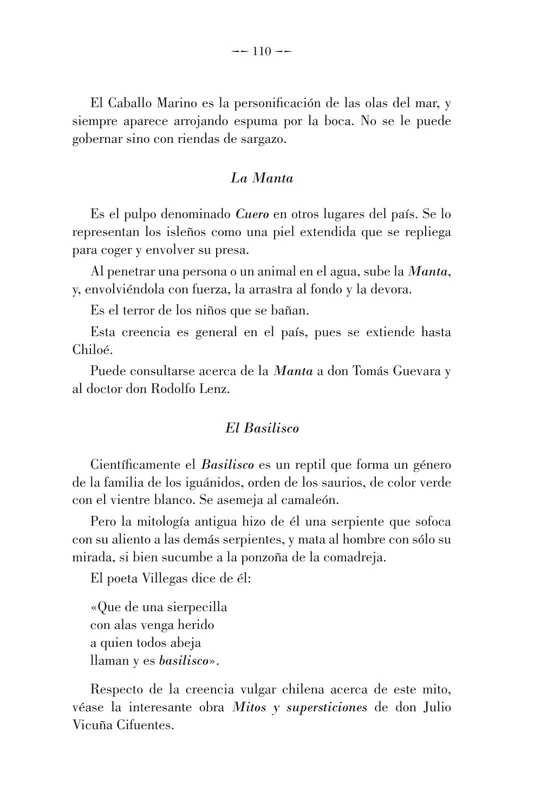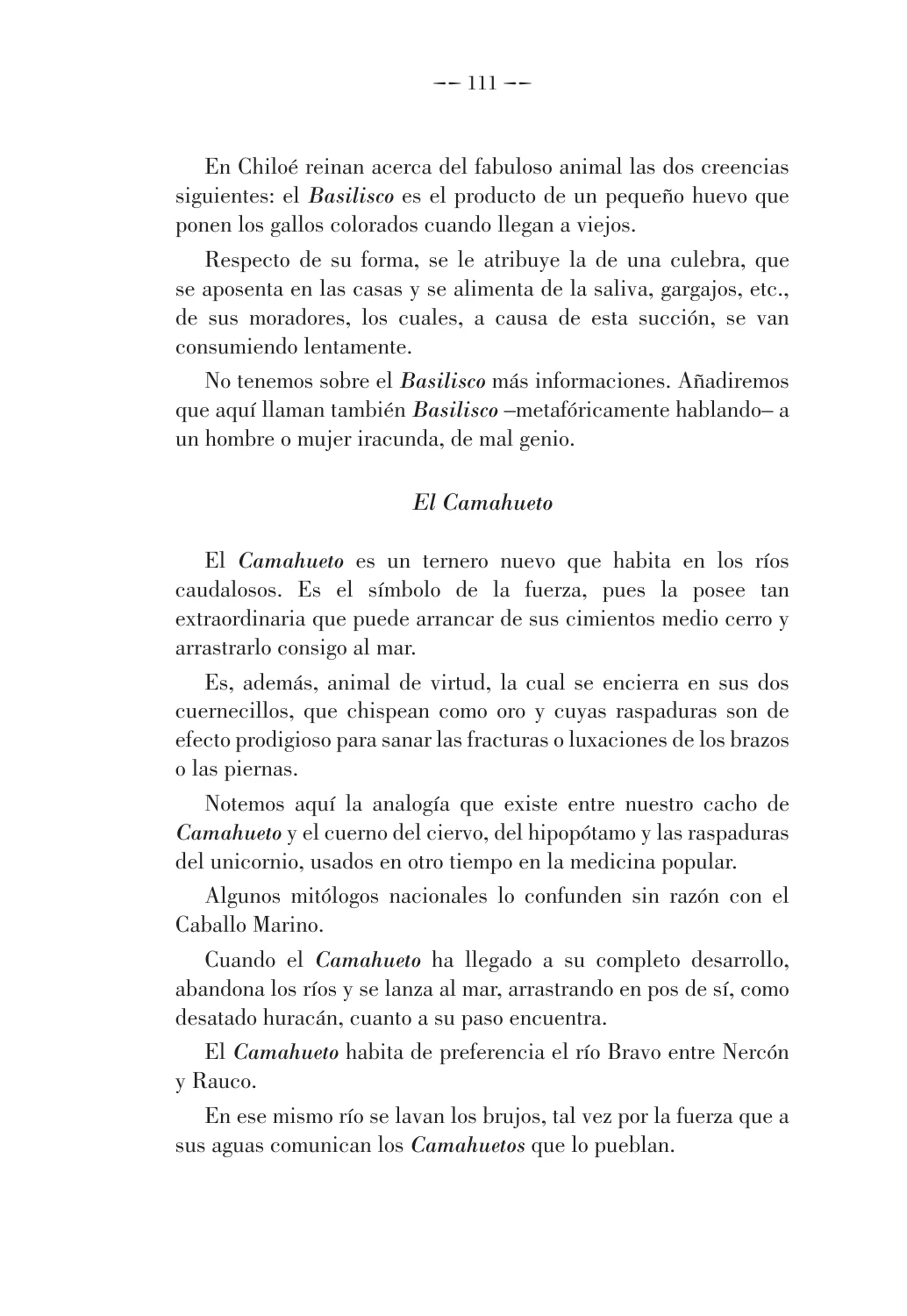
basilisco-chilote, named printed passage in Cavada museum edition, page111; documentary source-page facsimile
Exact documentary text facsimile of the named being, not creature artwork. Original1914 source reprinted in the2016 museum edition; page contains historical terminology and collector interpretations.
Overview
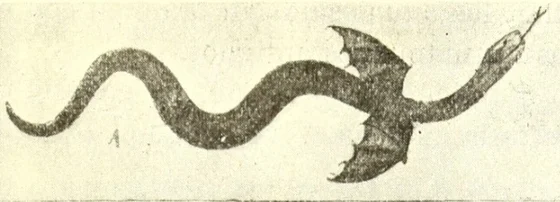
Cavada’s Chilote basilisk comes from a small egg laid by an old red rooster. The resulting snake hides in a house and takes the saliva or sputum of its inhabitants; their increasing weakness explains why an apparently ordinary dwelling becomes dangerous. His separate Piguchén discussion makes the ageing rooster itself an uncanny transformed creature after the egg is laid. The two entries therefore share a household narrative connection, but describe different actors: the changed bird and the hidden serpent. Cavada begins with classical basilisk comparisons, then limits his island information to the egg, snake, and saliva-taking motif.
The later Enciclopedia Chilena supplies a broader national synthesis that adds wings, crests, blood-feeding, and a deadly gaze. Its small serpent inhabits the spaces under wooden floors or other hidden corners. The gaze encounter turns on who sees whom first: a person surprised by its look dies, while someone who first notices the basilisk can cause the creature’s death. The encyclopedia also describes a mirror turned toward the hiding place, so the creature meets its own fatal reflection. Its reported distribution runs from Coquimbo to Chiloé, and it cites Cavada alongside other writers. These details extend the comparative reading; they are not all present in Cavada’s restricted island account. The distinction lets an illustrator choose a source-specific serpent rather than treating every familiar basilisk feature as mandatory.
Origins & earliest records
The documented witness is Cavada's 1914 collection; its comparison with older basilisk traditions does not by itself prove when or how the Chilote version developed. The local story is distinguished from the classical literary creature and from Basiliscus lizards. Publication is a date for the record, not for the invention of the oral narrative.
Records & interpretation
Cavada’s printed pages 109–111 support the rooster connection and household serpent, while explicitly limiting his local information. Encyclopedia document ECH-519/1 adds a wider Chilean synthesis with a gaze and mirror motif. The later synthesis does not retrospectively prove every additional detail was part of Cavada’s Chilote account.
In the literature
“el producto de un pequeño huevo que ponen los gallos colorados cuando llegan a viejos.”
IV: Mitos / El Basilisco; printed p.111; paragraph beginning “En Chiloé reinan acerca del fabuloso animal…”
The Chiloé account gives birth from an old red rooster’s small egg and a snake form living in houses, feeding on inhabitants’ saliva and phlegm while they waste away.
Selected bibliography
Documented works and useful reading. This is not a list of every appearance.
- 01
Chiloé y los chilotes
Historical folklore witness; cited printed pages 109–111. The museum edition updates orthography.
- 02
Chiloé y los chilotes (1914) de Francisco J. Cavada: un estudio glotopolítico
Critical context for the collector's linguistic authority and national modernisation project.
- 03
El Basilisco
Document ECH-519/1; wider Chilean synthesis compared with Cavada’s more restricted local record.
Family & connections
A source-supported family tree or inspiration record has not yet been compiled for this profile. Related reading below indicates a connection in subject matter, not a proven lineage or creative influence.
Located primary passages
Specific passages supporting details in this entry, grouped by their published witness.
Chiloé y los chilotes
Underlying work1914; inspected fourth museum edition, Ancud, November2016 (ISBN978-956-9172-04-5); modern typography, pagination and annotations.
- The Chiloé account gives birth from an old red rooster’s small egg and a snake form living in houses, feeding on inhabitants’ saliva and phlegm while they waste away.
This is Cavada’s historical collected account reproduced in2016, with its Christian and colonial framing; source criticism does not endorse its judgments or alleged practices. Exact inspected2016 pages, not assumed original1914 pagination. Spanish passage retained without an invented translation.
Encyclopedia background
An additional attributed reference, separate from the editorial profile above.
Read the open encyclopedia overview
The Basilisco chilote is a creature from Chilota mythology originating from the Chiloé Archipelago, in southern Chile.
The Basilisco chilote is described as having the crest of a rooster and the body of a serpent. It is hatched from an egg that is incubated by a rooster and lives in a hole which it digs under a house. It feeds on the phlegm and saliva of the people who live in the house, causing the inhabitants to dehydrate and eventually die.
To kill Basilisco chilote, you must burn the egg as soon as it is laid and kill the chicken that laid it, to prevent further eggs from being laid. Once hatched the only way to destroy it is by burning down the house where it lives.
This myth is based upon myths of the Colo Colo and the basilisk, but borrows more from the tradition of the cockatrice, which itself draws from the basilisk.
Text from Wikipedia contributors, “Basilisco Chilote”. CC BY-SA 4.0. Extracted introduction; formatting changed. Retrieved 5 October 2026. The source article may have changed since retrieval.
References
Sources supporting this profile. Linked pages have their own scope and editorial standards.
- Primary textChiloé y los chilotes — Museo Regional de Ancud edition, pp. 109–111Research access: 2026-10-05
- ResearchCritical study of Cavada's collectionResearch access: 2026-10-05
- ReferenceEnciclopedia Chilena, ECH-519/1: El BasiliscoResearch access: 2026-10-05
Image credits
Historical text facsimilebasilisco-chilote, named printed passage in Cavada museum edition, page111; documentary source-page facsimile
Exact documentary text facsimile of the named being, not creature artwork. Original1914 source reprinted in the2016 museum edition; page contains historical terminology and collector interpretations.