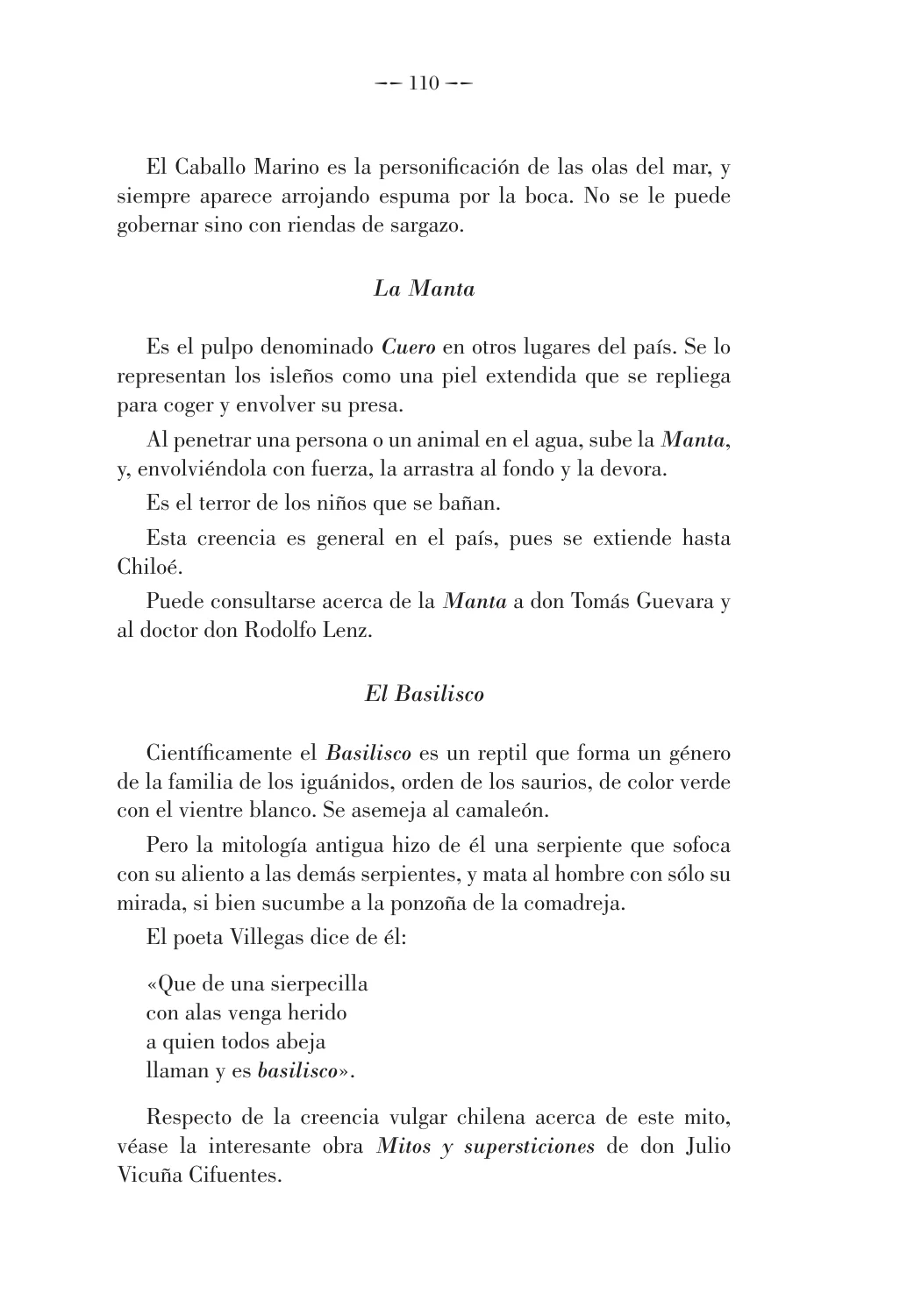
cuero, named printed passage in Cavada museum edition, page110; documentary source-page facsimile
Exact documentary text facsimile of the named being, not creature artwork. Original1914 source reprinted in the2016 museum edition; page contains historical terminology and collector interpretations.
Overview
Cavada's Chilote Manta spreads like an animal hide, rises when a person or animal enters the water, and folds around the victim before dragging it down. Vicuña Cifuentes records more elaborate mainland accounts. At Talagante the hide-shaped creature has many eyes along its edges and four larger eyes in the part corresponding to a head. Its wrapping movement explains how a flat-looking surface becomes a predator. Another account, located at Coihueco, gives it strength to pull horse and rider underwater together. The narrated countermeasure uses a heavily thorned branch: the creature grips it, wounds itself and cannot release its hold. These are different collected accounts, rather than a single prescribed anatomy or episode.
In Concepción the creature's beginning is told as the animation of a discarded donkey hide in the Bío-Bío River, where it grows and threatens bathers near its lair. Vicuña then quotes earlier descriptions under Trelquehuecuve and related spellings. A Guevara passage gives contracting, claw-ended arms and a whirlwind that pushes the creature back from the sunlit shore into the water. Other quoted witnesses emphasize claws around a calfskin-sized body. Vicuña identifies his quoted authors, so these passages remain mediated readings of Guevara and Lenz, not new independent interviews. The Chilote Manta and mainland Cuero labels are consolidated because the historical texts explicitly connect them; the locality distinctions remain visible.
Origins & earliest records
Cavada's 1914 publication and Vicuña's 1915 locality-based collection are dated documentary witnesses. The Bío-Bío donkey-hide episode supplies an origin within a story, not a historical explanation of the tradition's birth. Earlier Guevara and Lenz descriptions appear as quotations in Vicuña, and their quoted dates or claims are not presented as newly inspected originals.
Records & interpretation
Cavada's museum-edition p. 110 and Vicuña's printed pp. 38–39 were inspected. The latter directly distinguishes collected mainland accounts from quoted reference works. It supports eyed, contracting and animated-hide forms, but cannot establish actual attacks or identify a biological species. Cuero's association with an octopus is a collector's comparison, not accepted zoological classification.
In the literature
“una piel extendida que se repliega para coger y envolver su presa.”
IV: Mitos / La Manta; printed p.110; paragraph beginning “Es el pulpo denominado Cuero…”
Cavada identifies Manta with the Cuero name used elsewhere, describing a spread skin that folds around a swimmer or animal, drags its prey down and devours it.
Selected bibliography
Documented works and useful reading. This is not a list of every appearance.
- 01
Chiloé y los chilotes
Historical folklore witness; cited printed pages 110. The museum edition updates orthography.
- 02
Mitos y supersticiones recogidos de la tradición oral chilena
Printed pp. 38–39: mainland Cuero accounts and attributed earlier quotations.
- 03
Chiloé y los chilotes (1914) de Francisco J. Cavada: un estudio glotopolítico
Critical context for the collector's linguistic authority and national modernisation project.
Family & connections
A source-supported family tree or inspiration record has not yet been compiled for this profile. Related reading below indicates a connection in subject matter, not a proven lineage or creative influence.
Located primary passages
Specific passages supporting details in this entry, grouped by their published witness.
Chiloé y los chilotes
Underlying work1914; inspected fourth museum edition, Ancud, November2016 (ISBN978-956-9172-04-5); modern typography, pagination and annotations.
- Cavada identifies Manta with the Cuero name used elsewhere, describing a spread skin that folds around a swimmer or animal, drags its prey down and devours it.
IV: Mitos / La Manta; printed p.110; paragraph beginning “Es el pulpo denominado Cuero…”
This is Cavada’s historical collected account reproduced in2016, with its Christian and colonial framing; source criticism does not endorse its judgments or alleged practices. Exact inspected2016 pages, not assumed original1914 pagination. Spanish passage retained without an invented translation.
References
Sources supporting this profile. Linked pages have their own scope and editorial standards.
- Primary textChiloé y los chilotes — Museo Regional de Ancud edition, pp. 110Research access: 2026-10-05
- Primary textMemoria Chilena: Vicuña Cifuentes, Mitos y supersticiones (1915), pp. 38–39Research access: 2026-10-05
- ResearchCritical study of Cavada's collectionResearch access: 2026-10-05
Image credits
Historical text facsimilecuero, named printed passage in Cavada museum edition, page110; documentary source-page facsimile
Exact documentary text facsimile of the named being, not creature artwork. Original1914 source reprinted in the2016 museum edition; page contains historical terminology and collector interpretations.