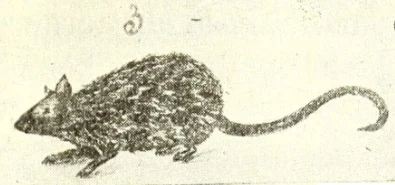
Colo-colo, figure42.3 in Guevara’s1908 historical account
Exact named historical figure, visually inspected: small rodent form with long tail. Scoped to Guevara’s1908 Mapuche-related witness; the profile records competing lizard, rodent and birdlike forms, so this is not universal anatomy. Commons identifies1908 source and life70-expired public domain.
Overview
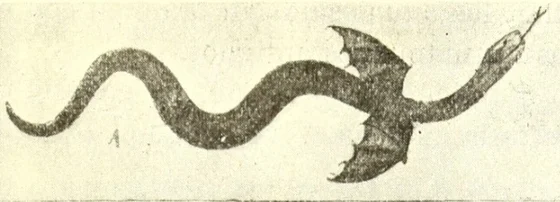
Colo-colo changes body from place to place in Vicuña Cifuentes's collection. The La Serena report gives it a lizard's form, while Santiago and Talagante describe a mouse. In Malloco it is a black bird; Quella supplies a batlike bird, and Coihueco again a mouse. At Coelemu its repeated cry identifies a presence that remains unseen. These accounts make the creature's sound and harm more consistent than its anatomy: a small visitor concealed near a house can threaten an entire household. The later Enciclopedia Chilena likens the repeated call to a clock, with syllables sounding the name itself, and describes it taking saliva from people during sleep.
The collection's printed page 36 separately quotes Guevara on the creature's development from an unusually small or malformed egg, popularly attributed to a rooster. One quotation gives a subterranean lizard; another traces a snake or lizard that becomes a feathered, ratlike animal. It dwells in holes near houses and comes out to lick spittle and used eating utensils. Guevara links that contact to wasting and death through his interpretation of sympathetic magic. Burning the supposed rooster's egg is recorded as a response to the danger. This quoted material belongs beside the directly collected regional reports rather than replacing them with a single form. Vicuña also cites Lenz's dictionary for colocolo as a wild-cat name. That lexical comparison differs from the saliva-taking narrative. The encyclopedia's reported geography, from Atacama to Llanquihue, is a later historical synthesis; it cannot show how every local teller pictured the being.
Origins & earliest records
The inspected witness is Vicuña Cifuentes’s 1915 collection, which quotes older Guevara and Lenz writing. Those quotations document an earlier scholarly conversation but were not independently checked in every cited original. The encyclopedia entry belongs to a 1948–1971 project; neither work establishes a first oral telling or one universally original Mapuche form.
Records & interpretation
Printed pages 35–36 distinguish regional reports from earlier works quoted by the compiler. Page 35's body descriptions were checked against the page image; page 36's Guevara and Lenz passages remain indirect witnesses. The encyclopedia independently documents its own clocklike-call formulation. Neither source establishes current prevalence or a single original anatomy.
In the literature
“es un ratoncillo muy bravo.”
VIII, El Colocolo; printed pp. 35–36 (PDF 54–55); p. 35, variant b, Santiago and Talagante
The collector records one mouse-shaped regional version of Colocolo.
Selected bibliography
Documented works and useful reading. This is not a list of every appearance.
- 01
Mitos y supersticiones recogidos de la tradición oral chilena
Printed pp35–36; varying anatomy and quotations from Guevara and Lenz.
- 02
El Colocolo
Historical encyclopedia document ECH-519/13; individual article year not supplied.
- 03
Mitos y supersticiones: recogidos de la tradición oral chilena — VIII, El Colocolo
Santiago de Chile: Imprenta Universitaria, 1915. Original Spanish edition; no translator. Biblioteca Nacional de Chile, Memoria Chilena, catalogue MC0008702 labels the item patrimonio cultural común and expressly permits use and reproduction.
Family & connections
A source-supported family tree or inspiration record has not yet been compiled for this profile. Related reading below indicates a connection in subject matter, not a proven lineage or creative influence.
Located primary passages
Specific passages supporting details in this entry, grouped by their published witness.
Mitos y supersticiones recogidos de la tradición oral chilena
Santiago de Chile: Imprenta Universitaria, 1915. Original Spanish edition; no translator. Biblioteca Nacional de Chile, Memoria Chilena, catalogue MC0008702 labels the item patrimonio cultural común and expressly permits use and reproduction.
- The collection distinguishes a blood-drinking lizard reported at Serena from saliva-drinking mouse forms at Santiago, Talagante and Coihueco, a small black bird at Malloco and a batlike bird at Quella; these are presented as regional reports, not one fixed anatomy.
VIII, El Colocolo; printed pp. 35–36 (PDF 54–55); p. 35, variants a–e
- A Coelemu account describes an unseen dangerous caller. Vicuña compares twenty-seven further reports, then explicitly quotes Guevara on anomalous eggs and saliva harm and Lenz on the ordinary wild-cat name; these citations are secondary witnesses within his collection.
VIII, El Colocolo; printed pp. 35–36 (PDF 54–55); pp. 35–36, variant f and comparative notes
Historical collection, not current zoology or universal Indigenous belief. Geographic source labels are those printed by the collector. Comparative quotations have not been independently verified against the original Guevara, Lenz, Lafone Quevedo or Mellet editions.
References
Sources supporting this profile. Linked pages have their own scope and editorial standards.
- Primary textMitos y supersticiones — Biblioteca Nacional de ChileResearch access: 2026-10-05
- ReferenceEnciclopedia Chilena, ECH-519/13: El ColocoloResearch access: 2026-10-05
Image credits
Historical illustrationColo-colo, figure42.3 in Guevara’s1908 historical account
Exact named historical figure, visually inspected: small rodent form with long tail. Scoped to Guevara’s1908 Mapuche-related witness; the profile records competing lizard, rodent and birdlike forms, so this is not universal anatomy. Commons identifies1908 source and life70-expired public domain.