Catalan language communities - AI-generated contextual illustration.
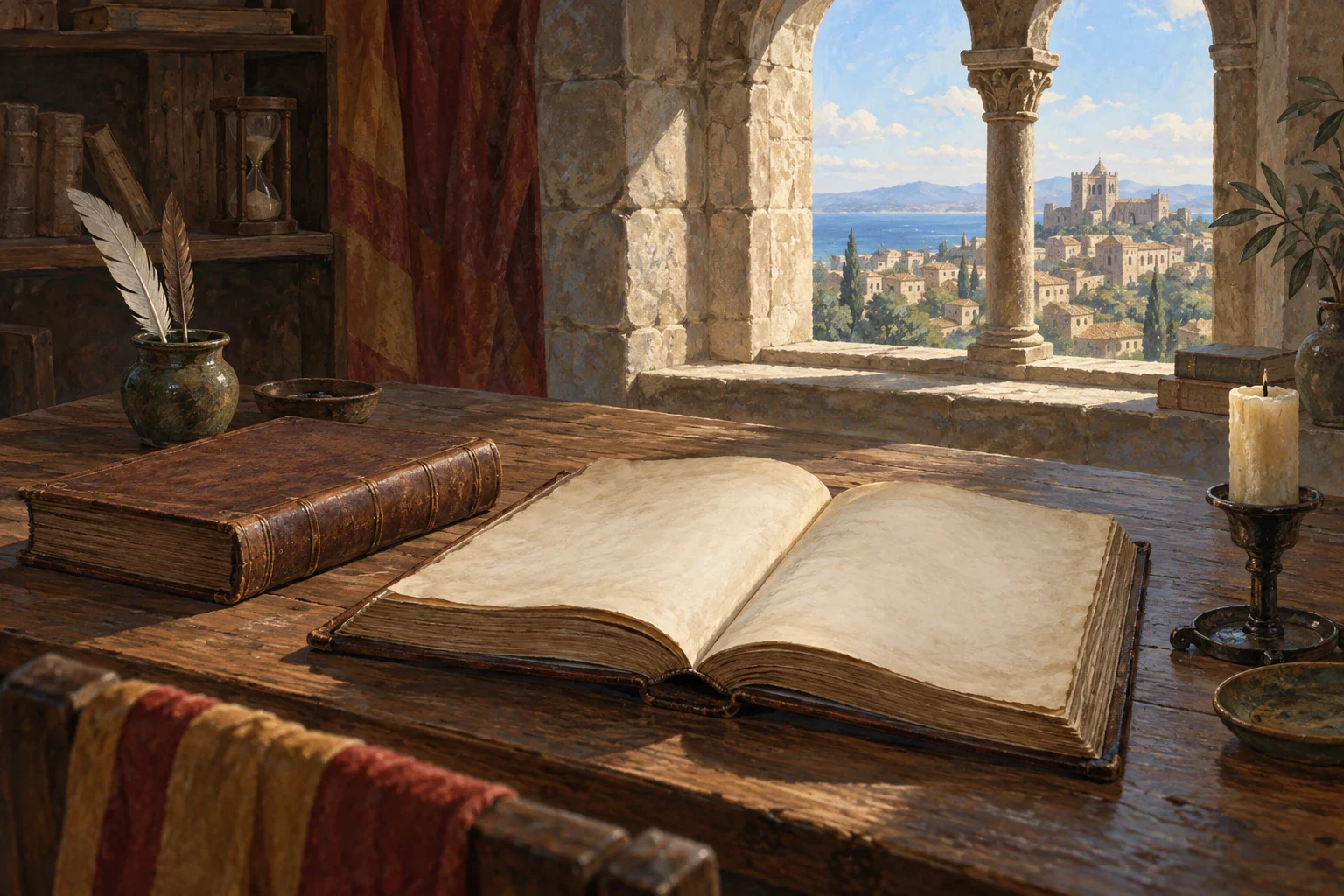
AI-generated contextual illustration evoking Catalan literary and legal transmission. Blank codices, desk, props and architecture are imagined, not a reproduction of a historical manuscript.
Overview
Catalan is a Romance language, and its communities of use extend beyond a single state border. Institut Ramon Llull describes speakers across four countries and a learning network that is both local and international. This entry focuses on linguistic and cultural participation. It does not equate all Catalan-speaking people with one nationality, political position or ancestry, and it does not imply that speaking another language excludes a person's Catalan cultural connections.
The institute's historical account locates the language's development from spoken Latin around the eastern Pyrenees in the eighth and ninth centuries. It identifies twelfth-century written witnesses and later expansion into Valencia and Mallorca. Medieval Catalan supported chronicles, philosophy and maritime law as well as poetry and narrative. Its later literary revival, the Renaixença, and early twentieth-century standardisation represent further changes rather than the continuation of an unchanged medieval culture.
The institute presents contemporary Catalan as a medium for literature, film, theatre, music and other cultural activities. Learners join Xarxa Llull through courses, stays and meetings. A complementary public institution, the Museu d'Història de Catalunya, established in 1996, frames history alongside social sciences and contemporary debate. These institutions offer selected routes into the culture, rather than a complete account of every community. The accompanying desk and blank codices imagine the context of literary and legal transmission without fabricating a manuscript.
History & identity
Catalan-speaking territories and international learning communities; selected Institut Ramon Llull accounts.
Sources & representation
Selected authoritative cultural-institution accounts; source-specific findings retained in cache.
Selected bibliography
Documented works and useful reading. This is not a list of every appearance.
- 01
Five reasons to study Catalan
Selected institutional account read for this overview; not a complete bibliography.
- 02
El català: una veu pròpia i mil·lenària
Selected institutional account read for this overview; not a complete bibliography.
- 03
Museu d'Història de Catalunya
Selected institutional account read for this overview; not a complete bibliography.
Language & cultural connections
Source-supported language and cultural connections have not yet been compiled for this profile.
References
Sources supporting this profile. Linked pages have their own scope and editorial standards.
- Institut Ramon LlullFive reasons to study CatalanResearch access: 2026-10-10
- Institut Ramon LlullEl català: una veu pròpia i mil·lenàriaResearch access: 2026-10-10
- Generalitat de CatalunyaMuseu d'Història de CatalunyaResearch access: 2026-10-10
Image credits
AI-generated contextual illustrationCatalan language communities - AI-generated contextual illustration.
AI-generated contextual illustration evoking Catalan literary and legal transmission. Blank codices, desk, props and architecture are imagined, not a reproduction of a historical manuscript.