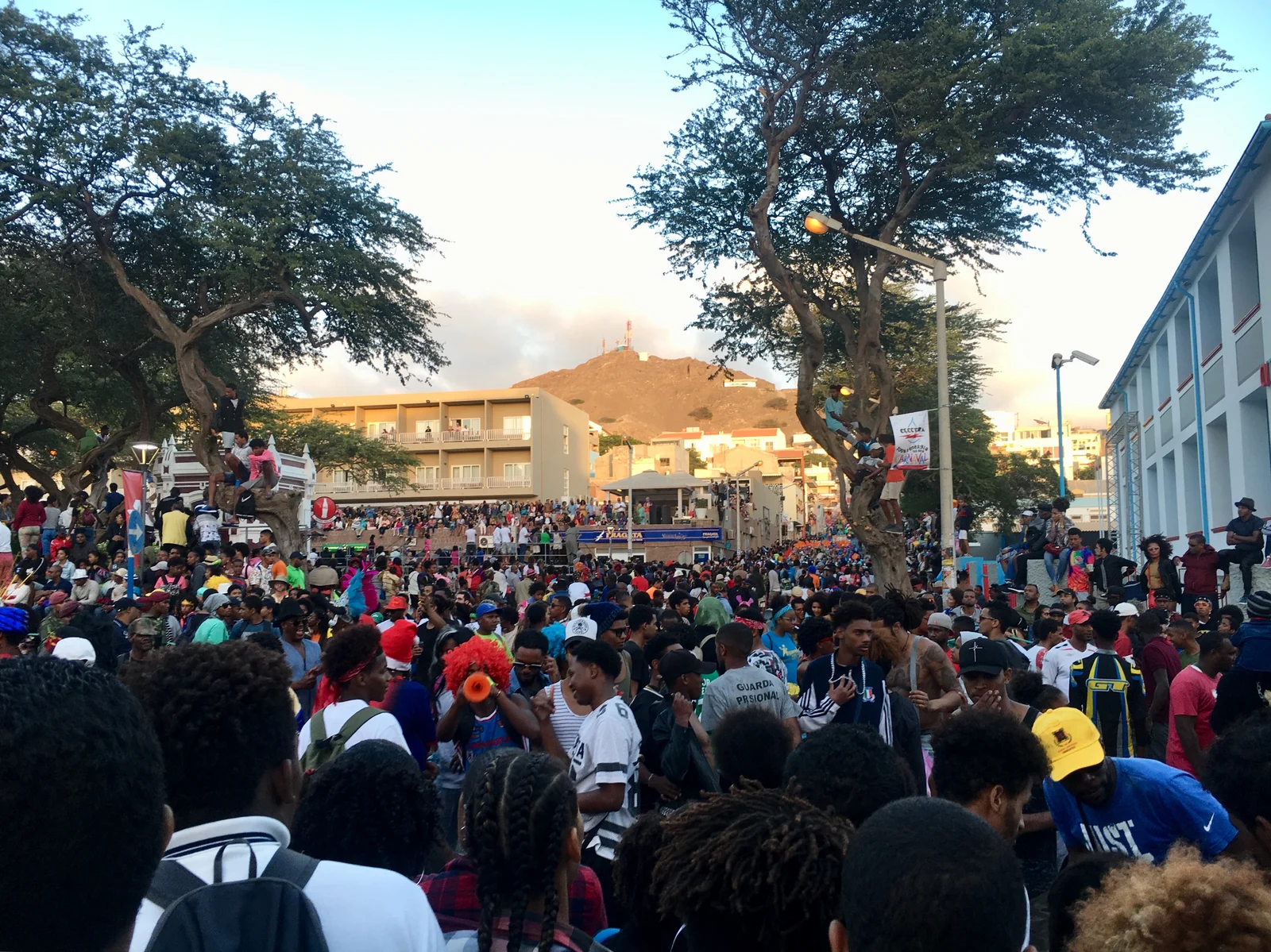
A dense carnival crowd fills a street and surrounding viewing areas beneath trees in Mindelo, with colourful costumes, urban buildings and a hill behind.
Carnival in Mindelo, São Vicente, photographed on 5 March 2019. The author identifies the event and place; this public cultural scene does not identify every attendee’s citizenship or heritage and does not represent all Cape Verdean communities.
Overview
Cape Verdean cultural relationships connect the Atlantic archipelago with diaspora settings and later generations. The Museu da Língua Portuguesa identifies Kriolu as an important cultural language with regional variation, alongside Portuguese. A July 2019 government report links language recognition with the safeguarding of cultural expression and identifies community bearers as central to Tabanca heritage. It explicitly discusses recognition among second and third generations abroad. These are accounts of language and cultural belonging, rather than a claim that every citizen speaks identically or participates in the same practice. The policy report describes its contemporary recognition initiative; it does not by itself settle present legal language status.
In Rhode Island, the Cape Verdean Museum attributes its foundation to Denise Oliveira in 2005. Its account describes a move from East Providence to Pawtucket and a collection built through donations by Cape Verdeans in different places. Photographs, artwork and historical belongings support exhibitions, a physical library and a travelling museum programme. Kriolu and music courses address children and adults, while educational events bring together scholars, artists, authors, families and schools. The museum describes partnerships with local educational and heritage institutions. Its evidence concerns a particular community-supported organisation, whose public programmes make diaspora cultural work visible without defining a single exclusive test of identity.
The Cape Verdean Association in New Bedford documents a different local project. Its account traces the proposed cultural home to a group purchasing the abandoned Strand theatre in 1990, followed by nonprofit incorporation in 1995. Volunteers and board members worked to secure and rehabilitate a fire-damaged building, with city grants, private support and fundraising contributing to continued work. The stated mission connects locally relevant programmes with partnerships throughout the diaspora. The history page describes rehabilitation as ongoing, so it is retained as a project account rather than proof of a completed centre. Organisational participation and cultural identity also remain distinct from American or Cabo Verdean citizenship.
Morna provides another documented setting for cultural transmission. Its 2019 UNESCO inscription describes music, voice, poetry and dance, including instrumental-only performance and lyrics addressing departure, reunion, longing and relationships with the ocean and homeland. The account identifies Cape Verdean Creole as the principal contemporary language of composition and recognises singers, instrumentalists, poets and composers as practitioners. Workshops, radio, performances, festivals and teaching centres help transmit the practice to younger people. This is an account of a particular living musical practice and its bearers. It does not imply that all Cape Verdeans perform Morna, nor that the inscription began the practice or certified an unchanged repertoire.
History & identity
Selected island heritage and diaspora institutional accounts document cultural relationships; policy recognition and organisation dates do not establish an ethnic origin.
Sources & representation
Language reference, government heritage report, two community institution histories and the complete indexed Morna description document distinct cultural settings.
Selected bibliography
Documented works and useful reading. This is not a list of every appearance.
- 01
Cabo Verde
Complete record read; regional Kriolu and language context used, first-visit and uninhabited-island dating excluded.
- 02
Conselho de Ministros aprova elevação da Língua Cabo-verdiana e da Tabanca a Património Cultural e Imaterial
Complete language and Tabanca paragraphs read; recognition and diaspora aims attributed, no current official-language legal conclusion.
- 03
About Us
Complete museum account read; named founder, relocation, donations and educational programmes used; uniqueness and population claims excluded.
- 04
Our Story
Complete mission and history read;1990 purchase,1995 incorporation and ongoing rehabilitation distinguished.
- 05
Morna, musical practice of Cabo Verde
Complete indexed English description read;2019 inscription, practitioners and transmission documented; live route served verification challenge, not bypassed.
Language & cultural connections
Source-supported language and cultural connections have not yet been compiled for this profile.
References
Sources supporting this profile. Linked pages have their own scope and editorial standards.
- Museum language referenceCabo VerdeResearch access: 2026-10-05
- Government heritage-policy reportConselho de Ministros aprova elevação da Língua Cabo-verdiana e da Tabanca a Património Cultural e ImaterialResearch access: 2026-10-05
- Diaspora community museum self-descriptionAbout UsResearch access: 2026-10-05
- Diaspora association self-descriptionOur StoryResearch access: 2026-10-05
- Heritage inscription accountMorna, musical practice of Cabo VerdeResearch access: 2026-10-05
Image credits
Contextual named Cape Verdean public festival photographA dense carnival crowd fills a street and surrounding viewing areas beneath trees in Mindelo, with colourful costumes, urban buildings and a hill behind.
Carnival in Mindelo, São Vicente, photographed on 5 March 2019. The author identifies the event and place; this public cultural scene does not identify every attendee’s citizenship or heritage and does not represent all Cape Verdean communities.