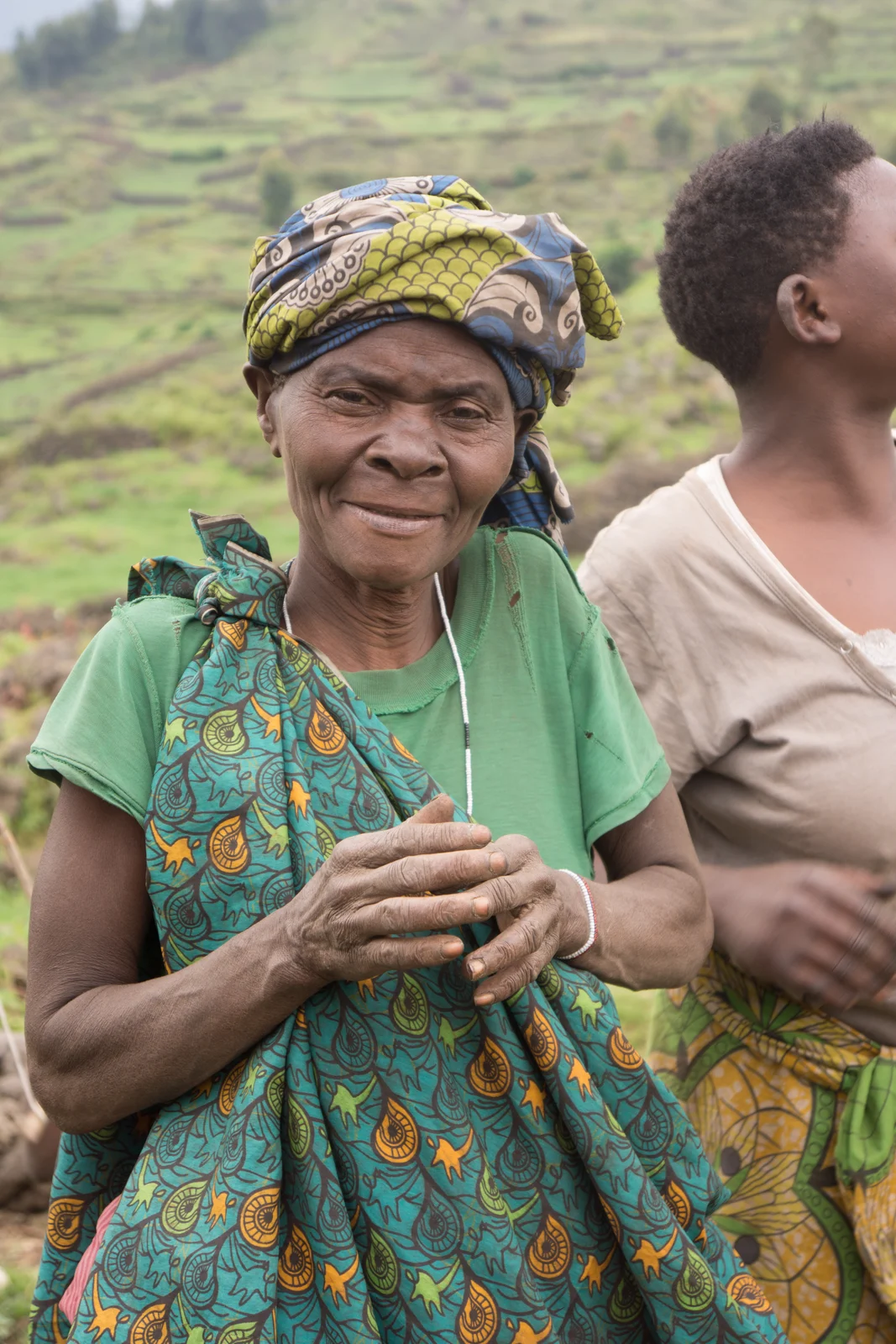
Woman identified by the photographer as Batwa in Kisoro, Uganda, wearing a green shirt and patterned headwrap and holding her hands together, with another person partly visible beside her.
A particular woman identified as Batwa by photographer Fanny Schertzer, Kisoro, 19 March 2015. Her personal name is not supplied; this portrait does not define the appearance or dress of all Batwa people.
Overview
Batwa communities in southwest Uganda have historical relationships with the Bwindi, Mgahinga and Echuya forests and present lives extending beyond those territories. United Organisation for Batwa Development in Uganda (UOBDU) places these communities within a wider Great Lakes context, but this profile does not treat all people called Batwa or Twa across different countries as one identical social setting. Its account connects forest exclusion with livelihood loss and marginalisation. The significance of that history is retained as the organisation presents it, without converting its older population estimates or undated poverty proportions into current statistics.
Batwa-directed organising is itself an important part of contemporary community life. UOBDU describes its establishment in 2000 with support from Forest Peoples Programme, and identifies land rights, literacy, education, livelihoods and institutional development as connected priorities. Its account describes a general assembly electing a board from the membership. These arrangements identify a particular organisation’s means of collective participation, rather than a government speaking for every Batwa person. The organisation’s stated purpose includes equal standing with other Ugandan citizens: cultural identity and national citizenship are therefore distinct dimensions, rather than competing classifications.
The Rushaga Batwa Indigenous Empowerment Organisation presents another locally rooted initiative. Its account names Julius Tumwikirize, a Mutwa, as founder in December 2019, with a focus on children’s education and cultural heritage in Kisoro. The organisation describes community visits and a Batwa council deciding priorities for funds. Its cultural-centre page records securing land in October 2022 and employing community members to share inherited stories. It names Bujuki and Nyakatwakazi as elders associated with the site. Holiday programmes bring Batwa children into contact with older knowledge, while visitor tours serve a different audience. The centre is a particular educational setting, not a reconstruction of everyone’s present home.
School support shows that cultural continuity is also concerned with future opportunities. The Rushaga organisation’s education page describes partnerships with schools serving Batwa and Bakiga children, including assistance with meals, uniforms, books and facilities. Its Rushaga Community School account records support for water provision and a kindergarten building, while identifying continued study beyond primary education as a financial challenge. The Nkuringo account separately describes teaching for Batwa children and Congolese refugee families and an ambition to expand provision. Reported assistance and proposed expansion are kept distinct. Together these sources document people organising schooling, representation and heritage transmission in response to changing circumstances, rather than reducing Batwa life to a forest past.
History & identity
A regional living-community account; organisational dates describe institutions, not the origin of Batwa identity. Wider Twa and Batwa usages require separate local documentation.
Sources & representation
UOBDU supplies its own institutional and regional accounts; Rushaga BIEO records named leadership and education/heritage work. Programme claims are attributed, with undated numerical estimates excluded.
Selected bibliography
Documented works and useful reading. This is not a list of every appearance.
- 01
About the Batwa
Complete regional account read; southwest forest relationships and exclusion. Old numerical estimates excluded.
- 02
Welcome
Complete institutional overview read; foundation, priorities and elected membership structure. Current board names omitted.
- 03
About us
Mission, About Us and council statements read; named founder and local priorities.
- 04
Cultural Center
Complete centre account read; land date, named elders and educational audiences. No practices or medicinal instructions copied.
- 05
Education
Complete three-school account read; support distinguished from needs and planned expansion.
Language & cultural connections
Source-supported language and cultural connections have not yet been compiled for this profile.
References
Sources supporting this profile. Linked pages have their own scope and editorial standards.
- Community regional accountAbout the BatwaResearch access: 2026-10-05
- Community institutional self-descriptionWelcomeResearch access: 2026-10-05
- Community-led institutional accountAbout usResearch access: 2026-10-05
- Community heritage programmeCultural CenterResearch access: 2026-10-05
- Community school programmeEducationResearch access: 2026-10-05
Image credits
Contextual community portrait photographWoman identified by the photographer as Batwa in Kisoro, Uganda, wearing a green shirt and patterned headwrap and holding her hands together, with another person partly visible beside her.
A particular woman identified as Batwa by photographer Fanny Schertzer, Kisoro, 19 March 2015. Her personal name is not supplied; this portrait does not define the appearance or dress of all Batwa people.