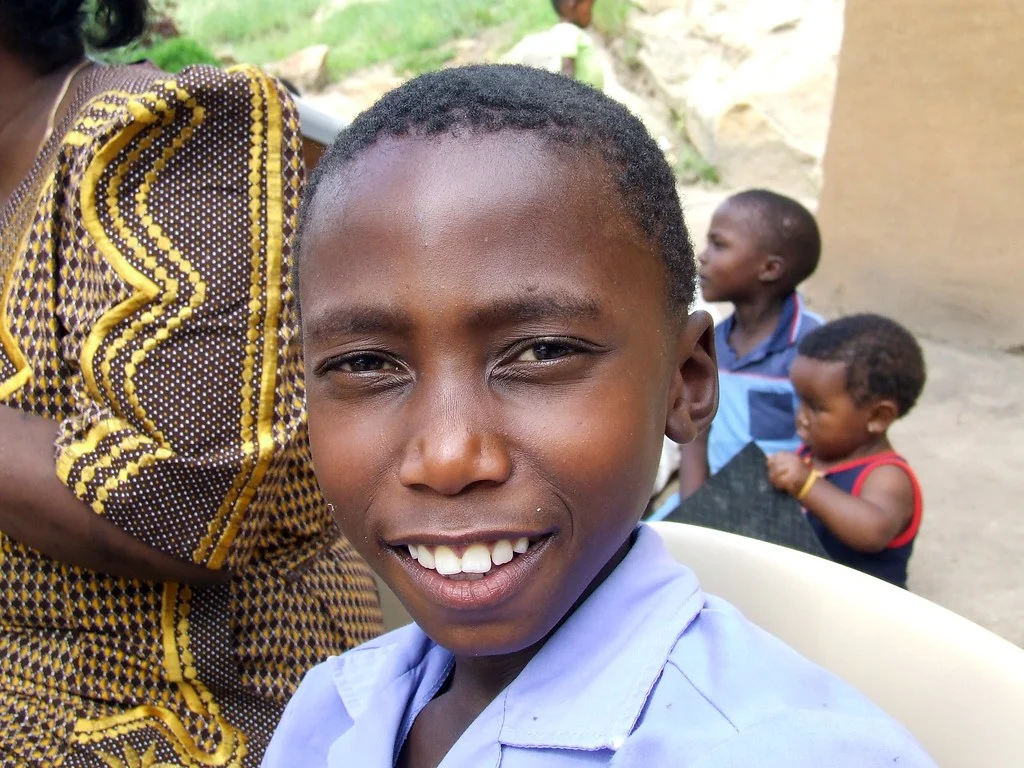
Fihliwe Morake, identified by photographer Michael Denne as a Basotho schoolboy, in a smiling 2006 portrait
Michael Denne identifies the sitter as Fihliwe Morake, a Basotho schoolboy photographed during a visit in March 2006. This is a particular person at that time, rather than a representative appearance for Basotho communities. The identities of the other people in the background are not specified.
Overview
Basotho cultural relationships extend across Lesotho and South Africa and are expressed through language, arts and community organisations. Mara a Basotho’s own account addresses people in both countries and welcomes interested participants beyond those settings. It dates the association’s establishment to 4 November 1996 and describes its purpose as protecting cultural interests and sustaining heritage. Its stated programme includes arts, archives, museums and leadership education. It also presents itself as independent of religious and party-political allegiance and explicitly inclusive. These are the association’s commitments; joining it is not a condition of Basotho identity, and its aims are not a survey of every person’s affiliations.
In Lesotho, Morija Museum & Archives connects collections and research with contemporary creative education. Its institutional history credits Queen ’Mamohato’s initiative in securing support for permanent facilities, with the archival building constructed in 1988. The museum, Morija Arts Centre and The Hub form a local cultural precinct. The arts centre’s exhibitions and workshops support locally made work and training; The Hub’s programmes include computer literacy, photography, animation and film-making for young people. These activities show heritage work using contemporary media as well as older collections. The account identifies particular institutions and programmes, rather than reducing Basotho culture to a fixed historical display.
Morija’s archive account makes its documentation history visible. It is a repository for the Paris Evangelical Missionary Society and its successor church institutions, alongside a specialist library concerning Lesotho and southern Africa. French, Sesotho and English collections include newspapers, government records, photographs, maps, missionary correspondence and books. Sesotho material includes Leselinyana and published music by composers such as J. P. Mohapeloa. This mixture requires attention to who produced a record: missionary and colonial documentation does not automatically speak for the communities described. Phased digitisation has involved several partners, while the archive distinguishes available digitised material from further access dependent on facilities and resources.
Across the border, the Basotho Cultural Village in Qwaqwa presents a different educational setting. Its government account dates the opening to 20 October 1994 and locates the open-air museum in Golden Gate National Park. Huts and displayed belongings are arranged to interpret changing architectural and household settings over time, with actors demonstrating selected activities. The same institution supports crafts sales, exhibitions, workshops and cultural competitions involving school, church, youth and adult groups. This is a curated programme with multiple audiences and participants. Its historical sequence should be read as museum interpretation, not as evidence that present Basotho households all follow the staged arrangements.
History & identity
Community and institutional accounts locate selected Basotho cultural work in Lesotho and South Africa; association and museum dates describe organisations rather than the beginning of cultural identity.
Sources & representation
A community organisation, Morija museum and archive accounts, and a complete two-page Free State museum document provide distinct contemporary and documentary perspectives.
Selected bibliography
Documented works and useful reading. This is not a list of every appearance.
- 01
Mara A Basotho
Complete organisational mission and objectives read; association membership, identity and institutional aims separated.
- 02
Morija Museum & Archives
Complete introductory history and highlights read; arts centre and youth digital work used, outdated completion plan excluded.
- 03
The Morija Archives
Complete archive body read; missionary records, Sesotho collections and phased digitisation distinguished; no individual book inspected.
- 04
Basotho Cultural Village
Complete two-page account read; opening, staged architectural history and crafts/workshops used; healing claims and protocols excluded.
Language & cultural connections
Source-supported language and cultural connections have not yet been compiled for this profile.
References
Sources supporting this profile. Linked pages have their own scope and editorial standards.
- Community cultural organisation self-descriptionMara A BasothoResearch access: 2026-10-05
- Community-linked museum institution accountMorija Museum & ArchivesResearch access: 2026-10-05
- Archive provenance and access accountThe Morija ArchivesResearch access: 2026-10-05
- Government living-museum accountBasotho Cultural VillageResearch access: 2026-10-05
Image credits
Contextual community portrait photographFihliwe Morake, identified by photographer Michael Denne as a Basotho schoolboy, in a smiling 2006 portrait
Michael Denne identifies the sitter as Fihliwe Morake, a Basotho schoolboy photographed during a visit in March 2006. This is a particular person at that time, rather than a representative appearance for Basotho communities. The identities of the other people in the background are not specified.