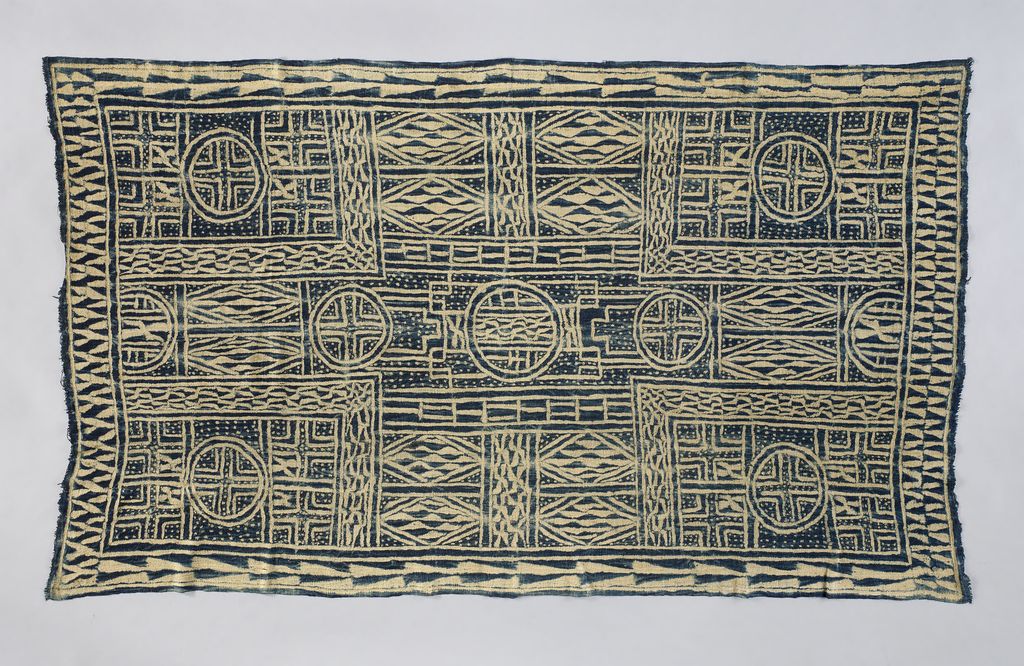
Complete cotton-and-dye n’dop wrapper attributed probably to a Bamum artist, Cameroon Grassfields, before 1952, Princeton University Art Museum 2021-46
This n’dop wrapper is made of cotton and dye. The museum attributes it probably to a Bamum artist in Cameroon’s Grassfields and dates it to the first half of the twentieth century, before 1952. The photograph retains its full border and geometric composition. The attribution remains qualified; this particular historical textile is not a portrait of present-day Bamum communities or a universal dress pattern.
Overview
Bamum communities in Cameroon are represented here through writing, archives and public cultural institutions, particularly around Foumban and the West Region. The Library of Congress uses Bamum alongside the spellings Bamoum, Bamun, Bamoun and Mum. Its research guide places the writing system developed under Sultan Ibrahim Njoya in the late nineteenth century within history, literature, art and geography. The script is an important heritage resource, but its development is not the beginning of the people themselves. The guide also describes a manuscript map acquired in 2021, illustrating how historical geographical work can enter a modern research collection.
Charles Riley's September 2006 report records collaboration with palace representatives, script users and the Bamum Scripts and Archives Project during a visit to Foumban. Museum curator Oumarou Nchare co-directed the project, whose participants examined manuscripts, assessed their condition and transcribed material. Riley distinguishes the Bamum language from Shümom, an artificial language associated with Njoya: the script could serve both. Work on computer encoding therefore involved decisions about older script phases, variable spellings and character ordering, rather than merely photographing an alphabet. The report names local collaborators and presents preservation as work requiring their knowledge and judgement.
A British Library catalogue record provides a smaller, concrete archival witness. Item EAP051/1/2/828 describes early notes for the Bamum Saa’ngam, a work concerning Bamum history and culture. The undated draft is catalogued as one leaf with two pages, written in pencil using Akauku Nyiet; the record distinguishes that script from the later Akauku Mfemfe used in the final work. It locates the original material in the palace archives at Foumban. This is evidence about an identified document and its preservation context. The catalogue description does not substitute for reading its contents, and the draft is not assigned an invented date.
The public UNESCO account of Nguon offers a different perspective on relationships between the Mfon, or monarch, and the Bamoun community. Inscribed on the Representative List in 2023, Nguon is described as supporting dialogue and accountability through community feedback and public consideration of governance, alongside collective celebrations. UNESCO identifies family and group transmission as well as radio and educational institutions. These public purposes connect cultural continuity with discussion of leadership, rather than presenting heritage solely as archived objects. The inscription date records an international recognition; it neither establishes the origin of Bamum identity nor proves a present legal or political outcome.
History & identity
Writing-system history and institutional recognition dates are distinct from the origin of Bamum communities.
Sources & representation
A library guide, named technical field report, item catalogue and public heritage account.
Selected bibliography
Documented works and useful reading. This is not a list of every appearance.
- 01
Bamum Script: An African Writing System
Complete indexed introduction read; thematic guide, no linked collection inspection.
- 02
Report on work with the Bamum script in Cameroon
Complete four-page report read; collaboration and language/script distinctions.
- 03
Early notes for the Bamum Saa’ngam: EAP051/1/2/828
Complete catalogue record read; manuscript itself not read.
- 04
Nguon: governance and associated expressions in the Bamoun community
Complete indexed public element body read; no linked nomination, film or ritual instructions.
Language & cultural connections
These connections link languages or specific cultural works and institutions; they do not establish biological ancestry or ethnic identity.
Bamum Scripts & Archives Project
Riley documented palace-project collaboration with local script users on manuscript preservation and encoding in 2006.
References
Sources supporting this profile. Linked pages have their own scope and editorial standards.
- Library research guideBamum Script: An African Writing SystemResearch access: 2026-10-05
- Primary technical field reportReport on work with the Bamum script in CameroonResearch access: 2026-10-05
- Institutional archive catalogueEarly notes for the Bamum Saa’ngam: EAP051/1/2/828Research access: 2026-10-05
- Public heritage documentationNguon: governance and associated expressions in the Bamoun communityResearch access: 2026-10-05
Image credits
Contextual cultural object photograph with qualified attributionComplete cotton-and-dye n’dop wrapper attributed probably to a Bamum artist, Cameroon Grassfields, before 1952, Princeton University Art Museum 2021-46
This n’dop wrapper is made of cotton and dye. The museum attributes it probably to a Bamum artist in Cameroon’s Grassfields and dates it to the first half of the twentieth century, before 1952. The photograph retains its full border and geometric composition. The attribution remains qualified; this particular historical textile is not a portrait of present-day Bamum communities or a universal dress pattern.