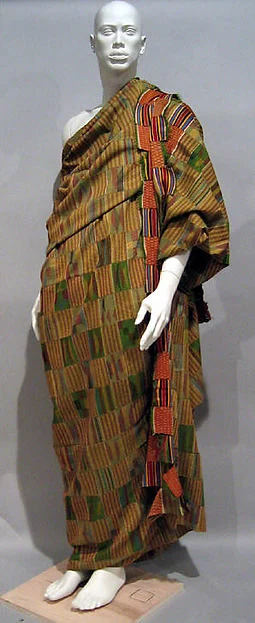
Nineteenth-century Asante-Akan man’s kente cloth displayed on a museum mannequin, Met accession 1972.56.1
The photograph shows a nineteenth-century kente cloth catalogued from Kumasi, Ghana, displayed on a museum mannequin. Its narrow woven strips are joined into a larger wrap. The mannequin is a display support, not a portrait of an Asante person; this one garment does not stand for the dress of every member of the living community.
Overview
Asante are a living people associated with Asanteman and Kumasi in Ghana, with communities abroad. Their identity cannot be reduced to the geographical Ashanti Region, a museum collection or membership in a particular association. Manhyia Palace Museum describes itself as a place for preserving and sharing Asanteman’s political, social and spiritual history. Its building was constructed in 1925 as the residence of Agyeman Prempeh I and later used by his successors. The museum records restoration and inauguration in 1995. This building history supplies a concrete institutional chronology; it is not a date when Asante identity began or evidence that all individuals relate to royal institutions in the same way.
Royal regalia carry histories of skill, authority and displacement. The British Museum documents jewellery, insignia and emblems associated with the Asantehene and court officials, made using several forms of goldwork. It explicitly connects many holdings with British looting at Kumasi during nineteenth-century wars and with coerced indemnity payments. Its account treats these objects as culturally and spiritually significant to Asante people, rather than merely valuable raw material. In January 2024, it announced a partnership with Manhyia Palace Museum involving a long-term loan to Kumasi. A loan and cultural collaboration should be distinguished from permanent restitution, and the documented history of a collection from the history of every Asante object.
Contemporary making continues alongside work on historical collections. The V&A describes Unity as a collaboration involving Asante royal goldsmith Nana Poku Amponsah Dwumfour, British Ghanaian artist Emefa Cole and Amankwaa Opoku Benjamin. Its account identifies a gold circle and intertwined leaves above a bronze tree, with porcupines among the sculpture’s symbols. It connects the design to cooperation and Asante visual language, and describes production involving workshops in Kumasi and London. These are credited makers and a particular artwork, not a fixed style that all Asante artists must follow. The project also shows historical metalworking knowledge participating in contemporary international practice.
Diaspora institutions combine cultural transmission with practical mutual support. The Asanteman Association of North America’s mission lists teaching young people about heritage, social networking and workshops covering cultural traditions alongside health, employment, immigration and other everyday concerns. It also aims to support educational and social programmes in Asanteman and to foster exchanges with other communities. These are the organisation’s stated aims, not proof that each programme has reached every member or that it speaks for all Asante abroad. Together, community organising, museum work and credited artistic collaboration document a living range of relationships with heritage, distinct from nationality, institutional membership and the boundaries of a historical kingdom.
History & identity
A living community overview keeping Asanteman’s royal and historical institutions distinct from modern geographical regions, citizenship and diaspora membership. Museum construction and association programmes do not date the origin of the people.
Sources & representation
Manhyia’s institutional history, the British Museum’s collection-provenance statement, a credited V&A artistic project and ACONA’s complete mission are used for their specific scopes. The association’s copied encyclopaedic kingdom-history page is not treated as primary historical research.
Selected bibliography
Documented works and useful reading. This is not a list of every appearance.
- 01
The museum building
Complete indexed building section read; 1925 residence and 1995 museum conversion documented.
- 02
Asante Gold Regalia
Complete indexed collection and partnership sections read; looting, indemnity and 2024 loan distinguished.
- 03
Unity: artistic collaboration
Complete artwork, makers and cooperation sections read; the displayed 29 October 2025 update precedes the 5 October 2026 access date.
- 04
Aims, mission and objectives
Complete aims read; heritage education and mutual support retained as organisational objectives.
Language & cultural connections
These connections link languages or specific cultural works and institutions; they do not establish biological ancestry or ethnic identity.
Asanteman Council of North America (ACONA)
ACONA lists member Asanteman associations in the United States and Canada. Association membership does not represent every Asante person.
References
Sources supporting this profile. Linked pages have their own scope and editorial standards.
- Community museum self-descriptionThe museum buildingResearch access: 2026-10-05
- Museum collection provenanceAsante Gold RegaliaResearch access: 2026-10-05
- Museum maker documentationUnity: artistic collaborationResearch access: 2026-10-05
- Community institutional self-descriptionAims, mission and objectivesResearch access: 2026-10-05
Image credits
Contextual cultural object photographNineteenth-century Asante-Akan man’s kente cloth displayed on a museum mannequin, Met accession 1972.56.1
The photograph shows a nineteenth-century kente cloth catalogued from Kumasi, Ghana, displayed on a museum mannequin. Its narrow woven strips are joined into a larger wrap. The mannequin is a display support, not a portrait of an Asante person; this one garment does not stand for the dress of every member of the living community.