Arbëreshë cultural communities - AI-generated contextual illustration.
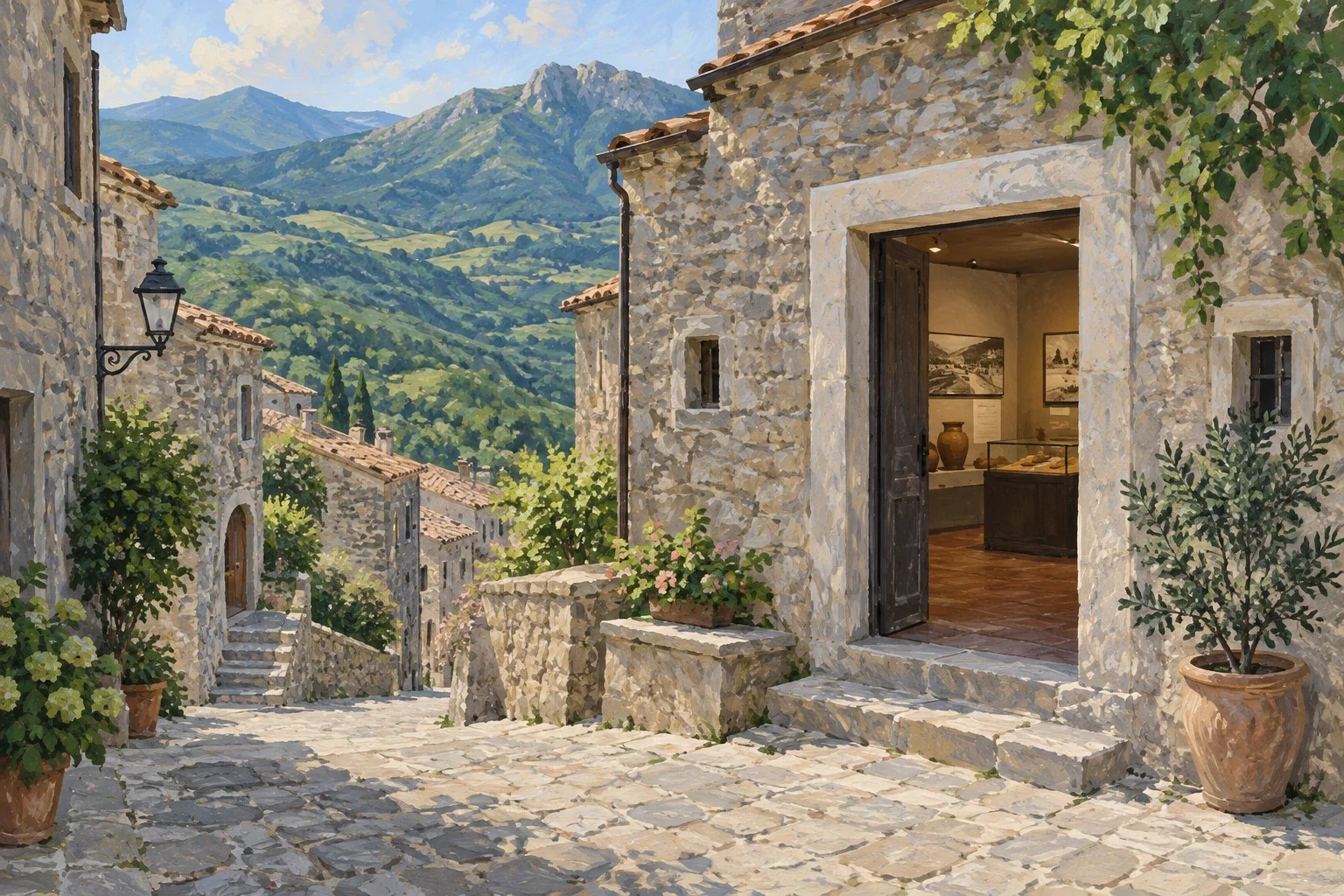
AI-generated contextual illustration evoking a museum approach in an Arbëreshë village, inspired by San Paolo Albanese's urban and rural context. Lane, doorway, displayed pictures, furnishings and mountain details are imagined; not the actual museum façade or photographic proof.
Overview
Arbëreshë cultural communities have histories connected to Albanian migrations into southern Italy. Mario Gandolfo Giacomarra's institutional research abstract discusses settlement in Sicily and Calabria in the fifteenth and sixteenth centuries, and the relationship between historical narrative, remembered myth and cultural and religious identity. This overview uses the Arbëreshë name employed by local museums, while avoiding the assumption that every community has an identical migration story or set of practices.
The museum at San Paolo Albanese in the Pollino area describes itself through territory, rural landscape, inhabited village and community memory. Its thematic areas include history and myth, domestic life, family organisation, work, ritual and social life. The institution explicitly links preservation with producing new culture. This framing gives living communities a future as well as a past; it should not be read as evidence that people's present lives remain unchanged from a historical display.
MUSARB in Piana degli Albanesi offers a distinct local account. It connects migration history with Greek-Byzantine religious heritage, continuing icon production, clothing worn for weddings and festivities, craft and domestic material culture. These particularities belong to its community account rather than every Arbëreshë locality. The accompanying imagined stone village lane instead draws on San Paolo Albanese's urban and landscape context. It depicts no invented representative person, costume or rite. Its doorway, buildings and mountain view are fictional details, not proof of the actual museum façade.
History & identity
Selected Arbëreshë communities in southern Italy, especially San Paolo Albanese and Piana degli Albanesi.
Sources & representation
Selected authoritative cultural-institution accounts; source-specific findings retained in cache.
Selected bibliography
Documented works and useful reading. This is not a list of every appearance.
- 01
Museo della Cultura Arbëreshe di San Paolo Albanese
Selected institutional account read for this overview; not a complete bibliography.
- 02
Museo della Cultura Arbëreshe
Selected institutional account read for this overview; not a complete bibliography.
- 03
La vicenda arbereshe tra storia e mito
Institutional abstract read; article not fully read.
Language & cultural connections
Source-supported language and cultural connections have not yet been compiled for this profile.
References
Sources supporting this profile. Linked pages have their own scope and editorial standards.
- Museo ArbëreshëMuseo della Cultura Arbëreshe di San Paolo AlbaneseResearch access: 2026-10-10
- MUSARB / Comune di Piana degli AlbanesiMuseo della Cultura ArbëresheResearch access: 2026-10-10
- Mario Gandolfo Giacomarra / Università degli Studi di PalermoLa vicenda arbereshe tra storia e mitoResearch access: 2026-10-10
Image credits
AI-generated contextual illustrationArbëreshë cultural communities - AI-generated contextual illustration.
AI-generated contextual illustration evoking a museum approach in an Arbëreshë village, inspired by San Paolo Albanese's urban and rural context. Lane, doorway, displayed pictures, furnishings and mountain details are imagined; not the actual museum façade or photographic proof.