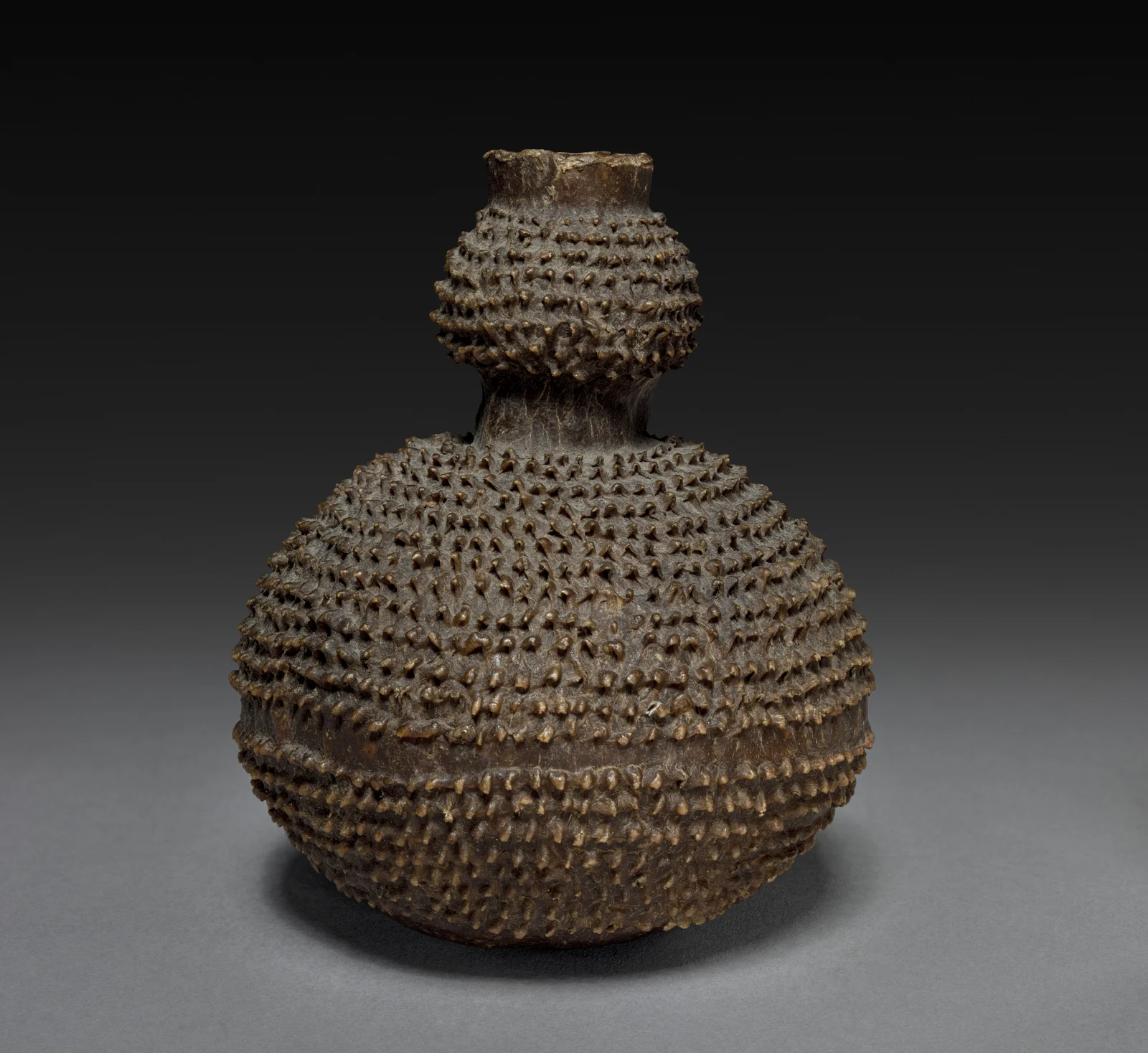
Dark brown double-bulbed snuff container with dense rows of small protrusions and an irregular open neck, catalogued as the work of a Xhosa-style maker.
Snuff container attributed to a Xhosa-style maker, late nineteenth or early twentieth century. A specific museum object, not a portrait or a representation of every contemporary amaXhosa community.
Overview
This initial account of amaXhosa cultural communities follows selected language scholarship and Eastern Cape museum interpretation. It does not equate speaking isiXhosa with one citizenship, one institutional membership or an identical personal history. The Amathole Museum's Xhosa Gallery is described as documenting social and cultural change from pre-colonial times into the present. Its wider exhibitions bring local political resistance, missionary education and publishing into the history of Qonce. This is an institution's presentation of a particular region, not a complete description of all communities. The gallery account's concern with recording oral knowledge belongs to its curatorial framing, rather than proof that living knowledge must inevitably disappear.
Pamela Maseko's 2011 doctoral abstract offers an explicitly argued account of language and education. It examines the development of isiXhosa terminology across missionary, apartheid and post-apartheid contexts, asking how terminology can support study in fields often taught through English. Maseko argues for collating and revising earlier terminology and for sustained classroom and lecture-hall use of African languages. Her account locates language development within changing institutions and political settings, rather than suggesting that a language cannot express new knowledge. The complete abstract and repository metadata were read for this profile; the thesis's full analyses and terminology lists remain outside its reading scope.
Rhodes University's African Language Studies introduction documents an ongoing institutional ambition: developing isiXhosa for use across disciplines and educational levels. Its public objectives connect scholarship with first- and second-language programmes, multilingualism, student access and retention, and multimedia facilities. These aims place language work within contemporary higher education as well as literary study. They are an institutional statement of purpose, not an evaluation demonstrating that every aim has been achieved. The distinction between a language programme and cultural identity also matters: enrolling in a course or researching isiXhosa does not establish a person's community affiliation, and community members need not share one educational pathway.
A Pan South African Language Board statement issued on 4 September 2023 shows another form of public language work. It announced a commemoration beginning at Lovedale Press, continuing to the isiXhosa lexicography unit at Fort Hare and concluding at the Eastern Cape legislature. The statement linked publishing and dictionary work with concern about unequal opportunities for indigenous-language writers. Its bicentenary framing concerns a history of written documentation, not the age of spoken isiXhosa or the beginning of amaXhosa identity. This was a prospective announcement: the account records its planned route and purposes without claiming that the event or every proposed preservation strategy was subsequently completed.
History & identity
Written-language anniversaries describe documentation, not spoken-language or community origins.
Sources & representation
Two complete native institutional bodies, a complete doctoral abstract and a complete indexed statement.
Selected bibliography
Documented works and useful reading. This is not a list of every appearance.
- 01
Exhibitions
Complete native written body read; focal Xhosa Gallery and regional interpretation, no exhibits viewed.
- 02
Intellectualisation of African languages with particular reference to isiXhosa
Complete abstract and metadata read; full thesis and terminology lists not read.
- 03
African Language Studies
Complete public introduction/objectives read; linked programmes and research not inspected.
- 04
PanSALB to commemorate 200 years of isiXhosa in writing
Complete indexed 4 September statement read; announcement, not subsequent outcome.
Language & cultural connections
Source-supported language and cultural connections have not yet been compiled for this profile.
References
Sources supporting this profile. Linked pages have their own scope and editorial standards.
- Institutional documentation or attributed scholarly abstractExhibitionsResearch access: 2026-10-05
- Institutional documentation or attributed scholarly abstractIntellectualisation of African languages with particular reference to isiXhosaResearch access: 2026-10-05
- Institutional documentation or attributed scholarly abstractAfrican Language StudiesResearch access: 2026-10-05
- Institutional documentation or attributed scholarly abstractPanSALB to commemorate 200 years of isiXhosa in writingResearch access: 2026-10-05
Image credits
Contextual cultural object photograph with qualified attributionDark brown double-bulbed snuff container with dense rows of small protrusions and an irregular open neck, catalogued as the work of a Xhosa-style maker.
Snuff container attributed to a Xhosa-style maker, late nineteenth or early twentieth century. A specific museum object, not a portrait or a representation of every contemporary amaXhosa community.