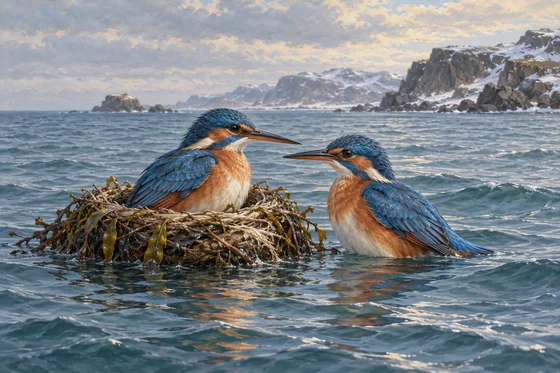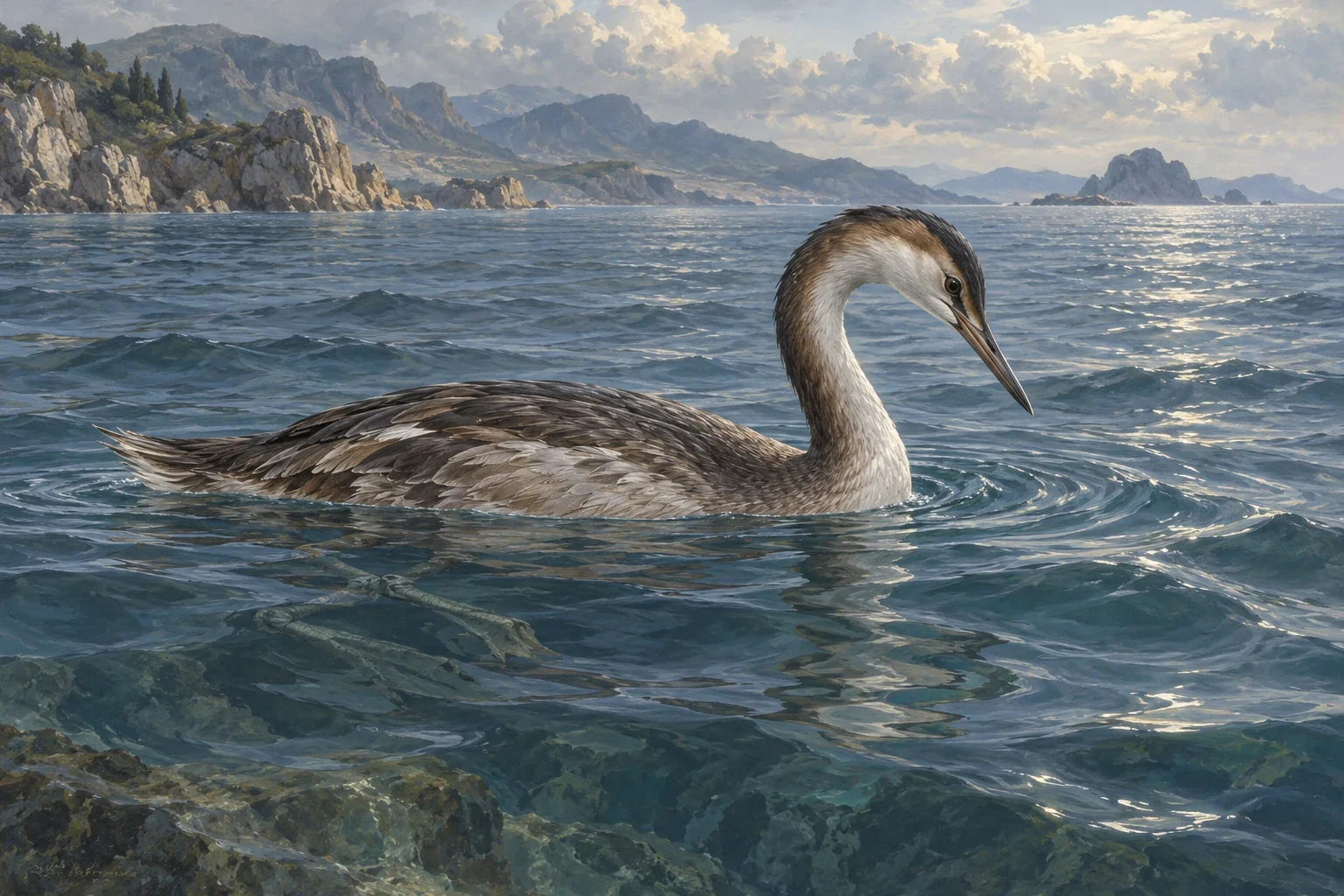
AI-generated illustration of Æsacus after his change into a diving bird in Ovid. The long neck and aquatic setting follow the description; plumage, exact anatomy, quiet surface pose, coast and light are artistic interpretation. No modern species is asserted, and the image does not depict the preceding death or self-destructive action.
AI-generated illustration of Æsacus after his change into a diving bird in Ovid. The long neck and aquatic setting follow the description; plumage, exact anatomy, quiet surface pose, coast and light are artistic interpretation. No modern species is asserted, and the image does not depict the preceding death or self-destructive action.
Overview
Ovid introduces Æsacus through a bird pointed out beside the sea. An observer of the transformed Ceyx and Halcyone notices another swimmer and explains that this bird too was once a king’s son. The new story follows the previous pair’s enduring affection but has a different ending: the transformation preserves distress rather than restoring companionship. Æsacus is identified as Priam’s son and Hector’s brother, born to Alexirhoë, daughter of the river Granicus.
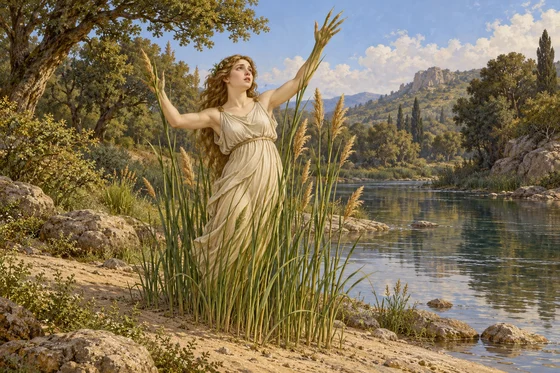
The young prince prefers mountains and fields to the royal court and crowded Troy. He has repeatedly sought Hesperie, daughter of Cebrenus, through the woods. When he sees her drying her hair beside her father’s stream, she runs away in fear and he pursues her. The narrative compares her flight to prey escaping a predator. It does not describe a reciprocal romance or an agreed courtship.
A snake concealed in the grass bites her foot during the flight, and she dies. Æsacus recognizes his responsibility for the circumstances: the snake inflicted the wound, but his pursuit caused the encounter. In grief he seeks death in the sea. Tethys intervenes, receives him gently and covers him with feathers, so that his attempt does not end his life. This rescue is not welcomed by the transformed prince; the account keeps his desire and the goddess’s action in conflict.
He repeatedly rises and plunges into the water, but his new plumage prevents the intended fatal fall. His sorrow explains his thinness, while the description emphasizes long legs, a long neck and a head held far from the body. The closing wordplay connects his name as a diving bird with the action of plunging. Riley calls the bird a didapper or diver; the selected passage does not securely identify a modern species or establish a scientific origin for its behaviour.
Riley’s explanation reports a substantially different account attributed to Apollodorus: another mother, a deceased wife named Sterope and a prophetic role in the Trojan family. It then gathers further conflicting reports about the prediction surrounding Paris’s birth. Those are commentary-mediated comparisons, not events silently added to Ovid’s Hesperie episode. The attached genealogical note also corrects the apparent straight ancestral sequence by distinguishing brothers from direct forebears. No complete family tree is inferred from the poetic list.
Origins & earliest records
Ovid, Metamorphoses XI, in Henry T. Riley’s English prose translation and commentary; retained George Bell & Sons edition1893.
Records & interpretation
XI Fable VIII,749–795, explanation and notes58–63; preceding complete Fable VII read as the frame. The complete selected narrative, synopsis, explanation and notes were read. Commentary variants are not independently collated against their named ancient authors.
Selected bibliography
Documented works and useful reading. This is not a list of every appearance.
- 01
Metamorphoses, Book XI, Fable VIII
XI Fable VIII,749–795, explanation and notes58–63; preceding complete Fable VII read as the frame. The1893 edition is distinguished from the earlier Riley translation.
Family & connections
A source-supported family tree or inspiration record has not yet been compiled for this profile. Related reading below indicates a connection in subject matter, not a proven lineage or creative influence.
References
Sources supporting this profile. Linked pages have their own scope and editorial standards.
- Public-domain literary witnessMetamorphoses XI — retained historical translation and commentaryResearch access: 2026-10-27
Image credits
AI-generated illustrationAI-generated illustration of Æsacus after his change into a diving bird in Ovid. The long neck and aquatic setting follow the description; plumage, exact anatomy, quiet surface pose, coast and light are artistic interpretation. No modern species is asserted, and the image does not depict the preceding death or self-destructive action.
AI-generated illustration of Æsacus after his change into a diving bird in Ovid. The long neck and aquatic setting follow the description; plumage, exact anatomy, quiet surface pose, coast and light are artistic interpretation. No modern species is asserted, and the image does not depict the preceding death or self-destructive action.