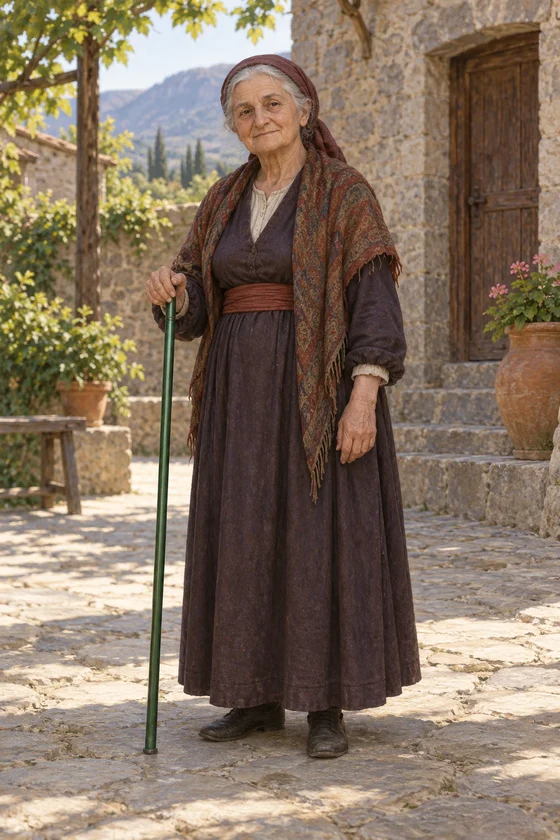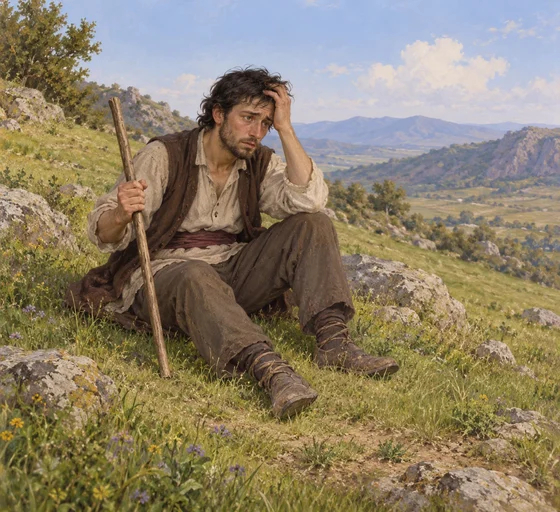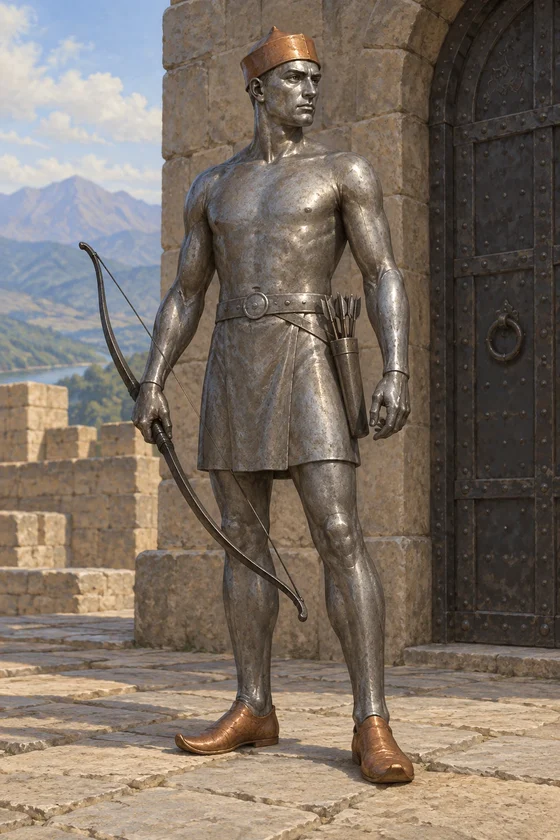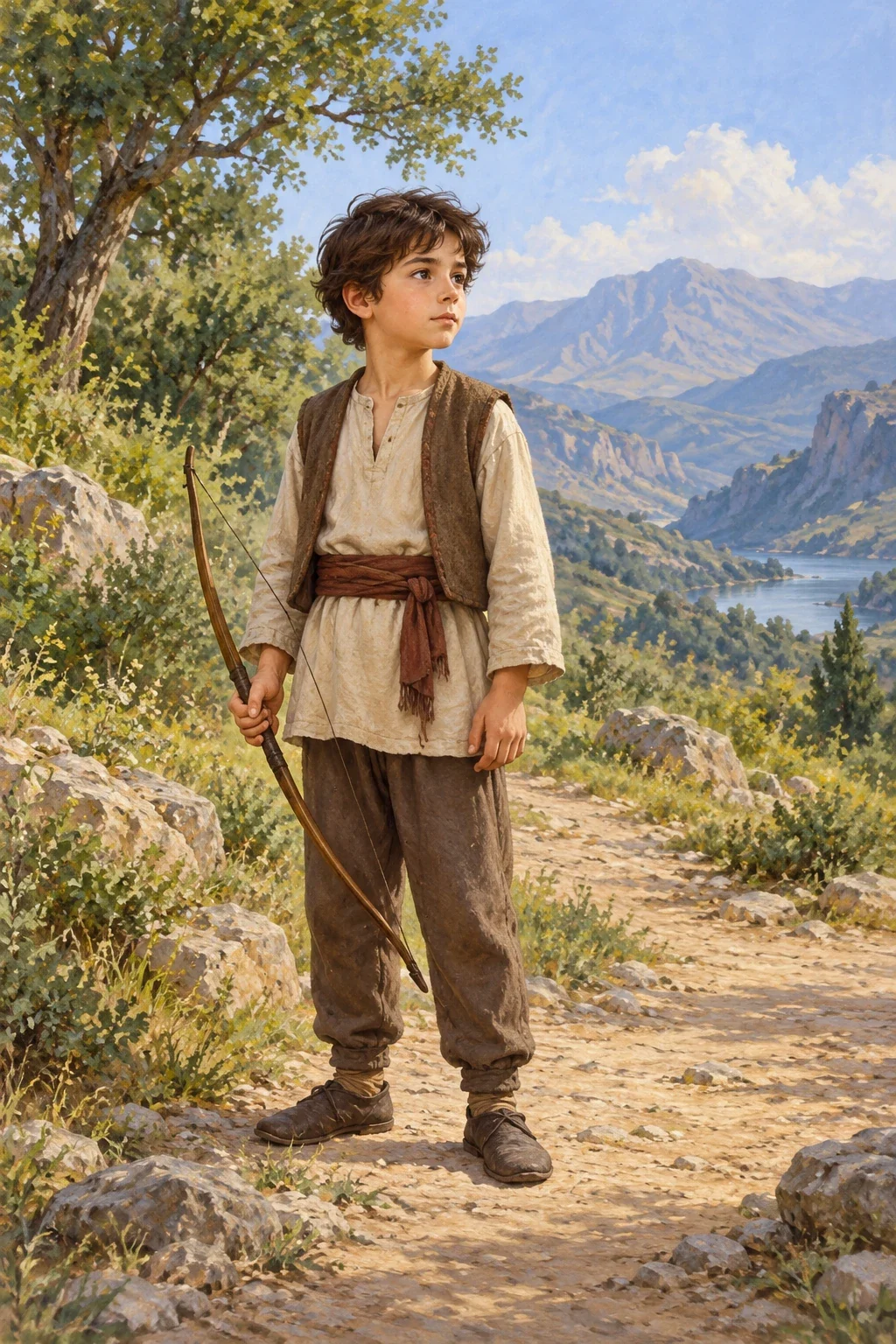
Portrayal of The Young Hunter of Macler’s Armenian Tale.
AI-generated portrayal of the tale’s opening child-state. Approximate age, appearance, clothing and landscape are imagined; no killed quarry is shown.
Overview
The unnamed hunter enters Macler’s L’heureux chasseur as a child with a bow. He gives a sparrow to the king and receives gold, then returns with larger quarry and wins further rewards. Jealous servants take half his gifts and propose a dangerous new task: supplying lion skins and elephant teeth to ornament a pavilion. The king accepts their suggestion without recognising its hostile purpose. Given a mount, the boy travels without knowing where to find the materials. The narration later also calls him a young man, but supplies no exact age or interval that would establish a detailed chronology of his growth.
He encounters a woman kneading dough and gains her protection by nursing from her. She says she would otherwise have eaten him; the act creates a maternal relationship instead of an ordinary hunting victory. Her forty sons return, detect a human presence and learn that he is now their brother. The narrator explicitly calls them demons. After hearing his difficulty, they ask for mules, wine and tools, then use these supplies to obtain the requested animal materials. The hunter’s success therefore depends on adopted kin who perform the major collection task; it is not evidence that he single-handedly defeats forty monsters or commands all demons.
When he returns, the servants attempt another trap by proposing that the king obtain the daughter of the king of the Indies for the pavilion. The hunter is sent with clothes, gold, a horse and weapons. His adventures on that journey are described only as incredible things, without a sequence the reader can reconstruct. He brings back the princess, and the king ultimately gives him both the pavilion and the opportunity to marry her. The royal comparison of her beauty to the sun is not treated here as proof that she is a solar being. The servants lose their position of advantage, and the hunter receives honours. The tale names neither his original family nor a permanent supernatural nature.
Origins & earliest records
TaleIV, L’heureux chasseur, in Macler’s 1905 French translation; source note identifies Hamov Hodov, p. 168.
Records & interpretation
Complete tale IV, pp. 50-56, including opening child-state, royal gifts, jealous servants, maternal adoption, forty demon brothers, second demand and final honours; source and pool-comparison notes read.
Selected bibliography
Documented works and useful reading. This is not a list of every appearance.
- 01
Contes arméniens
IV, L’heureux chasseur, pp. 50-56; antecedent source page168. Complete French tale and source framing retained; Armenian original not independently collated.
Family & connections
A source-supported family tree or inspiration record has not yet been compiled for this profile. Related reading below indicates a connection in subject matter, not a proven lineage or creative influence.
References
Sources supporting this profile. Linked pages have their own scope and editorial standards.
- Historical French translation of Armenian collected narrativesMacler, Contes arméniens (1905), original French textResearch access: 2026-10-18
Image credits
AI-generatedPortrayal of The Young Hunter of Macler’s Armenian Tale.
AI-generated portrayal of the tale’s opening child-state. Approximate age, appearance, clothing and landscape are imagined; no killed quarry is shown.