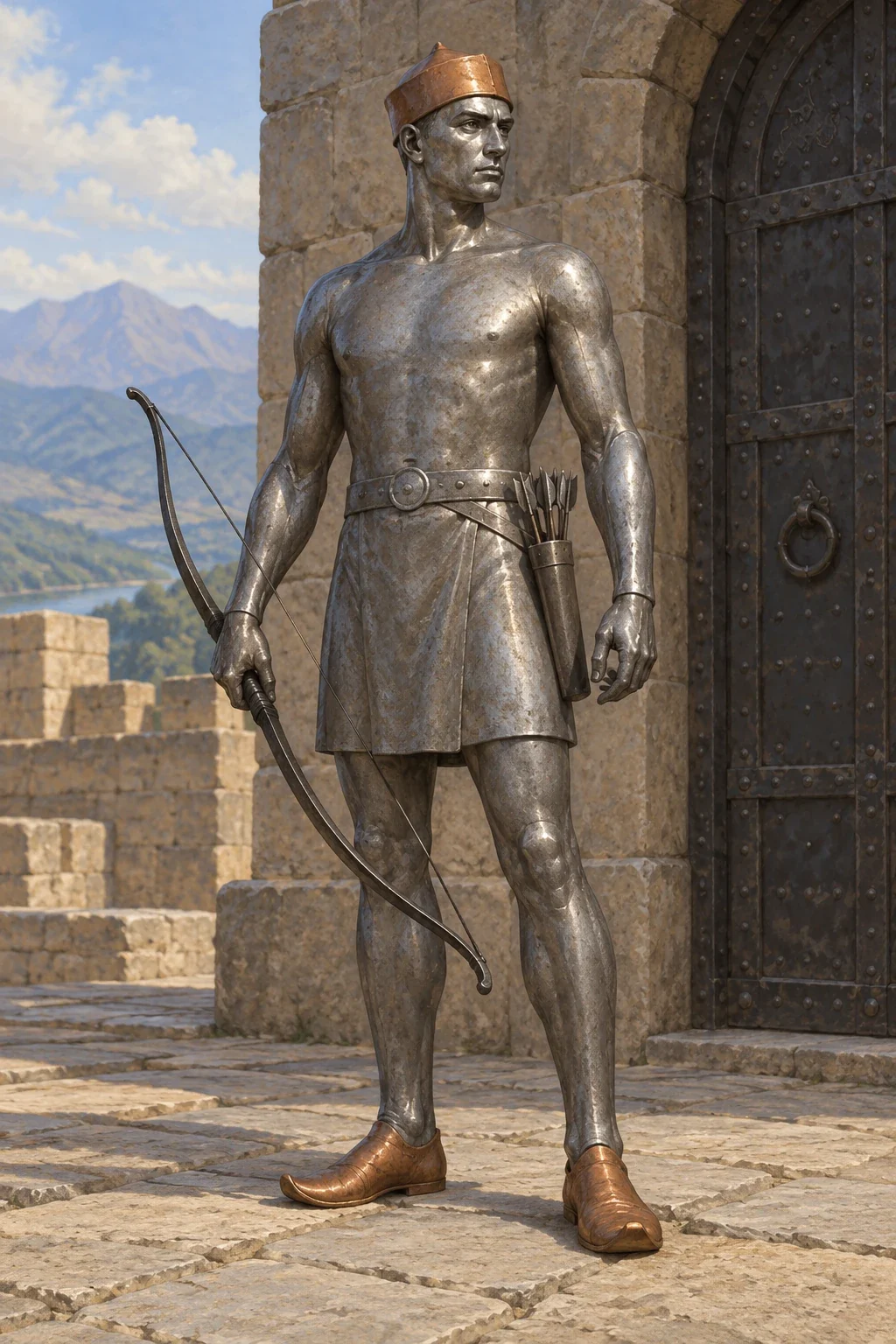
Portrayal of Khan Boghou (Macler’s Armenian Tale).
AI-generated portrayal from the historical narrative. Face, proportions, metal finish, bow styling and residence are interpreted; the steel body and copper cap/shoes follow the text.
Overview
Khan Boghou inhabits an ancient, heavily enclosed building of great stone blocks and iron. In Macler’s first Armenian tale, Badikan reaches it after exhausting his servants and treasure on a long expedition. The newcomer sees a man whose head and body are steel, with copper shoes and a copper cap; his bow and arrows are tempered iron, and the ground trembles under his steps. He detects human scent and threatens the intruder. Ordinary arrows and a sword cannot harm him. A sneeze throws Badikan into a field, yet Khan Boghou recognises his courage and offers him a place as a servant and hunter.
Despite his strength, he has repeatedly failed to seize the daughter of the king of the East. He sends Badikan to fetch her, but the princess loves Badikan and rejects becoming Khan Boghou’s partner. After she reaches his residence, she gains a delay before marriage and persuades him to reveal where his life is hidden. A white bull visits a white mountain spring; inside it is a fox, inside the fox a white mother-of-pearl box, and inside the box seven white sparrows. Khan Boghou identifies those birds with his soul, secrets and strength. His confidence rests on the supposed impossibility of overcoming each successive enclosure.
The princess secretly passes this knowledge to Badikan. By trapping the bull and reaching the nested birds, Badikan defeats an opponent his weapons could not directly injure. Khan Boghou feels the distant damage immediately and hurries toward the princess, but the destruction of the birds progressively disables and finally kills him. Badikan returns and marries her. The ending establishes the limit of the claimed immortality rather than confirming an indestructible metal species. His steel anatomy, copper accessories and external life belong to this individual in the translated telling, not a general description of Armenian monsters or a machine built by an inventor.
Origins & earliest records
Khan Boghou in tale I, Badikan et Khan Boghou, Macler’s 1905 French translation; original footnote cites Hamov Hodov, p. 121.
Records & interpretation
Complete tale I, printed pp. 11-22, including metal anatomy, meeting, captive princess’s intervention, nested soul account and ending; full original preface and Addenda retained.
Selected bibliography
Documented works and useful reading. This is not a list of every appearance.
- 01
Contes arméniens
I, Badikan et Khan Boghou, pp. 11-22; antecedent source page121. Complete French tale and source framing retained; Armenian original not independently collated.
Family & connections
A source-supported family tree or inspiration record has not yet been compiled for this profile. Related reading below indicates a connection in subject matter, not a proven lineage or creative influence.
References
Sources supporting this profile. Linked pages have their own scope and editorial standards.
- Historical French translation of Armenian collected narrativesMacler, Contes arméniens (1905), original French textResearch access: 2026-10-18
Image credits
AI-generatedPortrayal of Khan Boghou (Macler’s Armenian Tale).
AI-generated portrayal from the historical narrative. Face, proportions, metal finish, bow styling and residence are interpreted; the steel body and copper cap/shoes follow the text.