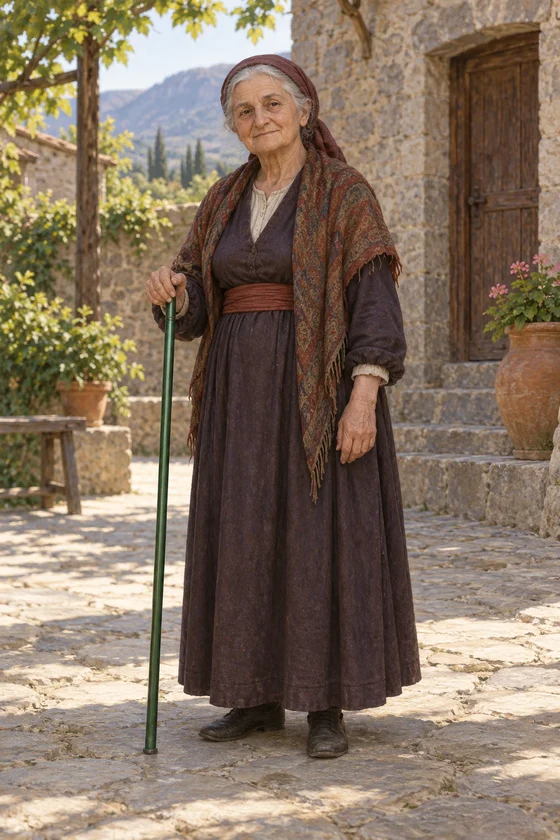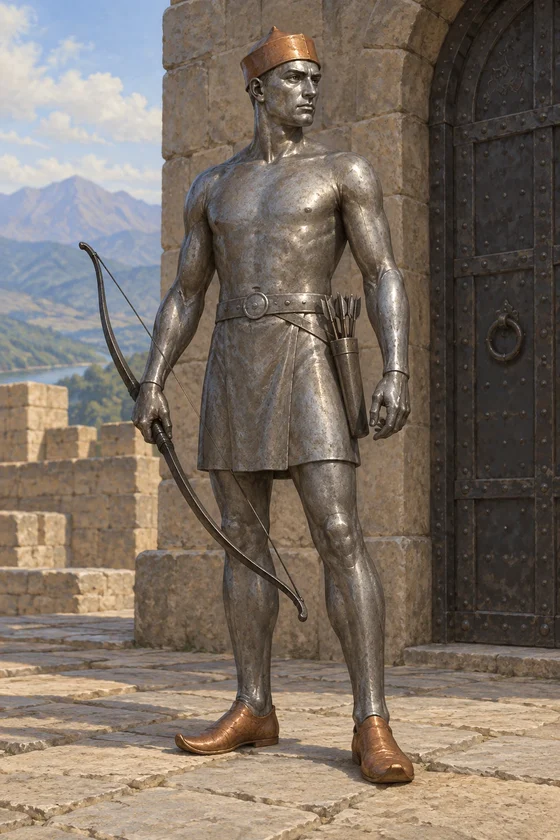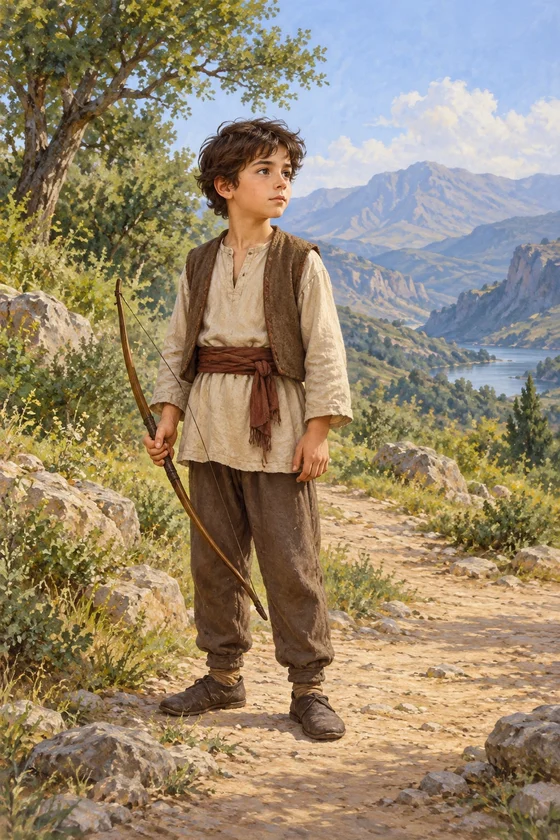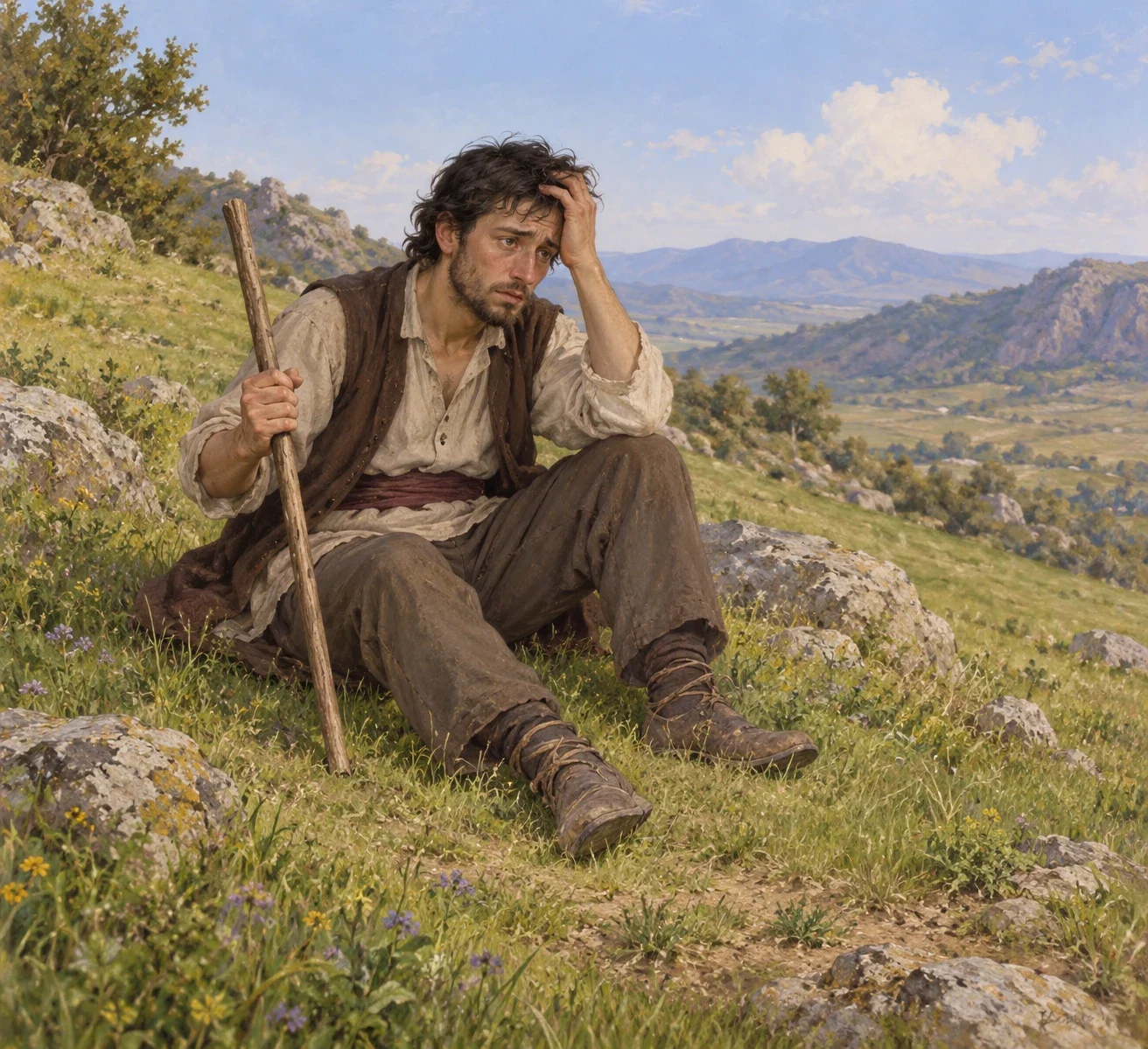
Portrayal of Tejigon (Macler’s Armenian Tale).
AI-generated portrayal from the historical narrative, before the seven-fly boast. Appearance, clothing and pasture staging are imagined.
Overview
Tejigon begins with two goats and a difficult cow, while his wife continually demands that he leave to earn money. He takes the cow and a stick and sets out, milking the animal when hungry and riding it when tired. In a pasture he crushes seven troublesome flies in a single action. Encouraged by this small success, he dictates a claim to a dervish that he has killed seven people with one hand, then fastens the written paper between the cow’s horns. The false wording matters: his later admirers read it as proof of victories over people, rather than the flies he actually killed.
Seven brothers find him asleep on their land. They interpret his presence as audacity and his trembling on waking as anger. Inviting him to become their elder brother, they give him honour and service. His anxious silence appears to them a sign of superior intelligence. He answers questions about his missing horse, weapons and servants with extravagant claims of self-sufficiency, and eventually accepts marriage to their sister. The narrative has already introduced a wife at the beginning but does not pause to resolve that earlier relationship. It presents the new alliance through the brothers’ admiration, without making Tejigon genuinely fearless.
Four rejected suitors combine their armies against the brothers. Tejigon initially hides; when finally summoned, he is carried into the enemy by a horse he cannot control. Observers mistake this uncontrolled charge for courage. Trying to save himself, he catches a tree’s branches, and the jolt uproots it; the narrator suggests that the tree was rotten. The enemy imagines that he means to wield it as a weapon and flees in disorder. His allies celebrate him, and the defeated men bring livestock and promise obedience. His success rests on a sequence of misunderstandings and accidents, not an explicitly magical body, exceptional training or a proven power to kill seven people with one blow.
Origins & earliest records
Tale XVI, Tejigon, in Macler’s 1905 French translation; its footnote identifies Hamov Hodov, p. 220, as the Armenian antecedent.
Records & interpretation
Complete Tejigon, pp. 120-126, from poverty and departure through the seven-fly inscription, adopted brotherhood, second marriage, battle misunderstanding and final gifts; full preface retained.
Selected bibliography
Documented works and useful reading. This is not a list of every appearance.
- 01
Contes arméniens
XVI, Tejigon, pp. 120-126; Armenian antecedent cited at p. 220. French translation and selected source context retained; no direct Armenian collation.
Family & connections
A source-supported family tree or inspiration record has not yet been compiled for this profile. Related reading below indicates a connection in subject matter, not a proven lineage or creative influence.
References
Sources supporting this profile. Linked pages have their own scope and editorial standards.
- Historical French translation of collected Armenian narrativesMacler, Contes arméniens (1905), original French textResearch access: 2026-10-18
Image credits
AI-generatedPortrayal of Tejigon (Macler’s Armenian Tale).
AI-generated portrayal from the historical narrative, before the seven-fly boast. Appearance, clothing and pasture staging are imagined.