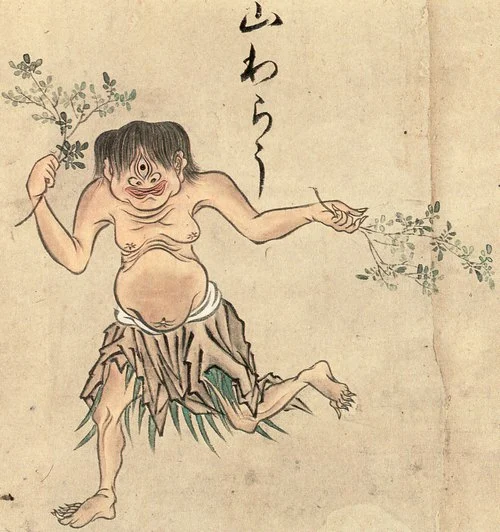
Yamawaro
Image associated with the exact linked encyclopedia article; consult credited file description for its interpretation.
Overview
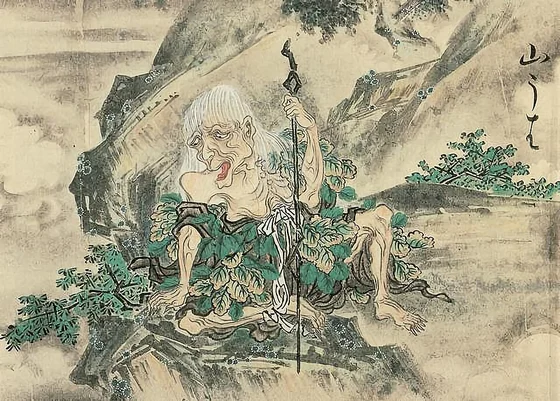
Yamawaro are mountain beings reported especially in western Japan and Kyushu. Descriptions can present them as hairy, childlike figures, with some accounts adding a single eye. Their relationship with humans is not purely hostile: stories describe help with work in the mountains, provided that the promised payment is respected. The creature belongs to the practical world of woods, labour and negotiated obligations.
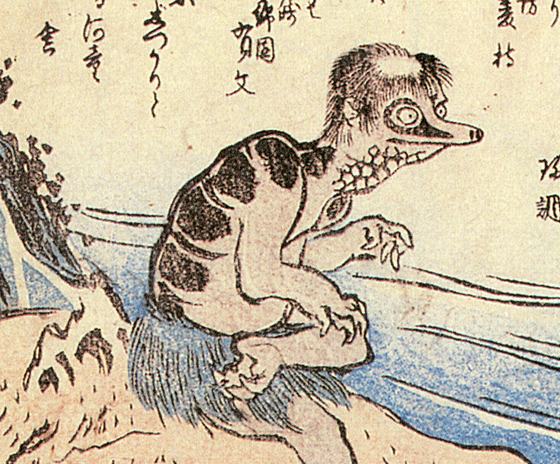
Some traditions connect yamawaro with kappa that have moved from water into the mountains, but this is a regional explanation rather than a universal seasonal biology. The Wakan Sansai Zue and later illustrated collections preserve differing appearances. Those differences are part of the record. A reader should distinguish the details of a printed illustration from what a particular storyteller said about assistance, food, bathing or mischievous interference.
Origins & earliest records
Selected illustrated witness: Toriyama Sekien's Gazu Hyakki Yagyō (1776). This is an attestation of the named representation, not a claim that the belief began in that year.
Records & interpretation
Historical prints and textual references establish an imagined being and its representation. The linked contextual article distinguishes the pictured form from regional accounts; these sources do not establish zoological existence.
Selected bibliography
Documented works and useful reading. This is not a list of every appearance.
- 01
Gazu Hyakki Yagyō
Selected historical witness; individual illustration now checked in the separately linked primary scan. This edition is not a claim of the earliest oral attestation.
Family & connections
A source-supported family tree or inspiration record has not yet been compiled for this profile. Related reading below indicates a connection in subject matter, not a proven lineage or creative influence.
Primary records and illustrations
Gazu Hyakki Yagyō
Volume 1, Yin (陰); digitized Smithsonian Libraries copy, 1805 edition. IIIF canvas index 13 (zero-based); GazuHyakkiyagyo1Tori_0014.jp2
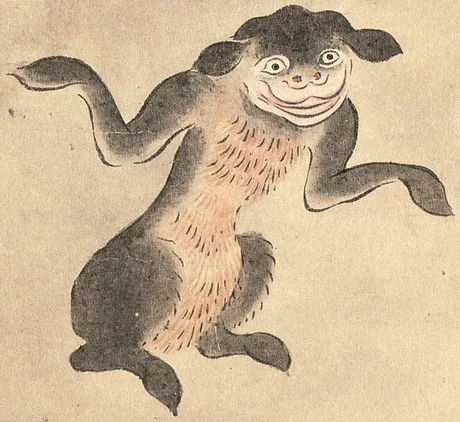
Named 山童; a hairy, one-eyed childlike creature stands on long legs beside a tree. Visual inspection of the digitized plate and its printed label; image URL is copied from the actual IIIF manifest, not a guessed leaf reference.
Encyclopedia background
An additional attributed reference, separate from the editorial profile above.
Read the open encyclopedia overview
Yamawaro (山童; or yamawarau) is a yōkai (spirit) said to appear in mountains in Western Japan, starting in the Kyūshū region. According to mythology, it is sometimes said that they are kappa that have come to dwell in the mountains.
Yamawaro are known by a number of different, similar terms; in Ashikita District, Kumamoto Prefecture, they are also known as yamawarō, yamamon, yamanto, yaman wakkashi (山の若い衆, "young person of the mountain") and yaman ojiyan (山の伯父やん, "mountain uncle"). In Kuma District in the same prefecture, they are also known as yaman-tarō (山ん太郎) or yamanbo (山ん坊).
The kanji for yamawaro can also be written as 山𤢖 (yamawaro). The sansō (山𤢖) is the name of the Chinese yōkai that this comes from.
Text from Wikipedia contributors, “Yamawaro”. CC BY-SA 4.0. Extracted introduction; formatting changed. Retrieved 5 October 2026. The source article may have changed since retrieval.
References
Sources supporting this profile. Linked pages have their own scope and editorial standards.
- Primary illustrated book / national-library recordNocturnal Procession of the Hundred Demons — historical editionResearch access: 2026-10-05
- National library / primary illustration contextTORIYAMA Sekien’s Illustrated Night Parade of the Demon HordeResearch access: 2026-10-05
- Secondary referenceYamawaro — contextual overview and bibliographyResearch access: 2026-10-05
- Primary illustrated plate / institutional digitizationGazu Hyakki Yagyō — directly inspected IIIF canvas index 13 (zero-based); GazuHyakkiyagyo1Tori_0014.jp2Research access: 2026-10-05
Image credits
Reference illustrationYamawaro
Image associated with the exact linked encyclopedia article; consult credited file description for its interpretation.