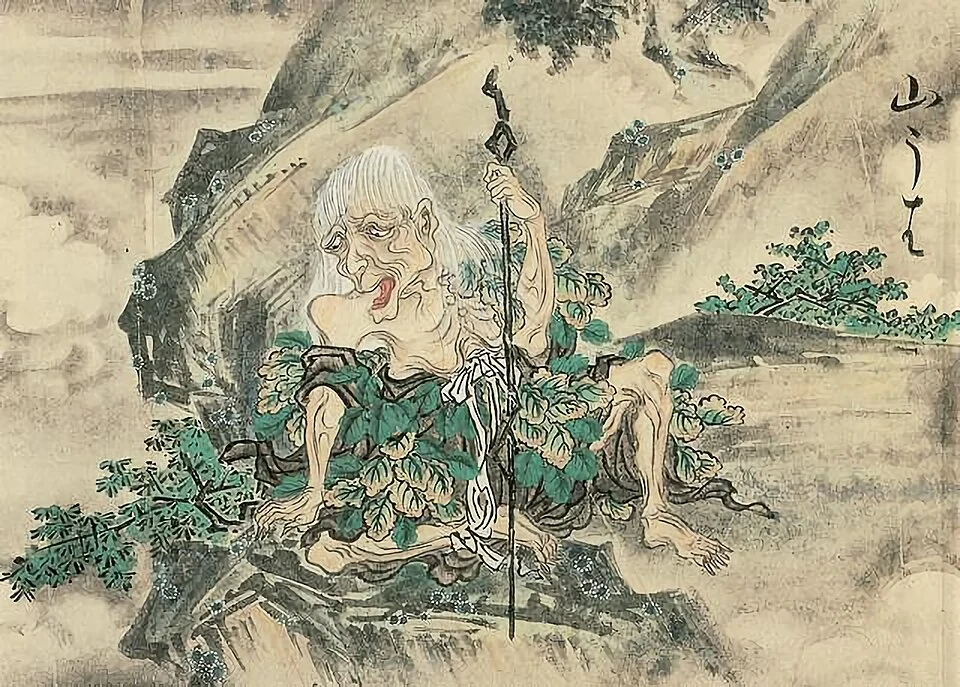
Yamauba
Image associated with the exact linked encyclopedia article; consult credited file description for its interpretation.
Overview
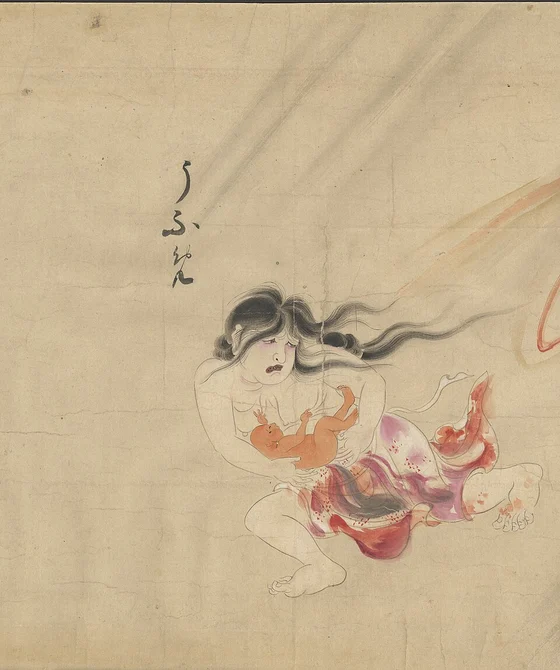
Yamauba, often translated as mountain old woman, appears across stories and pictures as a female inhabitant of places beyond ordinary settlement. Some narratives make her a dangerous pursuer or eater of humans; others make her a giver of assistance or good fortune. These contrasting roles are fundamental to the figure and should not be reduced to an evil witch with a fixed list of powers.
Her appearance changes with region and medium: age, hair, clothing and relation to children can differ. Sekien's encyclopedia supplies one artistic witness, while Hokusai and Utamaro offer others. The mountain setting makes hospitality uncertain and brings travellers into contact with someone outside everyday social order. This entry treats those repeated narrative tensions as interpretive patterns, while keeping individual tales distinct rather than combining their incidents into one biography.
A later representation can be followed through an individually catalogued object. The Metropolitan Museum holds Utamaro’s Yamauba and Kintarō, dated about 1795, as object JP980. Its curatorial account identifies Kintarō as a wild boy and Yamauba as his adoptive mother living in the mountains. The museum emphasizes the intimacy between mother and son across Utamaro’s images of the pair. That documented artistic relationship gives readers a specific alternative to interpreting every mountain-woman picture as a pursuing predator. The work is a color woodblock print on paper, rather than an anonymous oral narrative or a specimen. Its date establishes this particular representation; it does not establish the beginning of Yamauba traditions or require other artists to portray the same maternal relationship.
Origins & earliest records
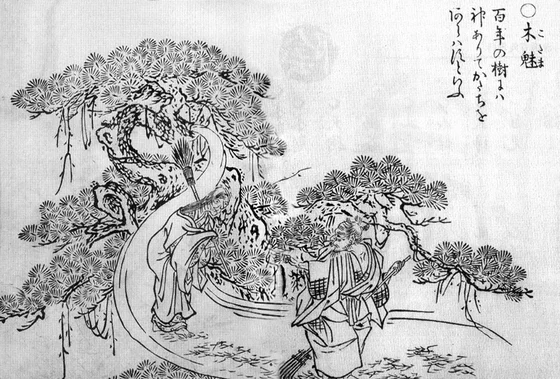
Selected illustrated witness: Toriyama Sekien's Gazu Hyakki Yagyō (1776). This is an attestation of the named representation, not a claim that the belief began in that year.
Records & interpretation
Historical prints and textual references establish an imagined being and its representation. The linked contextual article distinguishes the pictured form from regional accounts; these sources do not establish zoological existence.
Selected bibliography
Documented works and useful reading. This is not a list of every appearance.
- 01
Gazu Hyakki Yagyō
Selected historical witness; individual illustration now checked in the separately linked primary scan. This edition is not a claim of the earliest oral attestation.
Family & connections
A source-supported family tree or inspiration record has not yet been compiled for this profile. Related reading below indicates a connection in subject matter, not a proven lineage or creative influence.
Primary records and illustrations
Gazu Hyakki Yagyō
Volume 1, Yin (陰); digitized Smithsonian Libraries copy, 1805 edition. IIIF canvas index 14 (zero-based); GazuHyakkiyagyo1Tori_0015.jp2
Named 山姥; an aged woman with long hair sits among rocks and mountain vegetation. Visual inspection of the digitized plate and its printed label; image URL is copied from the actual IIIF manifest, not a guessed leaf reference.
Encyclopedia background
An additional attributed reference, separate from the editorial profile above.
Read the open encyclopedia overview
Yamauba (山姥, 山うば, or 山女郎), yamamba, and yamanba are variations on the name of a yōkai found in Japanese folklore. Mostly said to resemble women, yamauba may be depicted as predatory monsters or benevolent beings.
Text from Wikipedia contributors, “Yama-uba”. CC BY-SA 4.0. Extracted introduction; formatting changed. Retrieved 5 October 2026. The source article may have changed since retrieval.
References
Sources supporting this profile. Linked pages have their own scope and editorial standards.
- Primary illustrated book / national-library recordNocturnal Procession of the Hundred Demons — historical editionResearch access: 2026-10-05
- National library / primary illustration contextTORIYAMA Sekien’s Illustrated Night Parade of the Demon HordeResearch access: 2026-10-05
- Secondary referenceYamauba — contextual overview and bibliographyResearch access: 2026-10-05
- Primary illustrated plate / institutional digitizationGazu Hyakki Yagyō — directly inspected IIIF canvas index 14 (zero-based); GazuHyakkiyagyo1Tori_0015.jp2Research access: 2026-10-05
- Museum / primary artwork recordKitagawa Utamaro, Yamauba and Kintarō, ca. 1795; Metropolitan Museum, JP980Research access: 2026-10-05
Image credits
Reference illustrationYamauba
Image associated with the exact linked encyclopedia article; consult credited file description for its interpretation.