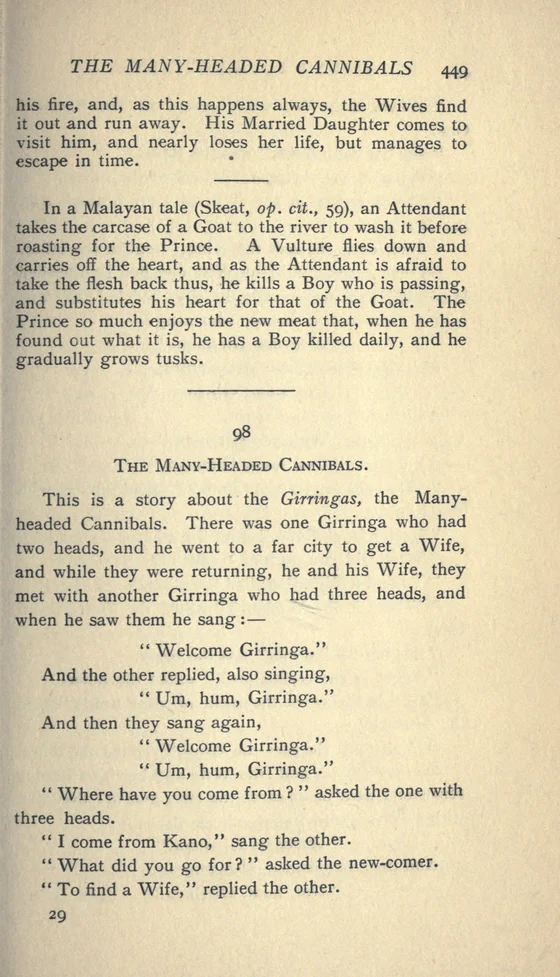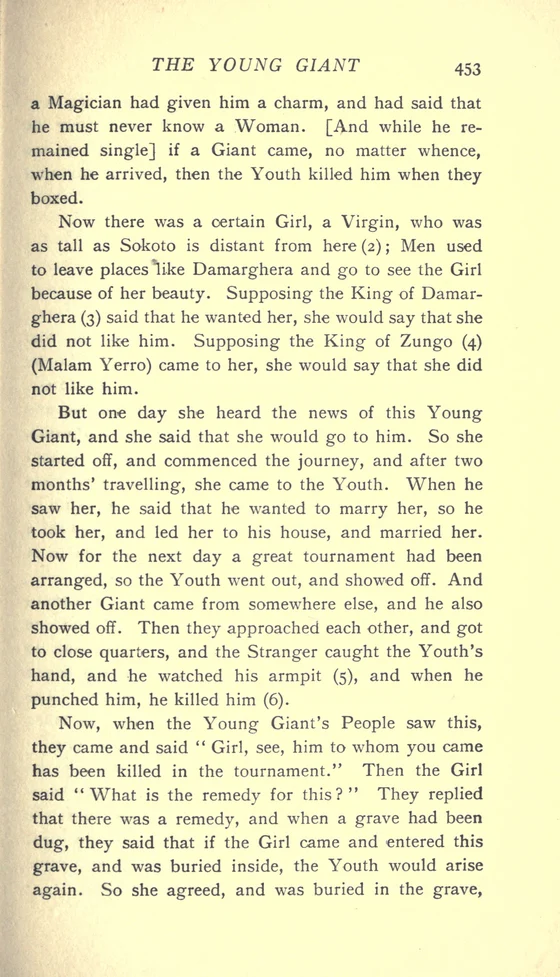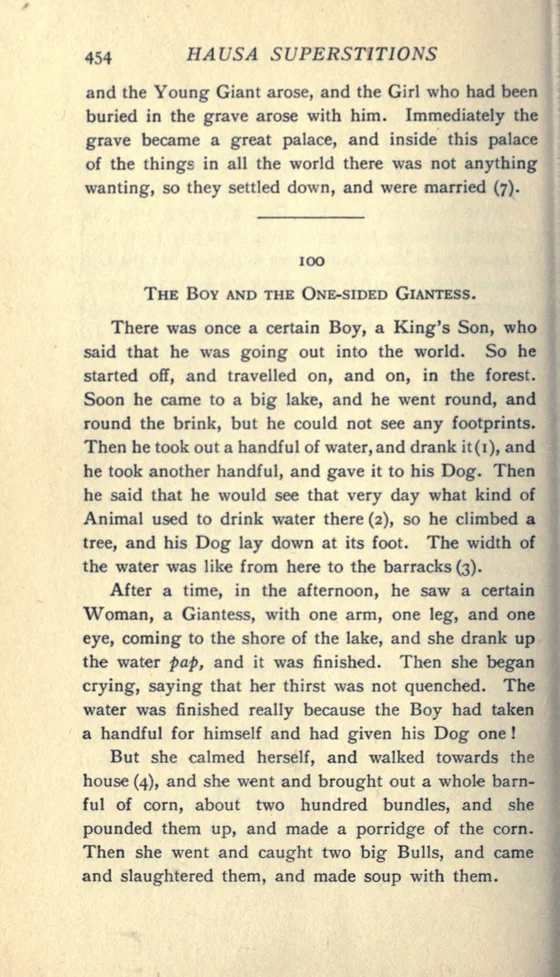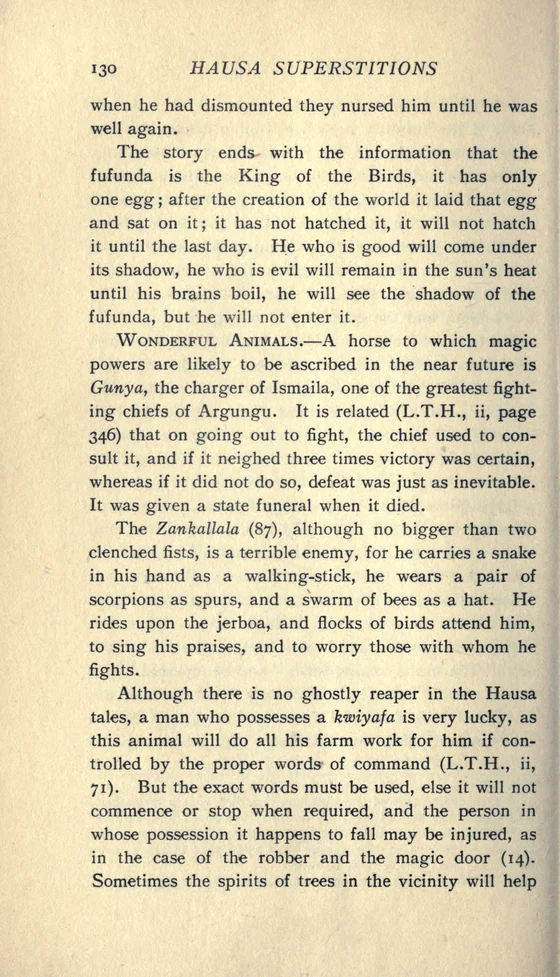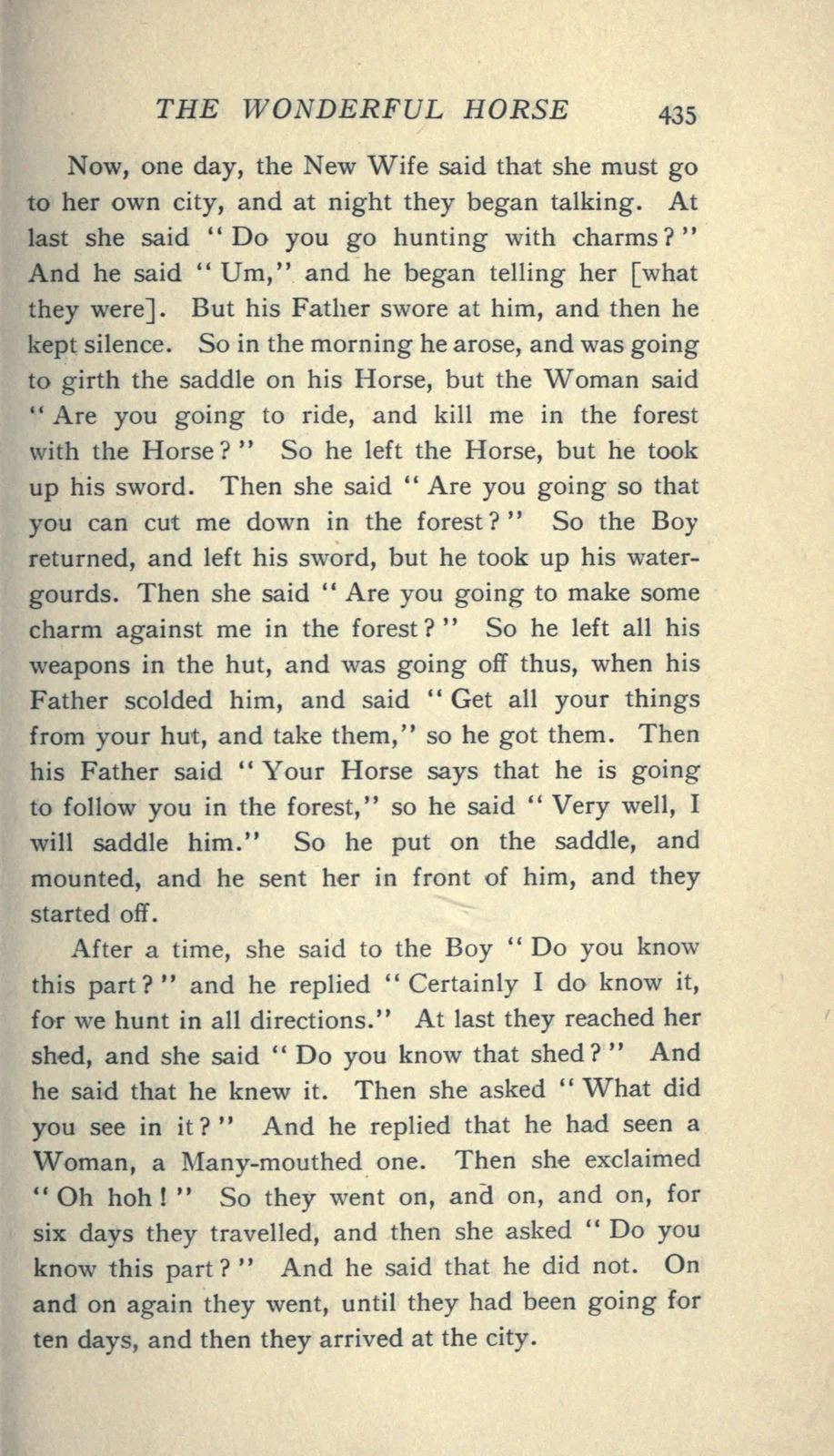
Wonderful Horse in the Hausa Hunter Tale:1913 documentary text page435; documentary source-page facsimile
Exact named narrative text facsimile, not a creature illustration. Printed page435; actual returned IIIF canvas486. Catalogue identifies1913 edition, author1877–1915, US NOT_IN_COPYRIGHT; historical translated text is life70 expired. Oral narrator attribution retained from profile. Actual scan directly inspected: exact named tale/episode text read, including printed page number and narrative features.
Overview
The hunter’s father insists that his son take the horse and weapons on the journey to the new wife’s home, countering her attempts to leave him defenseless. The horse itself says that it will follow him into the forest. At the remote settlement the woman prepares to eat her husband, but the horse speaks and wakes his attention when she approaches at night. After several days, rider and animal cooperate in an escape: the horse refuses grass as instructed, allowing the hunter to claim an illness requiring water carried in a basket. While their hostess attempts that task, he saddles the horse and flees.
When she catches up and reaches for a hoof, the horse’s tail becomes a razor and cuts her hand, delaying pursuit while she licks the blood. Further attacks wound his legs one by one. His frightened rider begs him not to fail; the horse promises to carry him safely even if only one leg remains, acting for the boy’s sake rather than its own. A final wound at the town gate kills the animal, but the father releases dogs that force the pursuer away. The hunter buys white cloth, wraps his protector and buries him. The later horse encountered in the streets is the woman’s new disguise, a distinct antagonist rather than this buried rescuer returning to life.
Origins & earliest records
Tremearne credits Sa(r)rikin Samari (S.S.) in the contents, with initials resolved by the introduction/preliminary correction. His general 1908–1909 collection dates are not an exact session date for this narrative.
Records & interpretation
Complete main narrative 95, The Boy, the Witch, and the Wonderful Horse, pp 432–438 directly read. Appended comparative variants are not merged into these events. The title is an editorial locator where the narrative supplies no personal name; classification of spirit or animal forms follows explicit actions rather than modern zoological identification.
Selected bibliography
Documented works and useful reading. This is not a list of every appearance.
- 01
Hausa Superstitions and Customs
Second edition; tale 95, The Boy, the Witch, and the Wonderful Horse, pp 432–438
Family & connections
A source-supported family tree or inspiration record has not yet been compiled for this profile. Related reading below indicates a connection in subject matter, not a proven lineage or creative influence.
References
Sources supporting this profile. Linked pages have their own scope and editorial standards.
- Collected primary narrative with narrator attributionHausa Superstitions and Customs — tale 95, The Boy, the Witch, and the Wonderful Horse, pp 432–438Research access: 2026-10-05
Image credits
Historical text facsimileWonderful Horse in the Hausa Hunter Tale:1913 documentary text page435; documentary source-page facsimile
Exact named narrative text facsimile, not a creature illustration. Printed page435; actual returned IIIF canvas486. Catalogue identifies1913 edition, author1877–1915, US NOT_IN_COPYRIGHT; historical translated text is life70 expired. Oral narrator attribution retained from profile. Actual scan directly inspected: exact named tale/episode text read, including printed page number and narrative features.