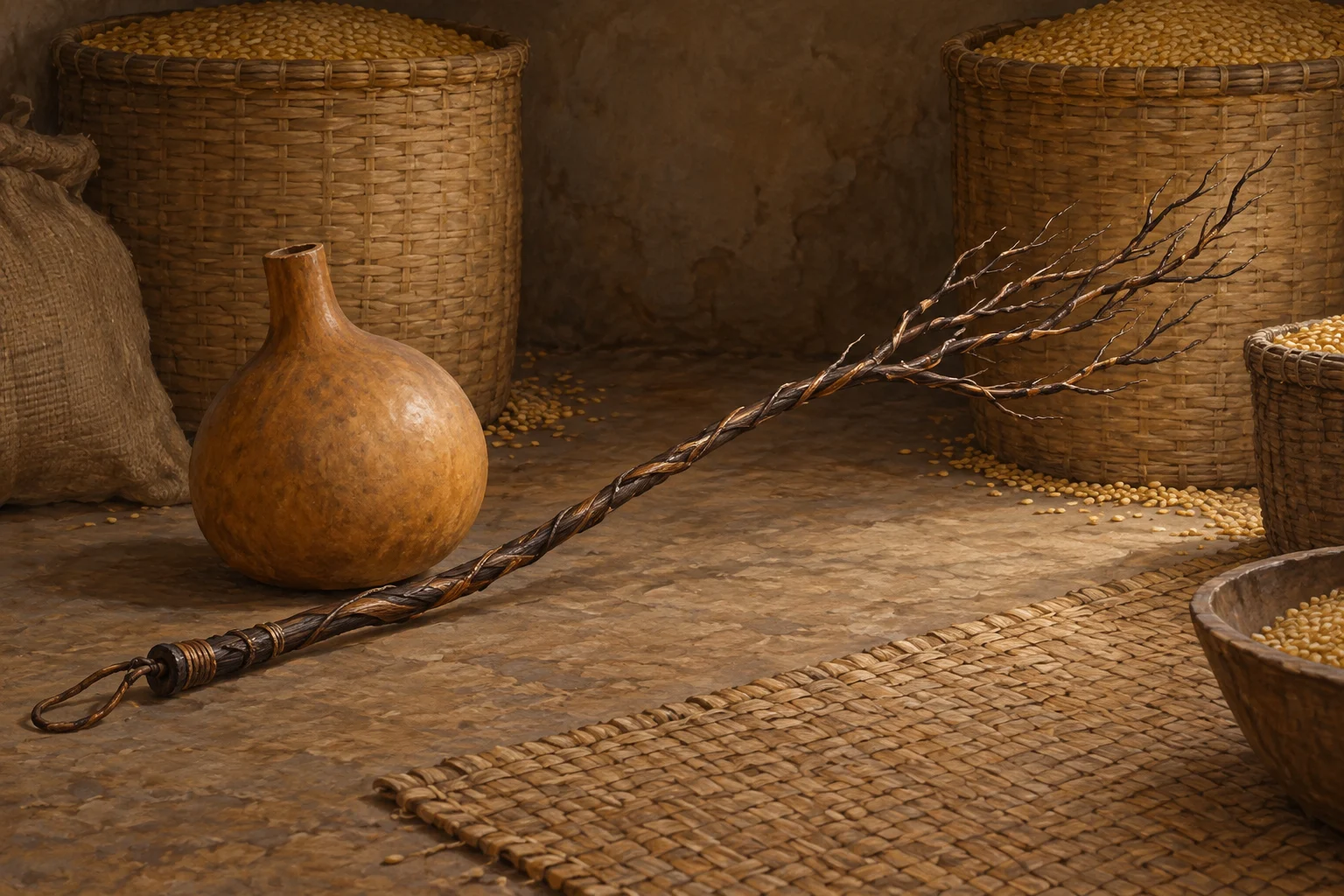
AI interpretation of the Whack-Me branch or whip resting beside a calabash in a grain store
AI-generated unofficial original narrative interpretation. Selected resting object in grain store. Braided woody design, handle loop, calabash, woven storage baskets, mat and room details invented; no particular cultural manufacture asserted. Not a historical reconstruction or community portrait.
Overview
The neglected woman returns to the bush seeking food after her husband appropriates the feeding spoon. She meets a branch, described alternatively as a whip, which answers her greeting and gives the name rendered Whack Me. Repeating it brings a beating rather than food. The object follows and strikes while she runs, until people intervene. She then brings her husband to it, presenting it as another source of nourishment. He is beaten too; the whip eventually tires and lies down, while he returns home groaning.
After recovering, he creeps toward the resting whip, pins it down and takes it to his grain store. He sends his hungry favored wife inside with a calabash and encourages her to greet the long object and ask its name. Its repeated beating makes her shout, and both the husband and the other wife flee to the forest. She finally escapes as well, leaving the house deserted. The conclusion explains that spoon and whip formerly inhabited the wilds before entering human homes. No reconciliation, return of the spoon or death of the household members is narrated.
Origins & earliest records
Malam Shaihu supplies the written Hausa material translated and transliterated by R. Sutherland Rattray. The compiler’s Author’s Note describes a mixed written and Arabic-manuscript mediation process; this tale is not labeled a verbatim oral field transcription by a separately named narrator.
Records & interpretation
Shaihu/Rattray, Hausa Folk-Lore, Customs, Proverbs, etc., Volume I (1913), tale 5, complete pp. 80–106; compiler methodology p. xii.
Selected bibliography
Documented works and useful reading. This is not a list of every appearance.
- 01
Hausa Folk-Lore, Customs, Proverbs, etc., Volume I
Shaihu/Rattray, Hausa Folk-Lore, Customs, Proverbs, etc., Volume I (1913), tale 5, complete pp. 80–106; compiler methodology p. xii.
Family & connections
A source-supported family tree or inspiration record has not yet been compiled for this profile. Related reading below indicates a connection in subject matter, not a proven lineage or creative influence.
References
Sources supporting this profile. Linked pages have their own scope and editorial standards.
- Bilingual manuscript tale; digitized primary OCRShaihu/Rattray 1913 — Whack-Me Whip of Shaihu’s TaleResearch access: 2026-10-05
- Compiler methodologyAuthor’s NoteResearch access: 2026-10-05
Image credits
AI-generated interpretationAI interpretation of the Whack-Me branch or whip resting beside a calabash in a grain store
AI-generated unofficial original narrative interpretation. Selected resting object in grain store. Braided woody design, handle loop, calabash, woven storage baskets, mat and room details invented; no particular cultural manufacture asserted. Not a historical reconstruction or community portrait.