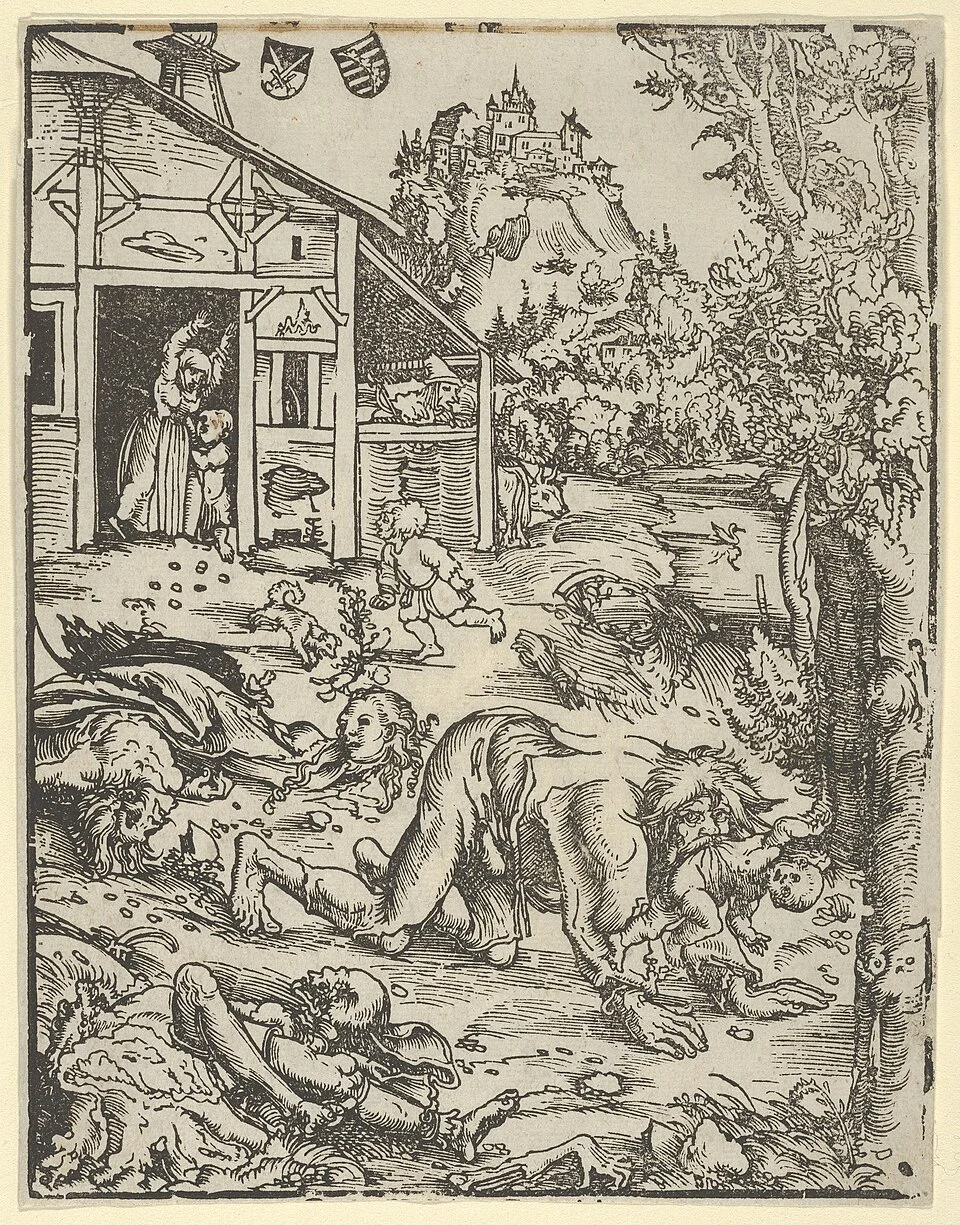
The Werewolf or the Cannibal, Lucas Cranach woodcut, circa1512
Early sixteenth-century woodcut depicting a man crawling on all fours amid victims; traditionally titled The Werewolf or the Cannibal. Historical interpretation of violent lycanthropy, not a universal wolf-headed anatomy. Met OpenAccess public-domain reproduction.
Overview
Human transformation into a wolf takes different forms in the selected ancient and medieval narratives. Ovid’s Metamorphoses presents Lycaon’s change within Jupiter’s account to the assembled gods. The Arcadian ruler plans to test the visitor’s divinity by killing him and serves him flesh from a murdered hostage. Jupiter destroys the dwelling; Lycaon flees, loses articulate speech and takes a wolf’s body while retaining features and a desire for slaughter that the poem associates with his former self. This episode describes a particular punishment before the flood narrative. It does not identify Lycaon as the first historical werewolf or explain every later wolf-transformation tradition.
Petronius places a different story inside the dinner at Trimalchio’s house. Niceros recalls travelling to Melissa during his enslavement, accompanied by a soldier who stops among tombs. The soldier removes his clothes, makes a circle around them and becomes a wolf; when Niceros later approaches the clothes, they have turned to stone. At Melissa’s house he hears that a wolf attacked the flock and was wounded in the neck by an enslaved defender. Returning home, he finds a pool of blood where the clothes had been and the soldier receiving treatment for a neck wound. The matching injury supplies Niceros’s reason for identifying the wolf with his companion. He insists that his story is true, while the surrounding work presents a character telling it to other diners. The bright moon belongs to the scene; the passage gives no recurring lunar transformation schedule.
Marie de France’s lay, read here in Eugene Mason’s 1911 prose translation as The Lay of the Were-Wolf, makes hidden clothing central. A Breton baron is absent for three days each week and eventually tells his wife that he lives in wolf form during these departures. Once she learns where his clothes are hidden, she arranges their theft with another knight and marries that man. More than a year later, a royal hunt corners the wolf. His appeal at the king’s stirrup persuades the king to protect him, and at court he behaves peaceably except toward the people involved in his betrayal. After he attacks his former wife, questioning reveals the theft. The recovered clothes initially produce no visible change. A counsellor advises privacy; left alone in the king’s chamber, he is subsequently found human and asleep. The ending restores his property and exiles the wife and her new husband. Clothing, recognition, restraint and selective retaliation distinguish this narrative from Niceros’s account.
Baring-Gould’s1865 chapter on northern traditions distinguishes several accounts of shape-changing, including assuming a skin, a soul travelling in another body and transformation through words. These are his collected categories, not a complete account of every European belief. His quoted Völsunga saga episode gives Sigmund and Sinfjötli wolf skins that they cannot immediately remove. The men acquire wolf behaviour, communicate through howls and roam separately while agreeing when to call for help. Transformation changes their abilities and their social relationship together, making the episode more specific than a generic attack by an unusually large natural wolf.
The wolf-skinned pair agree to call each other when facing more than seven men, but Sinfjötli kills eleven without calling. Sigmund bites through his throat in anger, then carries him home while they cannot leave their wolf forms. Baring-Gould's other quoted Völsunga episode places ten imprisoned brothers in stocks: a she-wolf eats one each night, leaving Sigmund alone. Signy sends a helper with honey for his face and mouth. When the wolf licks him, Sigmund catches her tongue in his teeth and tears it out, killing her. The passage attributes identification of the wolf as King Siggeir's transformed mother to some people's opinion. These are separately framed saga episodes: enchanted clothing governs the men's change, while the captor's relative is a reported interpretation of the she-wolf.
These witnesses support comparison of motifs rather than a single set of species rules. Clothes that preserve human identity, assumed wolf skins, a matching wound and punishment by a deity each perform different narrative work. A natural wolf is the animal form named in the accounts, but literary transformation supplies no biological family tree connecting human beings with wolves. Parentage in a named saga, a modern franchise’s transformation mechanism and scientific canid relationships require separate evidence.
Origins & earliest records
Ovid and Petronius provide separately located ancient Roman accounts, while Marie de France supplies a medieval Breton-set lay and Baring-Gould transmits selected northern material in1865. Dates of poems, translations and compilations are distinguished. These sources do not establish one oral origin, a first historical werewolf, or an unbroken transmission chain between the narratives.
Records & interpretation
The evidence consists of literary passages and a historical compilation. Niceros’s insistence on truth is part of a narrated banquet; the lay’s claims likewise belong to its narrative voice. The sources document different representations of human-wolf identity, not independently observed bodily transformations. Scientific wolf ancestry and diagnoses of real people are not inferred from these accounts.
In the literature
“At times, a dress of skin was cast over the body, and at once the transformation was complete”
Chapter III, “The Were-Wolf in the North”
Baring-Gould summarizes one northern transformation motif; the following text gives additional variants.
“was suddenly turned into a wolf!”
Chapter62, transformation paragraph · W. C. Firebaugh
Niceros’s reported roadside transformation, not an externally authenticated event.
“Here is a beast who has the sense of man.”
VIII, king’s speech during the forest hunt · Eugene Mason
The king infers human intelligence from the wolf’s appeal for protection despite its inability to speak.
Selected bibliography
Documented works and useful reading. This is not a list of every appearance.
- 01
Metamorphoses, Book I, Lycaon episode (163–239)
Complete Lycaon council/punishment passage and immediate transition to the flood read. This is a located literary witness, not proof of the first wolf-transformation tradition.
- 02
Satyricon, chapters61–62
Complete Niceros story with setting and immediate Trimalchio response in63 read. The inspected edition advertises later supplements elsewhere; this entry relies on the explicitly located Niceros episode, not those supplements.
- 03
The Lay of the Were-Wolf, VIII in French Mediaeval Romances from the Lays of Marie de France
Complete Mason telling, including theft, royal protection, recognition, private restoration and exile. Its Bisclavaret spelling and ending belong to this inspected English witness; no original manuscript inspection claimed.
- 04
The Book of Were-Wolves, chapterIII: The Were-Wolf in the North
Selected northern chapter inspected, including quoted Völsunga saga chapters5 and8; collector interpretations remain attributed.
- 05
The Book of Were-Wolves
Exact contiguous excerpt checked against the linked primary e-text on 2026-10-05; only whitespace normalized. Historical folklore compilation; its period medical claims are not current medical evidence.
- 06
Satyricon — Niceros’s werewolf story
Firebaugh translation, PG5225. Inspected Wikisource title/copyright independently confirms Boni &Liveright, NewYork1922: https://en.wikisource.org/wiki/The_Satyricon_of_Petronius_Arbiter . Exact PG print impression not independently identified. Entire selected61–63 read, not full novel or supplements.
- 07
The Lay of the Were-Wolf, VIII in French Mediaeval Romances
Inspected frontmatter explicitly1911 and EugeneMason; fullVIII independently read. Medieval French original not collated. Mason1862–1935 is recorded at https://en.wikisource.org/wiki/Author:Eugene_Mason ; exact underlying print impression unidentified.
- 08
MetamorphosesI163–239 — Lycaon transformation
BrookesMore, CornhillPublishingCo Boston1922, explicitly identified by inspected host heading. EntireI163–239 Lycaon passage plus immediate flood transition240–243 read via public web; native local fetch unavailable, no local-cache claim.
Family & connections
A source-supported family tree or inspiration record has not yet been compiled for this profile. Related reading below indicates a connection in subject matter, not a proven lineage or creative influence.
Located primary passages
Specific passages supporting details in this entry, grouped by their published witness.
The Book of Were-Wolves, chapterIII: The Were-Wolf in the North
Exact contiguous excerpt checked against the linked primary e-text on 2026-10-05; only whitespace normalized. Historical folklore compilation; its period medical claims are not current medical evidence.
- Baring-Gould summarizes one northern transformation motif; the following text gives additional variants.
This source represents its own literary or collected version. A novel or poem is evidence for depiction, not a universal definition or a zoological claim. Original source verification is preserved; attachment performed after exact generic profileID became available.
Satyricon, chapters61–62
Firebaugh translation, PG5225. Inspected Wikisource title/copyright independently confirms Boni &Liveright, NewYork1922: https://en.wikisource.org/wiki/The_Satyricon_of_Petronius_Arbiter . Exact PG print impression not independently identified. Entire selected61–63 read, not full novel or supplements.
- Niceros recounts a soldier undressing at roadside tombs and becoming a wolf. The discarded clothes appear stone-like. Later Melissa reports a sheep-raiding wolf wounded in the neck; Niceros finds the soldier receiving treatment at that same site. He concludes that the companion is a werewolf and avoids him. Trimalchio accepts the story before offering a different witches-and-changeling account.
Satyricon complete61–62 and immediate banquet response/witch tale63; chapter titles in hosted text
No whole-novel/book or original manuscript review claimed. Supernatural mechanisms remain version-specific; no global-first claim, ritual, practical transformation instruction or modern adaptation copied.
The Lay of the Were-Wolf, VIII in French Mediaeval Romances
Inspected frontmatter explicitly1911 and EugeneMason; fullVIII independently read. Medieval French original not collated. Mason1862–1935 is recorded at https://en.wikisource.org/wiki/Author:Eugene_Mason ; exact underlying print impression unidentified.
- Bisclavaret spends three days weekly as a wolf and requires hidden clothes to resume human form. His wife and her suitor steal them, trapping him. The hunted wolf seeks royal protection and behaves peaceably except towards the betrayers. After he injures his former wife, coercive questioning reveals the theft. Recovered clothing fails in public; left privately with it, he is found human and asleep. His estate is restored and the pair are exiled.
VIII The Lay of the Were-Wolf, complete prose telling, opening through exile
No whole-novel/book or original manuscript review claimed. Supernatural mechanisms remain version-specific; no global-first claim, ritual, practical transformation instruction or modern adaptation copied.
Metamorphoses, Book I, Lycaon episode (163–239)
BrookesMore, CornhillPublishingCo Boston1922, explicitly identified by inspected host heading. EntireI163–239 Lycaon passage plus immediate flood transition240–243 read via public web; native local fetch unavailable, no local-cache claim.
- Jupiter tells the divine council how Lycaon tested his guest’s divinity through attempted murder and a human-flesh meal. Thunder destroys the house. Fleeing Lycaon howls instead of speaking, his clothing becomes hair and his arms legs; recognisable appearance and bloodlust persist. The council then turns towards wider human destruction.
I163–239 complete Lycaon council/punishment; immediate240–243 flood transition
Entire poem and Latin original not claimed read; no global-first claim, recipe or modern translation quotation.
Encyclopedia background
An additional attributed reference, separate from the editorial profile above.
Read the open encyclopedia overview
In folklore, a werewolf (from Old English werwulf 'man-wolf'), or occasionally lycanthrope (from Ancient Greek λυκάνθρωπος 'wolf-human'), is an individual who can shapeshift into a wolf or therianthropic hybrid wolf–humanlike creature, either voluntarily or involuntarily due to a curse or other affliction. In modern fiction, especially film, transformations are often depicted as triggered by the full moon and transmitted by a bite or scratch from another werewolf. Early sources for belief in this ability or affliction, called lycanthropy, are Petronius (27–66) and Gervase of Tilbury (1150–1228).
The werewolf is a widespread concept in European folklore, existing in many variants, which are related by a common development of a Christian interpretation of underlying European folklore developed during the Middle Ages. From the early modern period, werewolf beliefs spread to the Western Hemisphere with colonialism. Belief in werewolves developed in parallel with the belief in witches during the late Middle Ages and the early modern period. Like the witchcraft trials as a whole, the trial of supposed werewolves emerged in what is now Switzerland, especially the Valais and Vaud, in the early 15th century and spread throughout Europe in the 16th, peaking in the 17th and subsiding by the 18th century.
The persecution of werewolves and the associated folklore is an integral part of the "witch-hunt" phenomenon, albeit a marginal one, with accusations of lycanthropy being involved in only a small fraction of witchcraft trials. During the early period, accusations of lycanthropy (transformation into a wolf) were mixed with accusations of wolf-riding or wolf-charming. The case of Peter Stumpp (1589) led to a significant peak in both interest in and persecution of supposed werewolves, primarily in French-speaking and German-speaking Europe. The phenomenon persisted longest in Bavaria and Austria, with the persecution of wolf-charmers recorded until well after 1650, the final cases taking place in the early 18th century in Carinthia and Styria.
After the end of the witch trials, the werewolf became of interest in folklore studies and in the emerging Gothic horror genre. Werewolf fiction as a genre has premodern precedents in medieval romances (e.g., Bisclavret and Guillaume de Palerme) and developed in the 18th century out of the "semi-fictional" chapbook tradition. The trappings of horror literature in the 20th century became part of the horror and fantasy genre of modern popular culture.
Text from Wikipedia contributors, “Werewolf”. CC BY-SA 4.0. Extracted introduction; formatting changed. Retrieved 5 October 2026. The source article may have changed since retrieval.
References
Sources supporting this profile. Linked pages have their own scope and editorial standards.
- Primary literary translationOvid, Metamorphoses I.163–239 and immediate flood transition, Brookes More translationResearch access: 2026-10-05
- Primary literary translationPetronius, Satyricon61–62, with banquet response in63, Firebaugh translationResearch access: 2026-10-05
- Historical prose translation of a medieval layMarie de France, The Lay of the Were-Wolf, Mason1911Research access: 2026-10-05
- Primary textBaring-Gould, The Book of Were-Wolves, chapterIIIResearch access: 2026-10-05
- Bibliographic comparison witnessFirebaugh Satyricon1922 title and publication statementResearch access: 2026-10-05
Image credits
Historical illustrationThe Werewolf or the Cannibal, Lucas Cranach woodcut, circa1512
Early sixteenth-century woodcut depicting a man crawling on all fours amid victims; traditionally titled The Werewolf or the Cannibal. Historical interpretation of violent lycanthropy, not a universal wolf-headed anatomy. Met OpenAccess public-domain reproduction.