Vampire
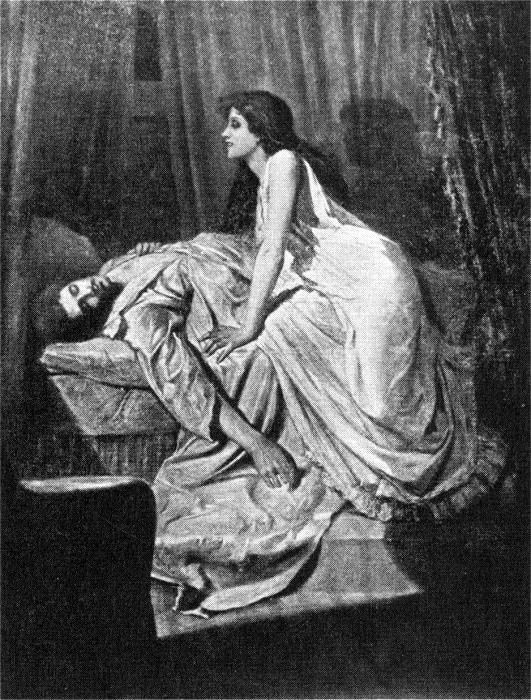
Philip Burne-Jones, The Vampire (1897), metaphorical depiction of a predatory woman over a prone man; historical artistic context, not a literal representation of all folkloric revenants.
Overview
Calmet's Moravian account comes through Monsieur de Vassimont and an unnamed parish priest. It describes dead acquaintances silently joining a table and nodding toward someone who then dies. In the same chapter, Calmet summarizes Schertz's Magia Posthuma: a recently buried woman's apparition alternates between dog and human shapes, attacks people and troubles livestock. A separate Hungarian-frontier report begins with a soldier seeing an unfamiliar guest at his host's table. After the host dies, the household identifies the visitor as his father, buried ten years earlier. Count de Cabreras, other officers, a surgeon and an auditor reportedly investigate; the corpse is described as fresh, with fluid blood. These are distinct stories and reported interpretations, transmitted through Calmet's informants and earlier publications. They preserve table appearances, physical assaults and examination of bodies alongside blood-drinking, rather than giving every revenant one standard attack or appearance.
Dracula’s 1897 fictional account assembles a more elaborate set of powers. Van Helsing describes continued life through blood, unusual strength, absence from mirrors and transformations into wolf, bat or mist, alongside restrictions on movement and entry. The character’s statements are rules within Stoker’s novel, even when framed as knowledge of old traditions. They should not be retroactively assigned to every revenant described by Calmet or to all beings translated as vampires around the world. The comparison shows a productive distinction between a returning corpse feared by a community and a literary predator with systematically narrated abilities. Specific traditions and named fictional vampires remain separate entries, while the general profile provides a source-based point of comparison.
Petrovitch’s selected Serbian collection records a different regional outline. Its Montenegro passage names lampirs and tenatz, describes blood-taking from sleeping people and livestock, and says they return to their graves in mouse form. It also records opposition to violent treatment of suspected bodies: the author cites Emperor Doushan’s code as punishing villages that exhume and burn corpses as severely as murder, and condemning an officiating priest. These statements are the anthology’s account of beliefs and legal responses; the medieval code itself has not been independently collated here.
John William Polidori’s The Vampyre, in the inspected 1819 London edition, makes Lord Ruthven a dangerous participant in fashionable society. Aubrey first mistakes the mysterious nobleman for the hero of his own romantic imagination, then sees his generosity and gambling bring others to ruin. In Greece, Ianthe tells Aubrey of a living vampire who sustains himself by taking a young woman’s life each year. Her account belongs to Polidori’s fictional dialogue. When she is found dead after a violent struggle in a hut, blood and marks at her throat lead the searchers to identify a vampire. Aubrey later finds a sheath among Ruthven’s possessions that fits the unusual dagger recovered there.
Ruthven subsequently appears to die from a gunshot wound. Before death he extracts Aubrey’s promise to conceal his crimes and death for a year and a day. The robbers report placing his body where the first moonlight would strike it; when Aubrey visits, both body and clothes are gone. The act of revival itself is not shown. Ruthven reappears in London, repeatedly invokes the oath and courts Aubrey’s sister. As Earl of Marsden he marries her while Aubrey’s warnings are treated as illness. Aubrey finally discloses the story at midnight and dies; the guardians arrive too late to save his sister. The plot links predation to social access, deception and a binding promise, rather than supplying the full catalogue of powers later described in Dracula.
Le Fanu’s Carmilla gives another distinct literary form. In chapter VI, Laura recounts a night vision of a large black, catlike animal pacing at the foot of her bed. She feels two sharp pains, wakes and sees a motionless female figure which appears to leave through the door, although she then finds the door locked from inside. Laura presents the experience through the uncertain boundary between dream and waking. This scene should not be simplified into a directly witnessed, step-by-step transformation. The same chapter connects Carmilla’s declarations of love with secrecy, jealousy and death, making the relationship with Laura central to this particular narrative.
Chapters XV–XVI complete the explanation within the novella. The opened grave identifies Mircalla, Countess Karnstein, with the guest; Laura bases the staking, beheading and burning account on an official report she says her father possesses, rather than claiming she watched the whole procedure herself. This documentary apparatus is part of the fiction. The conclusion attributes explanations of grave-rest, strength and predation to Baron Vordenburg’s learning, and identifies Carmilla and Millarca as anagrams of Mircalla. That name condition is described for this case, not established as a universal vampire rule. Laura’s final memory alternates between the attractive companion and the terrifying apparition, even after the reported destruction.
Origins & earliest records
Calmet’s work appeared first in1746 and was expanded in1751; the inspected English Phantom World edition is1850 and follows the1751 text. Stoker’s Dracula appeared in1897. These publication dates identify witnesses and reception. They do not establish the beginning of local revenant belief or make the novel the origin of all vampire traditions. Polidori’s1819 title and Carmilla’s1872 publication identify additional literary witnesses between those selected works; neither supplies the first origin of all revenant traditions.
Records & interpretation
Calmet’s second dissertation, chaptersVII–IX, documents reported appearances and interpretations of bodies. Dracula chapterXVIII supplies an explicitly fictional set of powers. The sources attest beliefs, reports and literary transformation, rather than independently verified resurrection, biological immortality or confirmation that historical deaths were caused by supernatural blood-drinking. Petrovitch’s complete Vampires subsection was read separately; his legal citation remains mediated. The complete main tale of The Vampyre and CarmillaVI/XV/XVI were read separately. Moonlight placement is reported by Polidori’s robbers; Le Fanu’s grave report and expert explanations belong to his fictional frame.
In the literature
“The vampire live on, and cannot die by mere passing of the time”
Chapter XVIII, Van Helsing’s explanation of vampire powers
Van Helsing’s deliberately nonstandard grammar is preserved; this is Stoker’s fictional vampire lore.
“the first cold ray of the moon”
Main tale, bandits’ report of Ruthven’s body being placed on the mount after his death
The bandits report Ruthven’s instruction to expose his dead body to moonlight. Aubrey subsequently finds it missing; the passage does not itself show resurrection.
“the appearance of healthy life”
XVI, “Conclusion”, paragraph rejecting conventional deadly vampire pallor
Laura reports the healthy appearance of this novella’s vampires, expressly contrasting a melodramatic convention; it is a literary statement, not a medical claim.
Selected bibliography
Documented works and useful reading. This is not a list of every appearance.
- 01
The Phantom World, second dissertation, chaptersVII–IX, pp260–265
Selected reports inspected; testimony and body interpretations are attributed rather than endorsed.
- 02
Dracula, chapterXVIII
Literary reception and explicitly novel-specific powers.
- 03
Hero Tales and Legends of the Serbians, Chapter II, Vampires, pp. 21–22
Regional mouse-return account and author-cited legal opposition; actual medieval code not independently read.
- 04
The Vampyre; a Tale
Complete main tale read from London opening to the final death of Aubrey’s sister; title gives1819 and Stationers’ Hall entry27March1819. Introductory historical claims and appended Byron material are not used as independently verified biography.
- 05
Carmilla,VI A Very Strange Agony; XV Ordeal and Execution; XVI Conclusion
Complete three selected chapters, prologue framing and front matter read. Laura’s nocturnal experience, reported grave proceedings and Vordenburg’s explanations are narrative evidence; not a full-novella reading claim.
- 06
Dracula
Exact contiguous excerpt checked against the linked primary e-text on 2026-10-05; only whitespace normalized. Original English novel.
- 07
Carmilla
Original English novella, first published 1872; selected Gutenberg transcription has front matter “Copyright 1872”, but does not identify its source print impression. Prologue and complete chapters VI, XV and XVI read independently; whole novella is not claimed read.
Family & connections
A source-supported family tree or inspiration record has not yet been compiled for this profile. Related reading below indicates a connection in subject matter, not a proven lineage or creative influence.
Located primary passages
Specific passages supporting details in this entry, grouped by their published witness.
Dracula, chapterXVIII
Exact contiguous excerpt checked against the linked primary e-text on 2026-10-05; only whitespace normalized. Original English novel.
- Van Helsing’s deliberately nonstandard grammar is preserved; this is Stoker’s fictional vampire lore.
This source represents its own literary or collected version. A novel or poem is evidence for depiction, not a universal definition or a zoological claim. Original source verification is preserved; attachment performed after exact generic profileID became available.
The Vampyre; a Tale
London: Sherwood, Neely, and Jones, 1819, as transcribed on the selected title page; entry at Stationers’ Hall dated 27 March 1819. Original English. Main story read completely from its London opening through Miss Aubrey’s death; prefatory historical claims and subsequent letter are outside the complete-story claim.
- Aubrey initially distrusts vampire reports, then finds Ianthe killed with blood and neck marks, recognizes the attacker’s dagger sheath among Ruthven’s possessions, and eventually identifies the reappearing Ruthven as the man marrying his sister. Ruthven first dies after a bandit’s shoulder shot and exacts a year-and-a-day oath. Bandits place his body on a summit to receive the first moonlight; Aubrey finds neither corpse nor clothing. Back in London, Ruthven enforces the oath while Aubrey is confined as supposedly insane. At midnight Aubrey reveals the danger and dies; the guardians arrive after his sister has supplied the vampire’s thirst.
No eyewitness revival, transformation of the victims, or universal vampire taxonomy is invented. Ianthe’s parents die from grief; her death and Miss Aubrey’s death do not demonstrate that either becomes a vampire. Main story completeness does not imply full verification of the separate introduction or appended letter.
Carmilla,VI A Very Strange Agony; XV Ordeal and Execution; XVI Conclusion
Original English novella, first published 1872; selected Gutenberg transcription has front matter “Copyright 1872”, but does not identify its source print impression. Prologue and complete chapters VI, XV and XVI read independently; whole novella is not claimed read.
- The prologue frames the narrative as a deceased woman’s paper among Doctor Hesselius’s cases. In VI the guest avoids disclosing her history, speaks of jealous love and blood sacrifice, and Laura experiences a catlike night visitor followed by a female figure disappearing through an apparently locked door. XV identifies Mircalla’s hidden monument and describes a legal inquiry, breathing body, blood-filled coffin and destruction by staking, decapitation and burning. Laura explicitly summarizes the last scene from her father’s copy of the commission report. XVI attributes further vampire principles to Baron Vordenburg, contrasts healthy appearance with theatrical pallor, and restricts Mircalla’s anagrammatic names to this particular case. Vordenburg narrates his ancestor’s concealment of the tomb; Laura’s recovery still leaves fearful, ambivalent memories.
Prologue; complete VI “A Very Strange Agony”, XV “Ordeal and Execution”, XVI “Conclusion”
Fictional documents and stated vampire laws are evidence for this novella’s representation. No real inquest authentication, universal anagram rule, or complete reading of intervening chapters is claimed. The prologue’s informant death is later than the narrated recovery; final recollection does not demonstrate Carmilla has revived.
Encyclopedia background
An additional attributed reference, separate from the editorial profile above.
Read the open encyclopedia overview
A vampire is a mythical creature with a human-like appearance that subsists by feeding on the vital essence (usually the blood) of humans. In European folklore, vampires are undead humanoid creatures that visit loved ones and cause mischief or deaths in the neighbourhoods they inhabited while they were alive. They wear shrouds and are often described as bloated and of ruddy or dark countenance, contrasting with the modern gaunt, pale vampire which dates from the early 19th century.
Vampiric entities have been recorded in cultures around the world, but the term vampire was first popularized in Western Europe following reports of an 18th-century mass hysteria drawing on a pre-existing folk belief in Southeastern and Eastern Europe. This delusion led, in certain cases, not only to individuals being accused of vampirism, but also to the corpses of such suspected vampires being pierced with stakes.
Local variants in Southeastern Europe were also known by different names, such as shtriga in Albania, vrykolakas in Greece and strigoi in Romania, cognate with Italian strega, meaning 'witch'.
In modern times, the vampire is generally held to be a fictitious entity, although belief in similar vampiric creatures (such as the chupacabra) still persists in some cultures. Early folk belief in vampires has sometimes been ascribed to the ignorance of the body's process of decomposition after death and how people in pre-industrial societies tried to rationalize this, creating the figure of the vampire to explain the mysteries of death. In 1982, scientist David Dolphin suggested that Porphyria was linked with legends of both vampirism and werewolves, receiving much media exposure. This theory has since been largely discredited.
The charismatic and sophisticated vampire of modern fiction was born in 1819 with the publication of "The Vampyre" by the English writer John Polidori; the story was highly successful and arguably the most influential vampire work of the early 19th century. Bram Stoker's 1897 novel Dracula is remembered as the quintessential vampire novel and provided the basis of the modern vampire legend, even though it was published after fellow Irish author Joseph Sheridan Le Fanu's 1872 novel Carmilla. The success of this book spawned a distinctive vampire genre, still popular in the 21st century, with books, films, television shows, and video games. The vampire has since become a dominant figure in the horror genre.
Text from Wikipedia contributors, “Vampire”. CC BY-SA 4.0. Extracted introduction; formatting changed. Retrieved 5 October 2026. The source article may have changed since retrieval.
References
Sources supporting this profile. Linked pages have their own scope and editorial standards.
- Primary textCalmet, The Phantom World,1850 English editionResearch access: 2026-10-05
- Primary textStoker, Dracula, chapterXVIIIResearch access: 2026-10-05
- Primary collected interpretationPetrovitch, Vampires, pp. 21–22Research access: 2026-10-05
- Primary Gothic fictionPolidori, The Vampyre; a Tale,1819 London editionResearch access: 2026-10-05
- Primary Gothic fictionLe Fanu, Carmilla,VI andXV–XVIResearch access: 2026-10-05
Image credits
Thematic illustrationVampire
Philip Burne-Jones, The Vampire (1897), metaphorical depiction of a predatory woman over a prone man; historical artistic context, not a literal representation of all folkloric revenants.