Umpengempe and the Revived Oxen: documentary text witness, Callaway 1868, printed page 272; documentary source-page facsimile
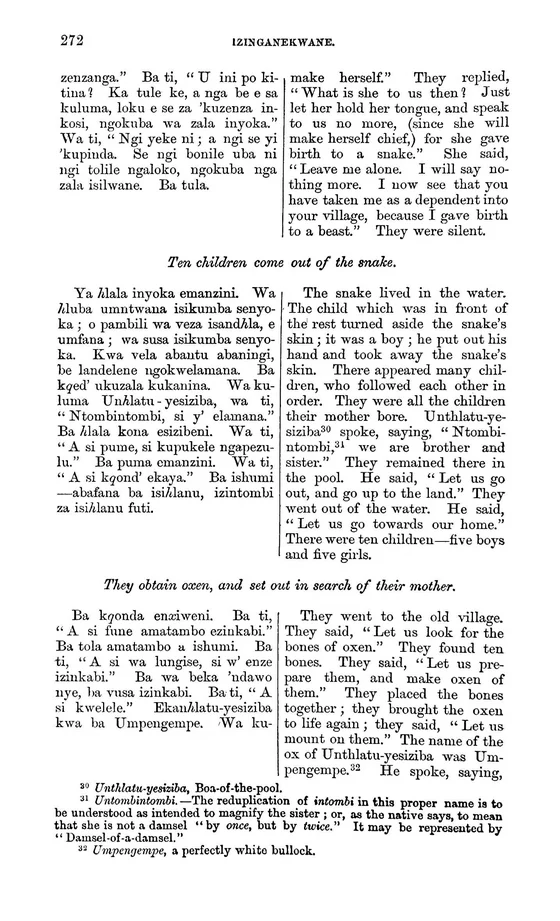
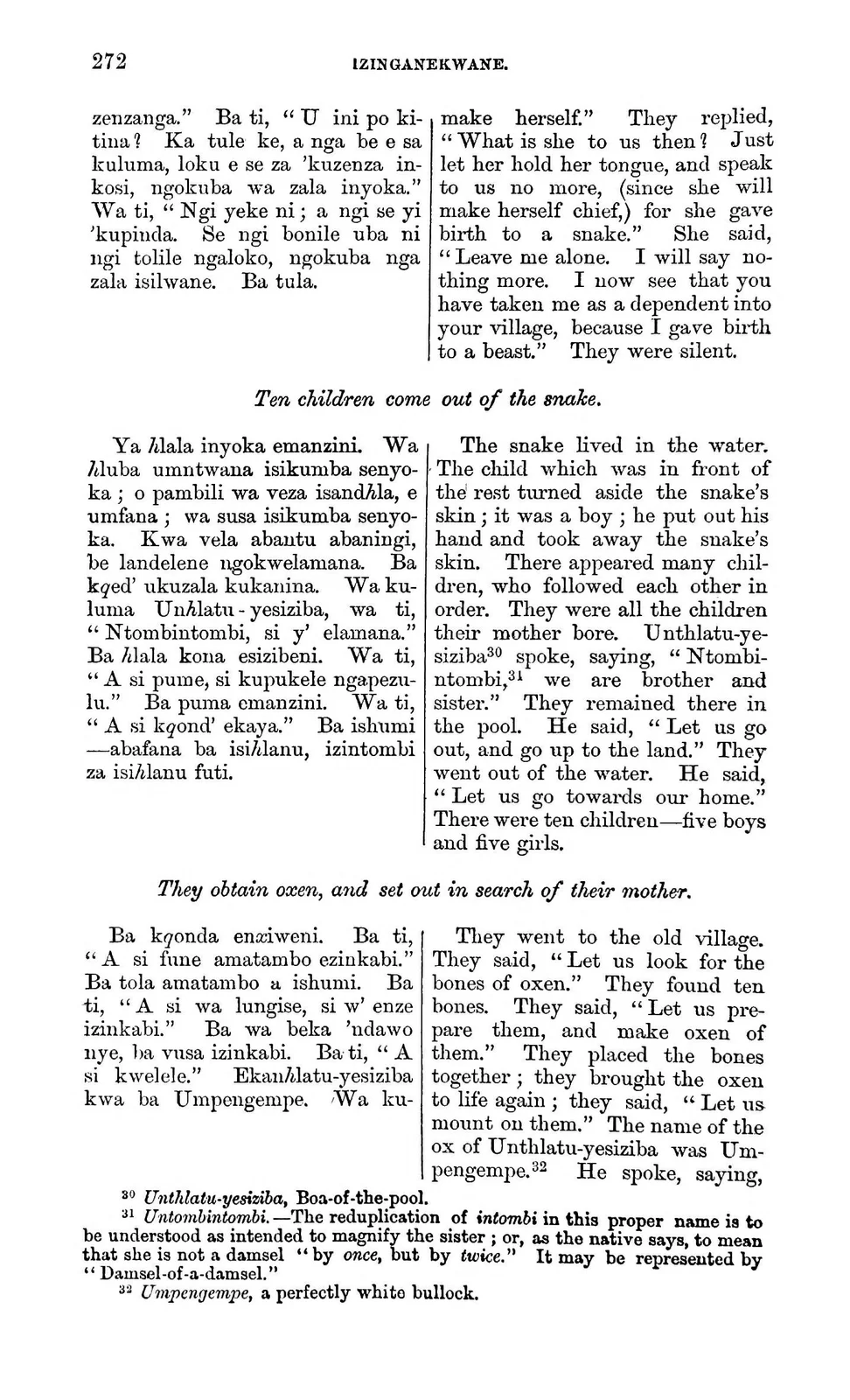
Children assemble ox bones and revive the oxen; note 32 names the white ox Umpengempe. Individually inspected original bilingual Zulu/English scanned page; documentary text, no creature illustration claimed. Physical edition 1868; translator/editor distinguished from traditional narrators. Public-domain publication and expired Callaway lifetime.
Overview
The ten children who emerge from a snake skin return to their family’s abandoned village before looking for their mother. They find ten ox bones, put them together and bring oxen to life. Each child mounts one. The foremost sibling, Unthlatu-yesiziba, rides Umpengempe, whose name Callaway explains in note 32 as a perfectly white bullock. This revival is explicitly narrated, rather than inferred merely because an ordinary ox accompanies human travellers.
The children stop at successive villages. They strike or call to the ox to cry in its accustomed manner and perform their repeated appeal for their mother, saying that she gave birth to them but did not nourish them and that they grew by eating earth. At the maternal grandmother’s village she recognizes the history, and at their father’s village the repeated performance brings their mother outside and summons the king. The wording presents ox cries alongside the children’s words, so the profile does not assign the whole human-language song unambiguously to the animal.
The children initially refuse to dismount. Their father eventually presents ten oxen to the eldest son and ten to the next-born daughter; they then get down, followed by the others. Those gifts are distinct from the oxen earlier revived at the deserted village. Umpengempe is the only individually named mount in the selected passage, and the remaining nine are retained as companions rather than padded separate entries.
Origins & earliest records
The selected account credits Umatshotsha (Umkamafuta). Callaway supplies the English translation and editorial notes; his comparative interpretations are distinguished from the contributor’s account.
Records & interpretation
Complete selected account and ending read: Unthlangunthlangu, complete pp. 267–280; revival and Umpengempe note 32 p. 272, journey and repeated song pp. 273–276, dismounting p. 279.
In the literature
“they brought the oxen to life again;”
Unthlangunthlangu, printed p.272 · Henry Callaway
The snake-born siblings revive oxen from bones before riding in search of their mother.
Selected bibliography
Documented works and useful reading. This is not a list of every appearance.
- 01
Nursery Tales, Traditions, and Histories of the Zulus, in Their Own Words, volume I
Unthlangunthlangu, complete pp. 267–280; revival and Umpengempe note 32 p. 272, journey and repeated song pp. 273–276, dismounting p. 279
- 02
Nursery Tales, Traditions, and Histories of the Zulus — Unthlangunthlangu
HenryCallaway, Nursery Tales, Traditions, and Histories of the Zulus, VolumeI, Springvale,Natal:JohnA.Blair1868; bilingual Princeton scan. Complete English Unthlangunthlangu267–280 read with selected notes25–37; original272/280 visually inspected. Umatshotsha(Umkamafuta) signature closes this main tale; preceding267 Umpengula signature belongs to the prior passage. Following food-abstinence appendices not claimed as completely read.
Family & connections
A source-supported family tree or inspiration record has not yet been compiled for this profile. Related reading below indicates a connection in subject matter, not a proven lineage or creative influence.
Located primary passages
Specific passages supporting details in this entry, grouped by their published witness.
Nursery Tales, Traditions, and Histories of the Zulus, in Their Own Words, volume I
HenryCallaway, Nursery Tales, Traditions, and Histories of the Zulus, VolumeI, Springvale,Natal:JohnA.Blair1868; bilingual Princeton scan. Complete English Unthlangunthlangu267–280 read with selected notes25–37; original272/280 visually inspected. Umatshotsha(Umkamafuta) signature closes this main tale; preceding267 Umpengula signature belongs to the prior passage. Following food-abstinence appendices not claimed as completely read.
- After ten siblings emerge from a snake in the pool, they gather ox bones at the abandoned village and bring the oxen back to life. They ride them while seeking their mother, asking the oxen to cry at successive settlements. Unthlatu-yesiziba’s ox is Umpengempe, glossed in note32 as perfectly white. Recognition by their grandmother and later parents occurs during this mounted journey; the two leading children dismount after receiving cattle, followed by the others. The father then transfers his possessions and rule to Unthlatu-yesiziba.
Unthlangunthlangu, complete printed pp.267–280; notes30–37, signature280
Umpengempe is the specifically named revived mount, while other revived oxen remain unnamed. The source states ten bones, not ten complete skeletons or a documented revival technique. Repeated sung words/formulas are not excerpted; the rider’s biological parentage is distinct from ownership of the ox.
References
Sources supporting this profile. Linked pages have their own scope and editorial standards.
- Attributed primary account with translation; digitized bilingual editionCallaway bilingual edition — Unthlangunthlangu, complete pp. 267–280; revival and Umpengempe note 32 p. 272, journey and repeated song pp. 273–276, dismounting p. 279Research access: 2026-10-05
Image credits
Historical text facsimileUmpengempe and the Revived Oxen: documentary text witness, Callaway 1868, printed page 272; documentary source-page facsimile
Children assemble ox bones and revive the oxen; note 32 names the white ox Umpengempe. Individually inspected original bilingual Zulu/English scanned page; documentary text, no creature illustration claimed. Physical edition 1868; translator/editor distinguished from traditional narrators. Public-domain publication and expired Callaway lifetime.