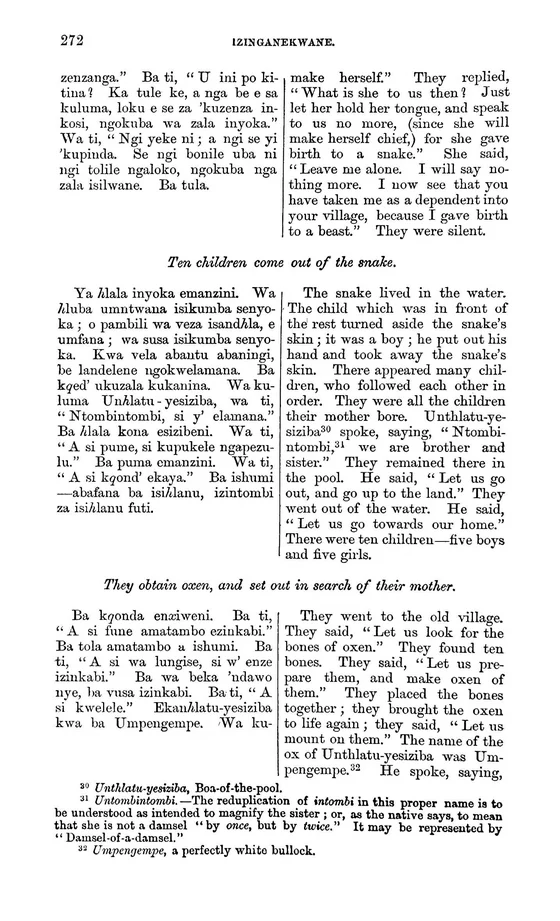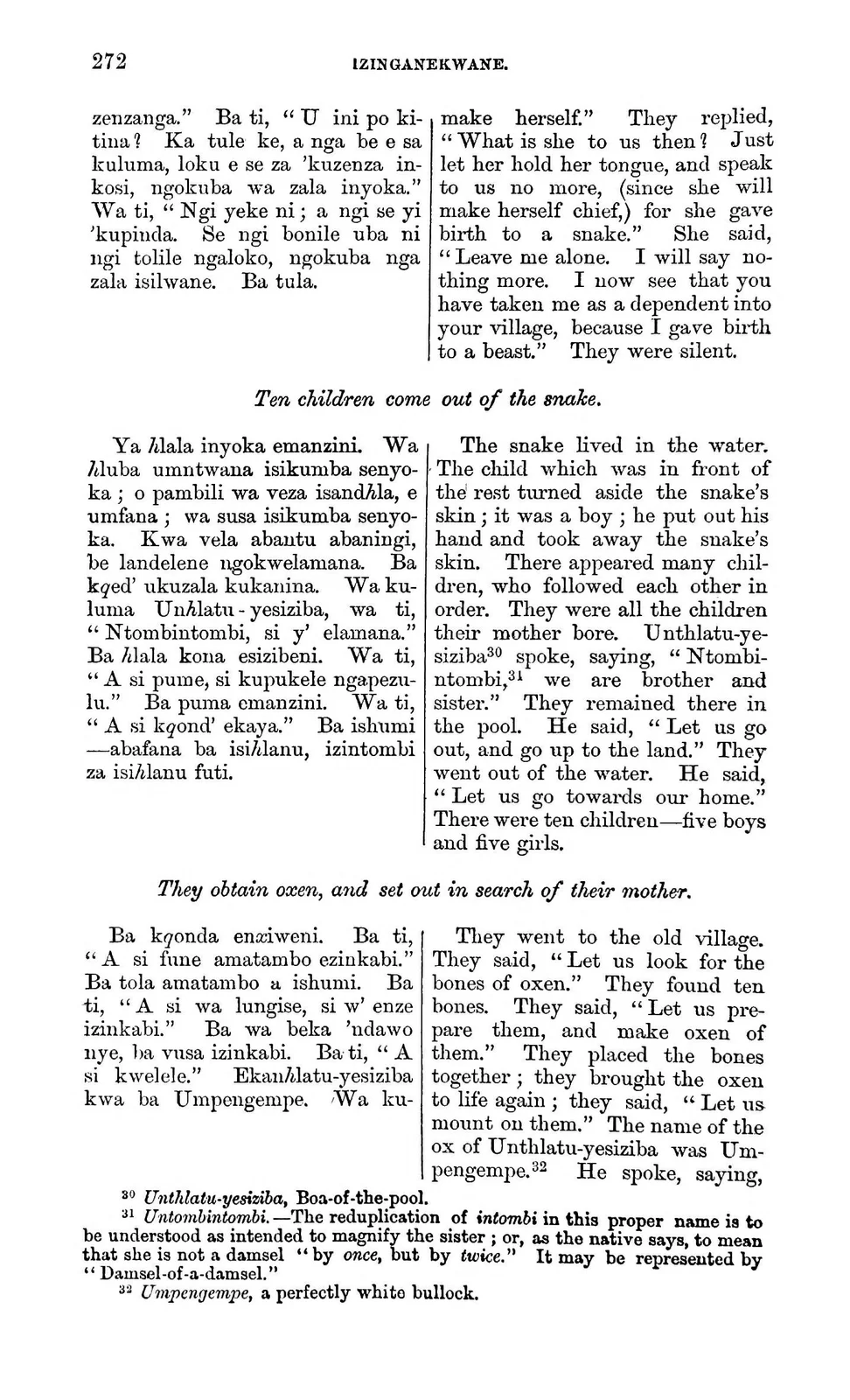
Ten Children of the Snake in Callaway’s Tale: documentary text witness, Callaway 1868, printed page 272; documentary source-page facsimile
Five boys and five girls emerge from the snake; exact ten-children narrative. Individually inspected original bilingual Zulu/English scanned page; documentary text, no creature illustration claimed. Physical edition 1868; translator/editor distinguished from traditional narrators. Public-domain publication and expired Callaway lifetime.
Overview
King Unthlangunthlangu expects his chief wife’s child to become sovereign, but her pregnancy lasts while other women’s children grow and marry. She finally gives birth to an immense snake over several days. It fills the house. The people find its head with a pole, bind its neck and drag it into a pool; the king abandons its mother when he moves his settlement. The translation calls it a boa, without furnishing a modern species identification.
In the pool the foremost child puts out a hand and removes the snake skin. Ten people appear in birth order: five boys and five girls. Their leader is Unthlatu-yesiziba, glossed as Boa-of-the-pool, and his next sibling is Ntombintombi. They go to the old village, find ten ox bones and bring oxen to life from them. Riding these, they travel in search of their mother, repeating a song that says they grew by eating earth after she gave birth without nourishing them.
Their grandmother recognizes the family history and accompanies them to their father’s settlement. Repeated questions establish their memory of the snake’s birth and disposal: their leader heard the proceedings while unable to see. They identify their mother and her marginal house at the gateway. Their father acknowledges them and rewards the eldest two with cattle. When invited to the superior house, Unthlatu-yesiziba insists on entering his mother’s house instead, recognizing the suffering her lower position represents. His father makes him king, surrendering his possessions and people to him. The skin and siblings belong to one collective birth narrative; the story is not split into ten invented individual biographies.
Origins & earliest records
The selected account credits Umatshotsha (Umkamafuta). Callaway supplies the English translation and editorial notes; his comparative interpretations are distinguished from the contributor’s account.
Records & interpretation
Complete selected account and ending read: Unthlangunthlangu, complete pp. 267–280; snake birth pp. 268–269, ten children and revived oxen p. 272, recognition and accession pp. 276–280.
In the literature
“There were ten children—five boys and five girls.”
Unthlangunthlangu, printed p.272 · Henry Callaway
The siblings emerge from one snake.
Selected bibliography
Documented works and useful reading. This is not a list of every appearance.
- 01
Nursery Tales, Traditions, and Histories of the Zulus, in Their Own Words, volume I
Unthlangunthlangu, complete pp. 267–280; snake birth pp. 268–269, ten children and revived oxen p. 272, recognition and accession pp. 276–280
- 02
Nursery Tales, Traditions, and Histories of the Zulus — Unthlangunthlangu
HenryCallaway, Nursery Tales, Traditions, and Histories of the Zulus, VolumeI, Springvale,Natal:JohnA.Blair1868; bilingual Princeton scan. Complete English Unthlangunthlangu267–280 read with selected notes25–37; original272/280 visually inspected. Umatshotsha(Umkamafuta) signature closes this main tale; preceding267 Umpengula signature belongs to the prior passage. Following food-abstinence appendices not claimed as completely read.
Family, evolution & connections
The ten children’s stated parents in Callaway’s tale
Umatshotsha (Umkamafuta)’s Unthlangunthlangu narrative in Callaway’s bilingual historical edition, pp. 267–280.
Scroll sideways to see all branches. With a keyboard, focus the tree and use the arrow keys.
- Unthlangunthlangu + unnamed mother (two stated parents)
- Unthlatu-yesiziba (foremost boy)
- Ntombintombi (next sister)
- Eight further unnamed children (collective branch)
The snake covering yields ten children; the recognition dialogue explicitly affirms their father and mother. The first two are named in the emergence sequence. A joint-parent root groups two stated parents, not one organism. The single snake birth and ten emergent children form one narrative event, not a separate snake ancestor followed by human descendants. Boa is the historical translation, not verified zoological identification. Maternal grandmother is explicitly attested separately but not drawn as parent of the joint root. Eight unnamed siblings stay collective rather than fabricated individual profiles.
Unthlangunthlangu, stated father of the ten snake-born children
The children explicitly affirm Unthlangunthlangu as their father during the recognition questions. This source-specific family is not a modern snake lineage.
Unnamed mother of the ten snake-born children
The children identify the woman as their mother and state that she gave birth once, to the snake from which they emerged. The snake skin is not a separate parent.
Unnamed maternal grandmother of the ten children
The accompanying elder calls the snake-bearing mother her own child, and the translation expressly identifies her as their mother’s mother.
Unthlatu-yesiziba and Ntombintombi in Callaway’s tale
The foremost boy directly addresses Ntombintombi as his sister. The narrative’s birth order names these first two within the ten children; they are not founders of distinct species.
Eight further unnamed siblings in Callaway’s ten-child brood
Five boys and five girls emerge in order from the snake covering, all described as the mother’s children. Beyond the two named eldest children, the remaining eight receive no invented names or separate biographies.
Located primary passages
Specific passages supporting details in this entry, grouped by their published witness.
Nursery Tales, Traditions, and Histories of the Zulus, in Their Own Words, volume I
HenryCallaway, Nursery Tales, Traditions, and Histories of the Zulus, VolumeI, Springvale,Natal:JohnA.Blair1868; bilingual Princeton scan. Complete English Unthlangunthlangu267–280 read with selected notes25–37; original272/280 visually inspected. Umatshotsha(Umkamafuta) signature closes this main tale; preceding267 Umpengula signature belongs to the prior passage. Following food-abstinence appendices not claimed as completely read.
- A king’s designated successor-bearing wife remains pregnant for years, then gives birth to a huge snake that is dragged into a pool. The court abandons her and later marginalises her at its new village. Unthlatu-yesiziba removes the skin and ten children emerge, five boys and five girls in alternating order, with Ntombintombi explicitly his sister. They revive oxen from bones and seek their mother, meet their maternal grandmother, and reach their father’s village. Under detailed questioning they identify birth, exile and each other. Their father recognises them, gives cattle and transfers kingship to Unthlatu-yesiziba, who insists on honouring his displaced mother.
Unthlangunthlangu, complete printed pp.267–280; notes30–37, signature280
The children collectively emerge from one snake; the telling does not describe ten independent snake births. The mother’s abandonment is not actual death. No claim about natural snake biology, complete appendix review or earliest origin; Callaway’s comparative origin speculation remains editorial.
References
Sources supporting this profile. Linked pages have their own scope and editorial standards.
- Attributed primary account with translation; digitized bilingual editionCallaway bilingual edition — Unthlangunthlangu, complete pp. 267–280; snake birth pp. 268–269, ten children and revived oxen p. 272, recognition and accession pp. 276–280Research access: 2026-10-05
Image credits
Historical text facsimileTen Children of the Snake in Callaway’s Tale: documentary text witness, Callaway 1868, printed page 272; documentary source-page facsimile
Five boys and five girls emerge from the snake; exact ten-children narrative. Individually inspected original bilingual Zulu/English scanned page; documentary text, no creature illustration claimed. Physical edition 1868; translator/editor distinguished from traditional narrators. Public-domain publication and expired Callaway lifetime.