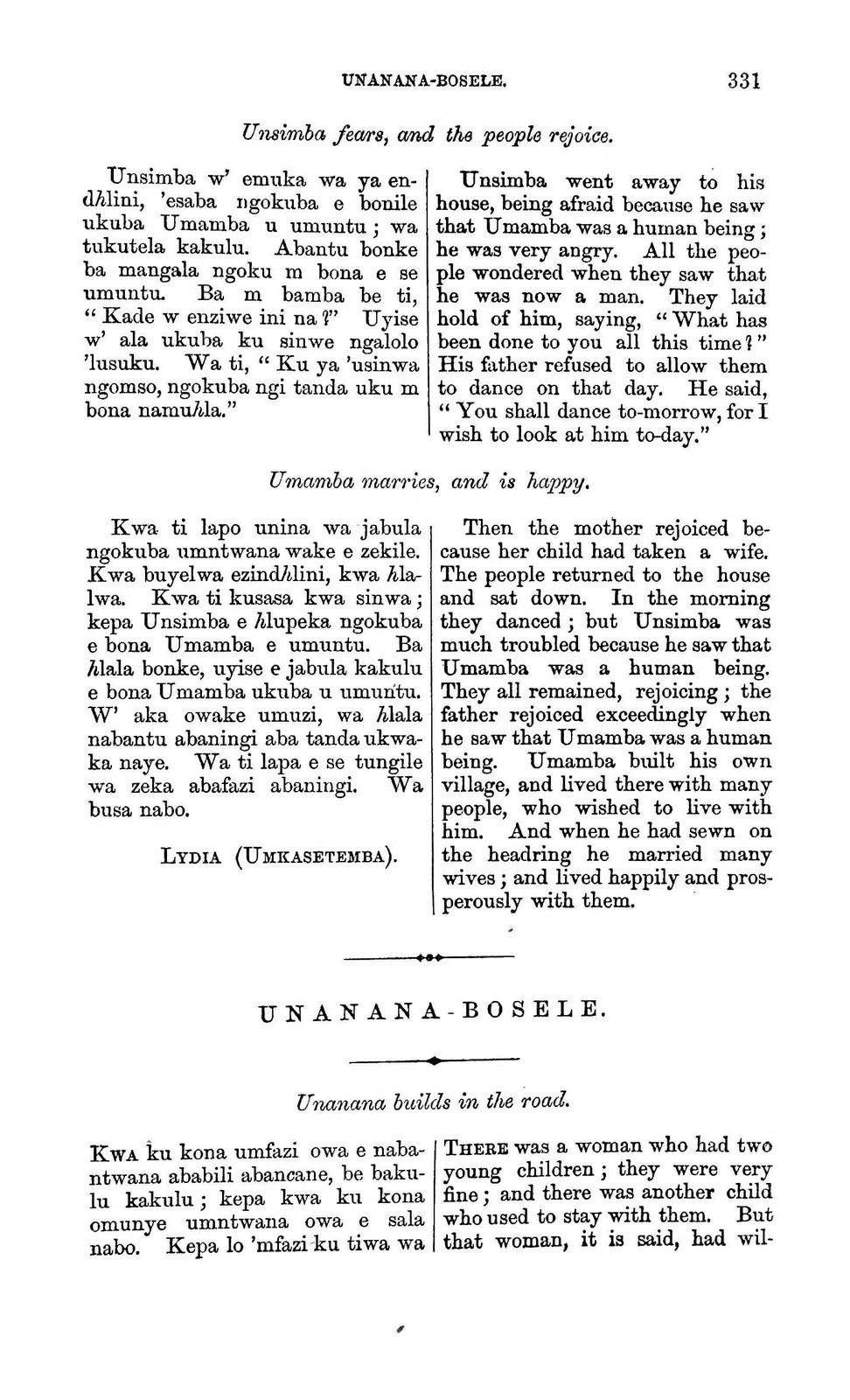
Umamba in Callaway’s Serpent-Skin Tale: documentary text witness, Callaway 1868, printed page 331; documentary source-page facsimile
Umamba revealed as human at his wedding; printed Lydia attribution. Serpent-skin narrative, not a zoological species depiction. Individually inspected original bilingual Zulu/English scanned page; documentary text, no creature illustration claimed. Physical edition 1868; translator/editor distinguished from traditional narrators. Public-domain publication and expired Callaway lifetime.
Overview
Umamba initially appears as a chief’s son born in the form of an imamba and moving on his belly. His mother’s three previous infants died after her sister handled them, and the household suspects her, although the father says he does not know what killed them. The rival wife’s son Unsimba grows up human. Maidens flee from Umamba, while the father struggles over whether the younger son should be allowed to marry first. Unthlamvu-yetusi nevertheless chooses the apparent snake.
In their private room Umamba asks her to anoint him, explaining that belly-crawling hurts and that his attendant ordinarily performs the task. She first tries to use a stick rather than touch him. He asks her to pour the soft fat into her hand, repeatedly assuring her that he devours nobody. The cold snake body frightens her. After she anoints it he tells her to hold the house pillar, look away and pull strongly to stretch his contracted body. The skin comes into her hands, and she sees a beautiful human body that glistens.
He then explains the concealed history: before his birth his mother asked her brother to obtain a small imamba’s skin and placed the infant inside it. She kept his humanity secret because she feared that the other wives would kill him. He has previously removed the hide with his attendant’s help, and now asks his bride to preserve the secret. On the journey to her family she carries the fat pot; they lag behind the company so she can strip the painful skin privately. He walks as a man, then puts it back on before reaching the others.
At the wedding spectators laugh at the prospect of a snake dancing. Umamba privately removes the hide, dresses with the ornaments his mother brings, then puts on a large serpent skin for his public entrance. In the cattle-pen the attendant takes hold of his head and strips it away. His glistening appearance overwhelms the spectators. Unsimba retreats in anger, while their father delays the dance until the next day so he can look at his revealed son. Umamba later establishes his own village, attracts followers and marries additional wives after taking the head-ring. The explanation makes the apparent serpent birth a deliberate protective concealment, not an unnamed enchanter’s curse.
Origins & earliest records
The selected bilingual account credits Lydia (Umkasetemba). Callaway supplies its English translation and comparative notes. The printed credit is retained; his proposed historical explanations are distinct from the narrated events.
Records & interpretation
Complete selected bilingual narrative and closing contributor credit read: Umamba, pp. 321–331; apparent serpent birth pp. 321–323, skin removal and protective explanation pp. 327–329, public wedding reveal pp. 330–331.
In the literature
“I devour no one”
Umamba, printed p.327 · Henry Callaway
Umamba reassures his bride before she uncovers the concealed human body.
Selected bibliography
Documented works and useful reading. This is not a list of every appearance.
- 01
Nursery Tales, Traditions, and Histories of the Zulus, in Their Own Words, volume I
Umamba, pp. 321–331; apparent serpent birth pp. 321–323, skin removal and protective explanation pp. 327–329, public wedding reveal pp. 330–331.
- 02
Nursery Tales, Traditions, and Histories of the Zulus, Volume I — Umamba
Henry Callaway, Nursery Tales, Traditions, and Histories of the Zulus, Volume I, Springvale, Natal: John A. Blair,1868; bilingual edition, selected Princeton scan. Complete Umamba321–331 and Unanana-bosele331–335 read; both end with Lydia(Umkasetemba).
Family, evolution & connections
The chief’s two sons in Callaway’s Umamba tale
Explicit family statements in Umamba, pp. 321–331; two mothers are sisters.
Scroll sideways to see all branches. With a keyboard, focus the tree and use the arrow keys.
- Unnamed chief father
- Unsimba (mother: the chieftainess’s sister)
The father identifies both sons; their mothers are individually described as sisters. Mothers are named by relationship, not invented personal names. Their sisterhood also makes the sons maternal cousins. The unnamed sister’s precise parentage remains unstated, so she is omitted here. Snake disguise does not indicate snake descent.
Unnamed chief father (Callaway Umamba)
The chief names Umamba and Unsimba as his children. They have different mothers, explicitly sisters whom the chief marries; the mothers’ shared father is another unnamed king.
Unnamed mother of Umamba (Callaway)
Umamba’s mother arranges the snake skin through her brother before his birth. The later explanation identifies Umamba as human inside the skin; this is not ancestry from a real snake.
Unsimba (Callaway Umamba)
Umamba and Unsimba share the chief father, while their mothers are sisters. They are therefore paternal half-brothers and maternal cousins within this account; no names are invented for their mothers.
Unthlamvu-yetusi (Callaway Umamba)
Unthlamvu-yetusi chooses Umamba, supports his hidden human identity and attends the completed wedding. Her sister Unthlamvu-yobuthlalu is paired with Unsimba, rather than being Umamba’s second bride.
Unnamed sister of Umamba (Callaway p325)
A woman explicitly called Umamba’s sister sits in his room when his prospective bride arrives. The text does not establish whether she shares both his parents.
Unnamed maternal uncle of Umamba (Callaway p328)
Umamba states that his mother asked her brother to obtain an imamba’s skin. The relation is explicit; the skin supplier is not called his father and is not a snake ancestor.
Located primary passages
Specific passages supporting details in this entry, grouped by their published witness.
Nursery Tales, Traditions, and Histories of the Zulus, in Their Own Words, volume I
Henry Callaway, Nursery Tales, Traditions, and Histories of the Zulus, Volume I, Springvale, Natal: John A. Blair,1868; bilingual edition, selected Princeton scan. Complete Umamba321–331 and Unanana-bosele331–335 read; both end with Lydia(Umkasetemba).
- A chief marries two sisters, appointing one chieftainess. Three of her infants die while held by her jealous sister, whose later son is Unsimba. The next child appears to be a snake, Umamba, and survives. His father questions whether the other infants were killed instead of claiming proof. Brides fear Umamba, but Unthlamvu-yetusi chooses him while her sister Unthlamvu-yobuthlalu is intended for Unsimba.
- Umamba reassures his chosen bride that he does not eat people. After oiling and stretching him she removes the skin, revealing a beautiful human body. He explains that his mother had her brother obtain a small snake’s skin and concealed him in it at birth; his household mistook him for a snake. A servant had previously helped remove the covering, and Umamba asks the bride to keep the secret.
Umamba, printed pp.325–329; private skin removal and explanation
- On the marriage journey the couple privately remove and replace the skin. At the wedding Umamba wears a larger skin until his servant exposes him before everyone. Unsimba withdraws angrily; their father delays the dance to look at his revealed son. Umamba marries, establishes his own village, later takes additional wives and prospers.
The later skin explanation revises the opening impression of literal serpent birth. Callaway’s proposed interpolation or evil-eye interpretation in note79 is editorial conjecture. The narrative is not an ordinary mamba species description. The bride discovers a concealed human, not a curse whose caster and mechanism the text independently establishes. The successful marriage is not a monogamous ending; the text explicitly supplies later wives. Lydia(Umkasetemba) is credited at p331.
References
Sources supporting this profile. Linked pages have their own scope and editorial standards.
- Attributed primary narrative with translation; digitized bilingual editionCallaway bilingual edition — Umamba, pp. 321–331; apparent serpent birth pp. 321–323, skin removal and protective explanation pp. 327–329, public wedding reveal pp. 330–331.Research access: 2026-10-05
Image credits
Historical text facsimileUmamba in Callaway’s Serpent-Skin Tale: documentary text witness, Callaway 1868, printed page 331; documentary source-page facsimile
Umamba revealed as human at his wedding; printed Lydia attribution. Serpent-skin narrative, not a zoological species depiction. Individually inspected original bilingual Zulu/English scanned page; documentary text, no creature illustration claimed. Physical edition 1868; translator/editor distinguished from traditional narrators. Public-domain publication and expired Callaway lifetime.