Tzitzimime
Image associated with the exact linked encyclopedia article; consult credited file description for its interpretation.
Overview
In Sahagún’s New Fire account, households await the flame that will renew a fifty-two-year cycle. Failure would leave the sun unable to return and allow terrible beings to descend and consume people. Families gather on rooftops; pregnant women wear maguey-leaf masks and are enclosed in granaries, while masked children must remain awake. The text treats the feared transformation of pregnant women as a related danger, rather than simply naming every pregnant woman a tzitzimitl. A different passage, a prayer to Tlaloc during drought and famine, imagines the sky falling and the tzitzimime ending human habitation in permanent darkness. These are distinct occasions in the same historical corpus: an urgently awaited renewal ceremony and an appeal for relief from hunger.
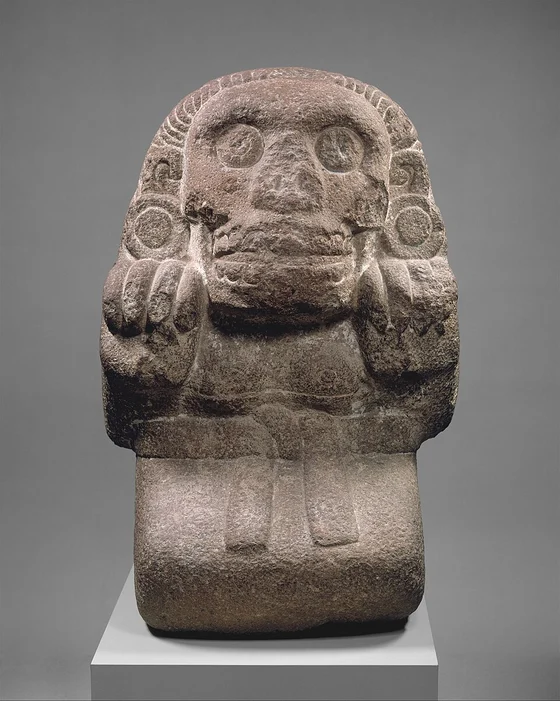
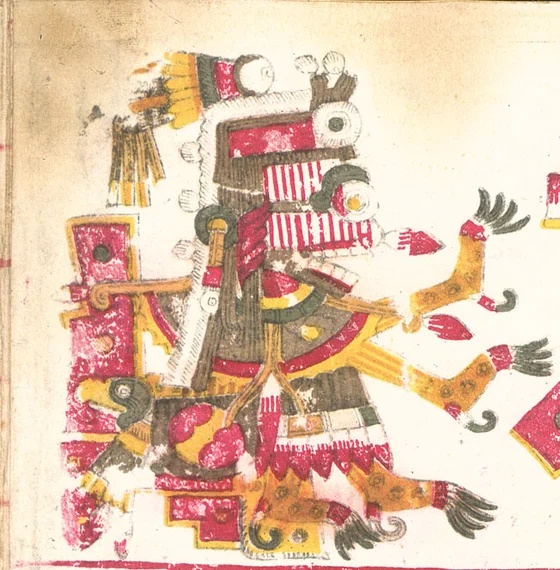
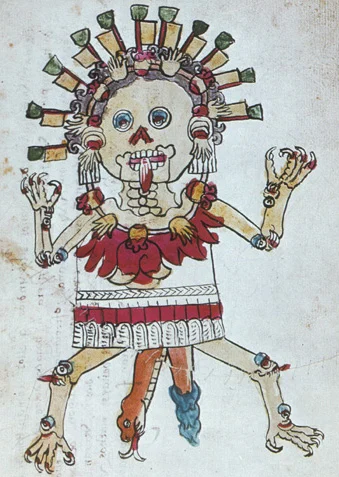
The beings also appear in material and pictorial descriptions. Book VIII’s military insignia include a gold toztzitzimitl figure, a green-feathered xoxouhquitzitzimitl with gold, and a corresponding white-feathered iztactzitzimitl. These names describe representations carried or worn in war. Cecelia Klein’s iconographic study compares the skeletal figures of Codex Magliabechiano 76r and Codex Tudela 46r, including their glaring eyes, disordered hair, grasping limbs and shell-bordered skirts. She reads the skirts as evidence of female identities obscured by some male Spanish glosses, and argues that the beings also possessed generative and protective powers. Other texts name male sacred figures among them. Their gender and membership therefore require attention to the particular image or account.
Origins & earliest records
Sixteenth-century Nahua testimony and colonial manuscript paintings preserve several accounts of tzitzimime. Klein compares early pictorial and prose witnesses rather than deriving every figure from one fixed prototype. The selected 1829 Sahagún printing transmits older testimony; neither its publication nor an archive upload establishes the beginning of the religious tradition.
Records & interpretation
The inspected Sahagún volume II locates the famine prayer in Book VI.VIII, p. 67; New Fire fears in Book VII.X, pp. 261–262; and named insignia in Book VIII.XII, pp. 296–297. Klein’s 2000 study offers an argued interpretation of manuscript costume and gender. Spanish demon terminology and male glosses do not settle the identity of every painted figure.
In the literature
“un monstruo hecho de oro”
BookVIII chXII, p296; toztzitzimitl insignia
Description of named military regalia; a representation rather than the being’s literal anatomy.
Selected bibliography
Documented works and useful reading. This is not a list of every appearance.
- 01
Historia general de las cosas de Nueva España, tomo II
Selected direct passages: VI.VIII p. 67; VII.X pp. 261–262; VIII.XII pp. 296–297. Editorial footnotes excluded.
- 02
The Devil and the Skirt: An Iconographic Inquiry into the Prehispanic Nature of the Tzitzimime
Estudios de Cultura Náhuatl 31, pp. 16–74; especially pp. 16–22 for the manuscript comparison and interpretation. Selected scholarship, not complete literature.
- 03
Historia general de las cosas de Nueva España, tomoII
Bernardino de Sahagún and Nahua collaborators, Historia general de las cosas de Nueva España, tomoII,1829, edited by Carlos María de Bustamante. Selected BookVIII paragraphs read; original printed270,295,296 visually checked. Editor footnotes excluded.
Family & connections
A source-supported family tree or inspiration record has not yet been compiled for this profile. Related reading below indicates a connection in subject matter, not a proven lineage or creative influence.
Located primary passages
Specific passages supporting details in this entry, grouped by their published witness.
Historia general de las cosas de Nueva España, tomo II
Bernardino de Sahagún and Nahua collaborators, Historia general de las cosas de Nueva España, tomoII,1829, edited by Carlos María de Bustamante. Selected BookVIII paragraphs read; original printed270,295,296 visually checked. Editor footnotes excluded.
- The historical account reports fear during a solar eclipse in Avitzotl’s reign that named celestial monsters would descend and eat men and women. It documents a reported apprehension, not an observed descent or independent astronomical validation of the stated duration. The printed name reads tzitzimus rather than OCR tzitzimu.
- The warfare dress list describes toztzitzimitl as a golden monster-shaped element, xoxouhquitzitzimitl with green feathers and gold, and iztactzitzimitl with white plumage. These are material insignia named with tzitzimitl compounds; their descriptions do not establish one universal celestial being’s anatomy.
Only selected complete relevant paragraphs and surrounding page context independently checked. No ritual/prayer passages excerpted; colonial glosses not treated as neutral indigenous categories.
Encyclopedia background
An additional attributed reference, separate from the editorial profile above.
Read the open encyclopedia overview
A Tzitzimītl (plural Tzitzimīmeh) is a type of celestial deity associated with stars in Aztec mythology. They were depicted as skeletal female figures wearing skirts often with skull and crossbones designs. In post-conquest descriptions they are often described as "demons" or "devils", but this does not necessarily reflect their function in the Cemanahuacan belief system of the Aztecs.
The Tzitzimimeh were female deities and related to fertility. They were associated with the Cihuateteo and other female deities such as Tlaltecuhtli, Cōātlīcue, Citlālicue and Cihuacōātl, and they were worshipped by midwives and parturient women. The leader of the tzitzimimeh was the goddess Itzpapalotl, who was the ruler of Tamoanchan, the paradise where the Tzitzimimeh resided.
The Tzitzimimeh were also associated with the stars and especially the stars that can be seen around the Sun during a solar eclipse. This was interpreted as the Tzitzimimeh attacking the Sun, thus causing the belief that during a solar eclipse, the tzitzimime would descend to the earth and possess men. It was said that if the Aztecs could not start a bow fire in the empty chest cavity of a sacrificed human at the end of a 52-year calendar round, the fifth sun would end and they would descend to devour the last of men. The Tzitzimimeh were also feared during other ominous periods of the Aztec world, such as during the five unlucky days called Nemontemi which marked an unstable period of the xiuhpōhualli (solar year count) and during the New Fire ceremony marking the beginning of a new calendar round; both were periods associated with the fear of change.
The Tzitzimimeh had a double role in Aztec religion: they were protectresses of the feminine and progenitresses of mankind. They were also powerful and dangerous, especially in periods of cosmic instability.
Text from Wikipedia contributors, “Tzitzimitl”. CC BY-SA 4.0. Extracted introduction; formatting changed. Retrieved 5 October 2026. The source article may have changed since retrieval.
References
Sources supporting this profile. Linked pages have their own scope and editorial standards.
- ResearchHistoria general, tomo II (1829), selected celestial and military passagesResearch access: 2026-10-05
- ResearchKlein (2000), The Devil and the SkirtResearch access: 2026-10-05
Image credits
Reference illustrationTzitzimime
Image associated with the exact linked encyclopedia article; consult credited file description for its interpretation.