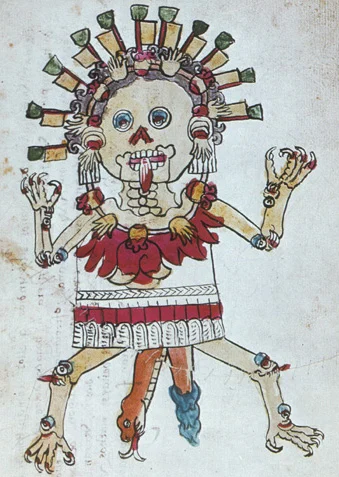
Itzpapalotl
Image associated with the exact linked encyclopedia article; consult credited file description for its interpretation.
Overview
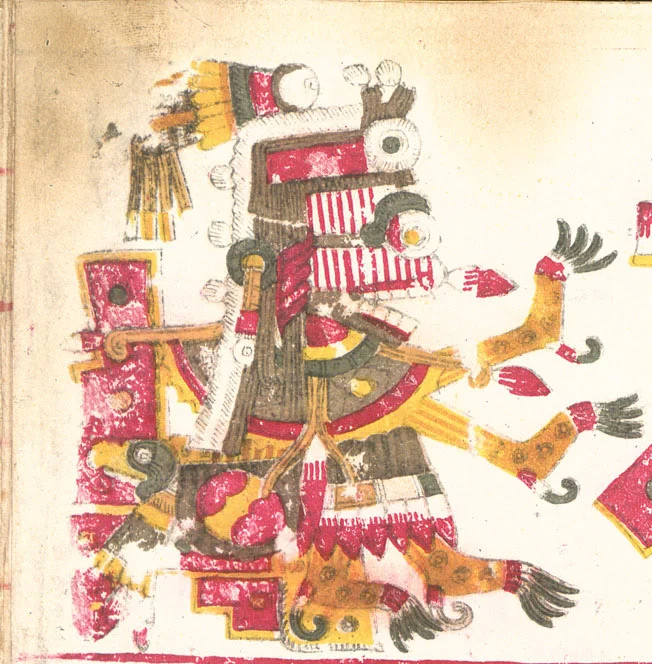
The INAH museum at El Cerrito presents Itzpapálotl as the patron goddess guiding seven Toltec-Chichimeca peoples from Chicomoztoc, the Hill of the Seven Caves. Its account points to Codex Cuauhtinchan 2 as a pictorial witness to the emergence and movement of those peoples. The goddess belongs here to a sacred explanation of origins, language and communal identity.
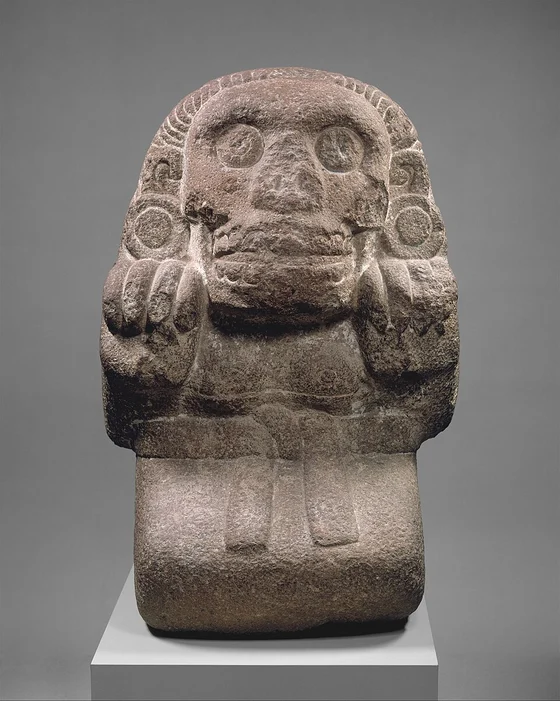
The museum also exhibits a carved stone stela representing her and describes an altar offering dedicated to her, including incense burners, flint points and beads. These material witnesses connect the named figure with a particular ceremonial setting. The profile accordingly keeps patronage, religious imagery and archaeology together without stripping the goddess into a creature's combat abilities. A museum's identification of an image remains an interpretation supported by context, distinct from a biological species or a proof that one surviving object marks the cult's beginning.
A different historical witness is the Nahuatl hymn printed as Teteuynan ycuic in Daniel Brinton’s 1890 Rig Veda Americanus. Its fifth stanza contains itzpapalotli, within a song addressing a maternal divine power and repeatedly invoking Tamoanchan. Brinton’s English paraphrase presents a shining butterfly, while his glossary treats the word as the name of a gold-and-feather royal insignia. His note on the stanza also proposes an ornamental reading for another difficult word. These alternatives matter: the occurrence cannot simply be turned into a literal description of the El Cerrito stela or a complete account of Itzpapalotl’s body.
Brinton also discusses Itzpapalotl in his notes to the separate Xochiquetzal hymn. Citing Codex Telleriano-Remensis, he treats the name as a synonym there but suggests that it may refer to an ornament of the image. This is a nineteenth-century interpretation, not a reason to collapse the two goddesses into one universal identity. In his preface Brinton explicitly presents his translations as tentative paraphrases. His introduction says he adopted the Madrid Sahagún manuscript’s readings and Nahuatl gloss, adding variants from the Florentine manuscript; the two codices themselves have not been independently read for this profile.
Origins & earliest records
The El Cerrito museum guide assigns its Itzpapálotl stela to 900–1200 CE; that is a dating of an artefact, not a first appearance of the goddess. Codex Cuauhtinchan 2 preserves another historical representation. The available witnesses do not establish the first oral origin narrative or a single chronology for every community's devotion.
Records & interpretation
INAH's gallery account directly supports the patron-guided emergence narrative and identifies the stela. Its site guide and offering description provide material context. This evidence documents representation and religious practice, while leaving questions of earlier worship and cross-regional variation open; no claim is made that a stone image records a literally observed supernatural anatomy. Brinton’s complete IV and IX document the name within an early published Nahuatl hymn edition and his historical interpretation, without replacing current archaeological attribution or independently verifying the underlying codices.
In the literature
“las alas y cola á modo de mariposa”
BookVIII chXII, p295; named insignia
Description of named military regalia; a representation rather than the being’s literal anatomy.
Selected bibliography
Documented works and useful reading. This is not a list of every appearance.
- 01
Codex Cuauhtinchan 2
Pictorial origin narrative identified by the museum; no complete direct codex reading claimed.
- 02
La estela guerrero Itzpapálotl de El Cerrito
Relevant study, pp. 27–48, verified in the INAH site-guide bibliography; full article not inspected.
- 03
Rig Veda Americanus: Sacred Songs of the Ancient Mexicans, with a Gloss in Nahuatl
Complete preface/introduction, hymn IV with gloss and notes, hymn IX with gloss and notes, and Itzpapalotl glossary entry read. The printed Nahuatl occurrence, Brinton’s paraphrase and his iconographic conjectures remain distinct.
- 04
Historia general de las cosas de Nueva España, tomoII
Bernardino de Sahagún and Nahua collaborators, Historia general de las cosas de Nueva España, tomoII,1829, edited by Carlos María de Bustamante. Selected BookVIII paragraphs read; original printed270,295,296 visually checked. Editor footnotes excluded.
Family & connections
A source-supported family tree or inspiration record has not yet been compiled for this profile. Related reading below indicates a connection in subject matter, not a proven lineage or creative influence.
Located primary passages
Specific passages supporting details in this entry, grouped by their published witness.
Historia general de las cosas de Nueva España, tomoII
Bernardino de Sahagún and Nahua collaborators, Historia general de las cosas de Nueva España, tomoII,1829, edited by Carlos María de Bustamante. Selected BookVIII paragraphs read; original printed270,295,296 visually checked. Editor footnotes excluded.
- The dress catalogue names an itzpapalotl back insignia with butterfly-like feather wings and tail, golden eyes, nails, feet and brows, and feather bunches compared to horns. This is a located representation report, not a direct account of the deity’s actions or a universal bodily specification. The compiler’s devil comparison is colonial framing.
Only selected complete relevant paragraphs and surrounding page context independently checked. No ritual/prayer passages excerpted; colonial glosses not treated as neutral indigenous categories.
Encyclopedia background
An additional attributed reference, separate from the editorial profile above.
Read the open encyclopedia overview
Ītzpāpalōtl ("Obsidian Butterfly") was a goddess in Aztec religion.
She was a striking skeletal warrior and death goddess and the queen of the Tzitzimimeh. She ruled over the paradise world of Tamōhuānchān, the paradise of victims of infant mortality and the place identified as where humans were created.
She is the mother of Mixcoatl and is particularly associated with the moth Rothschildia orizaba from the family Saturniidae. Some of her associations are birds and fire. However, she primarily appears in the form of the Obsidian Butterfly.
Text from Wikipedia contributors, “Ītzpāpālōtl”. CC BY-SA 4.0. Extracted introduction; formatting changed. Retrieved 5 October 2026. The source article may have changed since retrieval.
References
Sources supporting this profile. Linked pages have their own scope and editorial standards.
- MuseumINAH El Cerrito — Room 1: The Origins of the ToltecsResearch access: 2026-10-05
- MuseumINAH El Cerrito — Sacralización del EspacioResearch access: 2026-10-05
- MuseumINAH El Cerrito museum mini-guideResearch access: 2026-10-05
- Primary textBrinton1890: Nahuatl hymns, glosses and explicitly tentative English paraphrasesResearch access: 2026-10-05
Image credits
Reference illustrationItzpapalotl
Image associated with the exact linked encyclopedia article; consult credited file description for its interpretation.