Cihuateteo
Image associated with the exact linked encyclopedia article; consult credited file description for its interpretation.
Overview
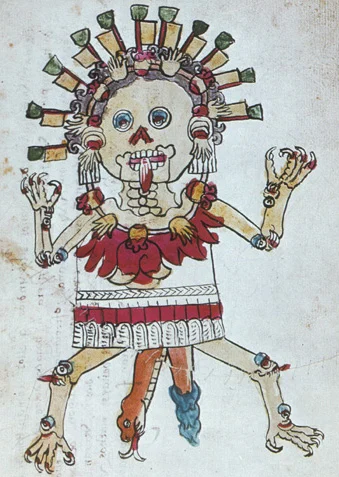
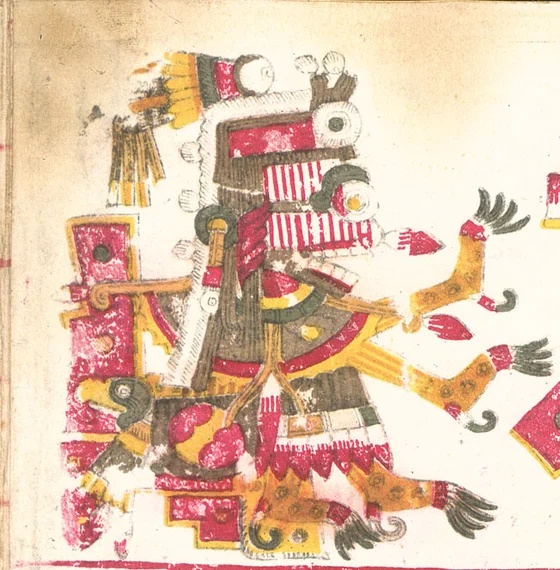
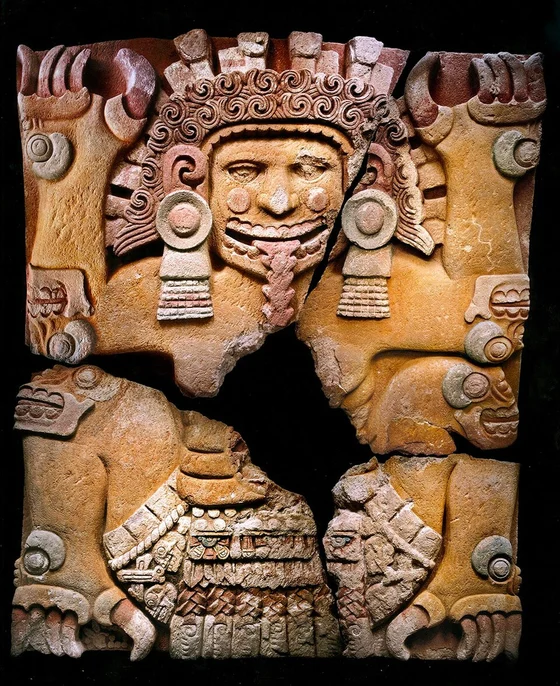
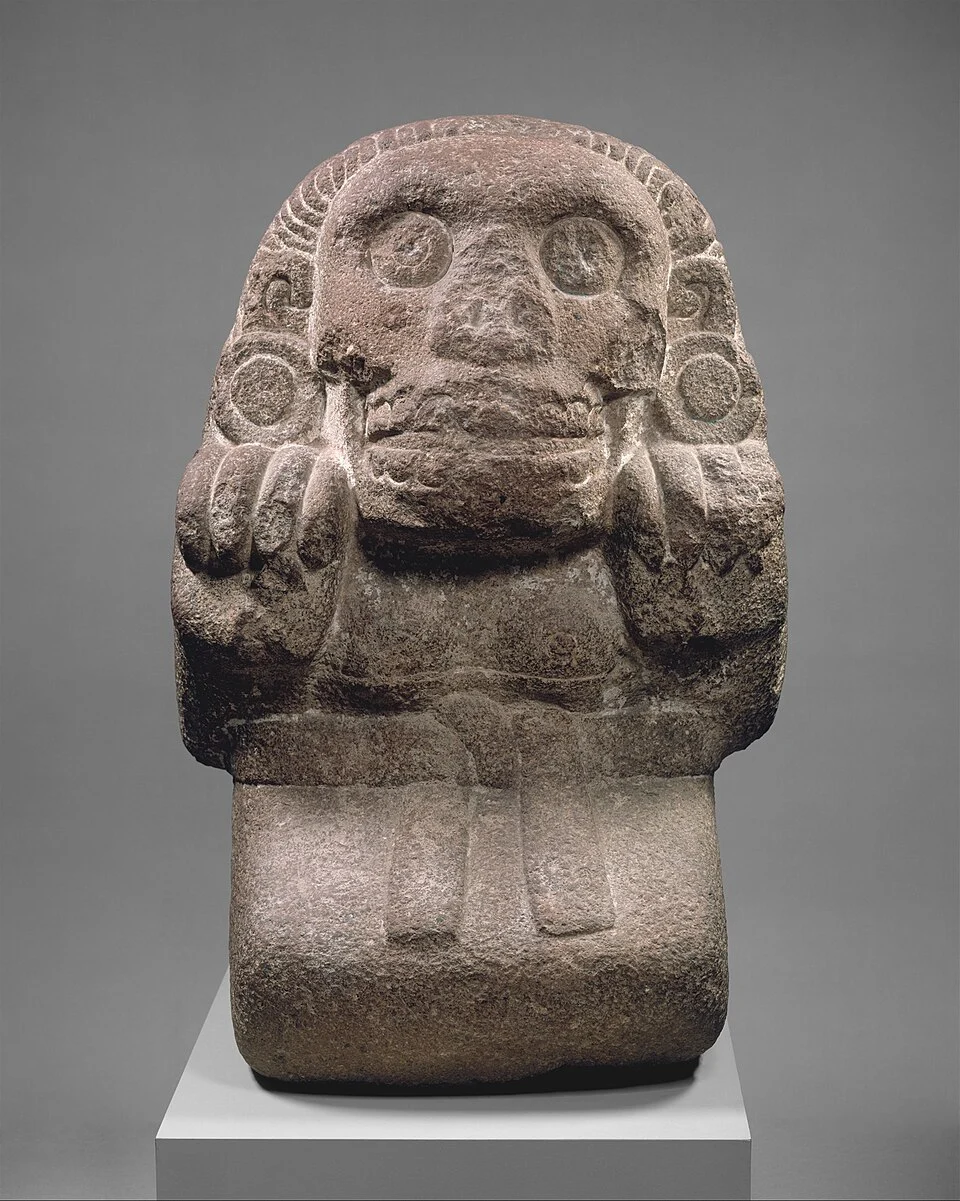
Cihuateteo are divine women associated with childbirth death. Museum interpretation connects them with escorting the afternoon sun toward the west, where they reside in Cihuatlampa. The Met’s surviving sculpture has a skull-like face, staring eyes, exposed teeth and disordered hair. A plain skirt and knotted belt accompany raised talons and clawed feet. Its head bears Ce Calli, 1 House, a day of descent. The museum lists four other descent days: 1 Deer, 1 Rain, 1 Monkey and 1 Eagle. These repeated calendar occasions give the figures a place in ritual time as well as a powerful physical representation.
Sahagún’s calendar account gives the descent practical consequences for families and religious specialists. During the sign 1 Rain, parents tell children to remain indoors because the descending Cioateteu may bring illness. People make offerings at their many oratories and cover the statues with paper. The separate 1 House chapter again records their descent, but also describes physicians and midwives as devoted to that sign, making sacrifices and offerings in their homes. These passages join fear of harmful encounters with active worship and specialist obligations. Crossroads shrines and recurring dates provide settings more specific than a wandering-ghost story. The Met proposes that its figure and four comparable, differently dated Mexico City sculptures originally formed a set; their original placement remains uncertain.
Origins & earliest records
Mexica sculpture dated to the fifteenth and early sixteenth centuries and sixteenth-century textual testimony document the figures. The Met’s object 00.5.30 entered its collection in 1900, a date of acquisition. Sahagún’s selected calendar passages appear in the 1829 volume I printing, which preserves earlier testimony rather than dating the start of the tradition.
Records & interpretation
The Met’s collection essay, credited to William T. Gassaway, supplies the sculpture’s features, solar setting and five descent dates. Sahagún’s Book IV, chapter XI, pp. 302–303, and chapter XXVII, pp. 323–324, directly support offerings, paper-adorned statues, child-protection restrictions and physicians’ and midwives’ devotion. The proposed original sculptural set and shrine placement remain museum interpretations.
Selected bibliography
Documented works and useful reading. This is not a list of every appearance.
- 01
Cihuateotl
Selected collection-object interpretation; museum catalogue is not the whole literature.
- 02
Lugar del eterno renacimiento del Sol
Institutional interpretation of Mexica cosmological service and childbirth death.
- 03
Historia general de las cosas de Nueva España, tomo I
Book IV.XI pp. 302–303 and IV.XXVII pp. 323–324; selected calendar passages inspected directly.
Family & connections
A source-supported family tree or inspiration record has not yet been compiled for this profile. Related reading below indicates a connection in subject matter, not a proven lineage or creative influence.
Encyclopedia background
An additional attributed reference, separate from the editorial profile above.
Read the open encyclopedia overview
In Aztec mythology, the Cihuateteo (; Classical Nahuatl: Cihuātēteoh, in singular Cihuātēotl) or "Divine Women", were the spirits of women who died in childbirth. They were likened to the spirits of male warriors who died in violent conflict, because childbirth was conceptually equivalent to battle in Aztec culture. According to tradition, a woman in labor was said to capture the spirit of her newborn child similar to the way a warrior captures his opponent in battle. These spirits are also associated with the west, the place where the sun sets each day.
Text from Wikipedia contributors, “Cihuateteo”. CC BY-SA 4.0. Extracted introduction; formatting changed. Retrieved 5 October 2026. The source article may have changed since retrieval.
References
Sources supporting this profile. Linked pages have their own scope and editorial standards.
- MuseumCihuateotlResearch access: 2026-10-05
- MuseumLugar del eterno renacimiento del SolResearch access: 2026-10-05
- ResearchHistoria general, tomo I (1829), Book IV.XI and IV.XXVIIResearch access: 2026-10-05
Image credits
Reference illustrationCihuateteo
Image associated with the exact linked encyclopedia article; consult credited file description for its interpretation.