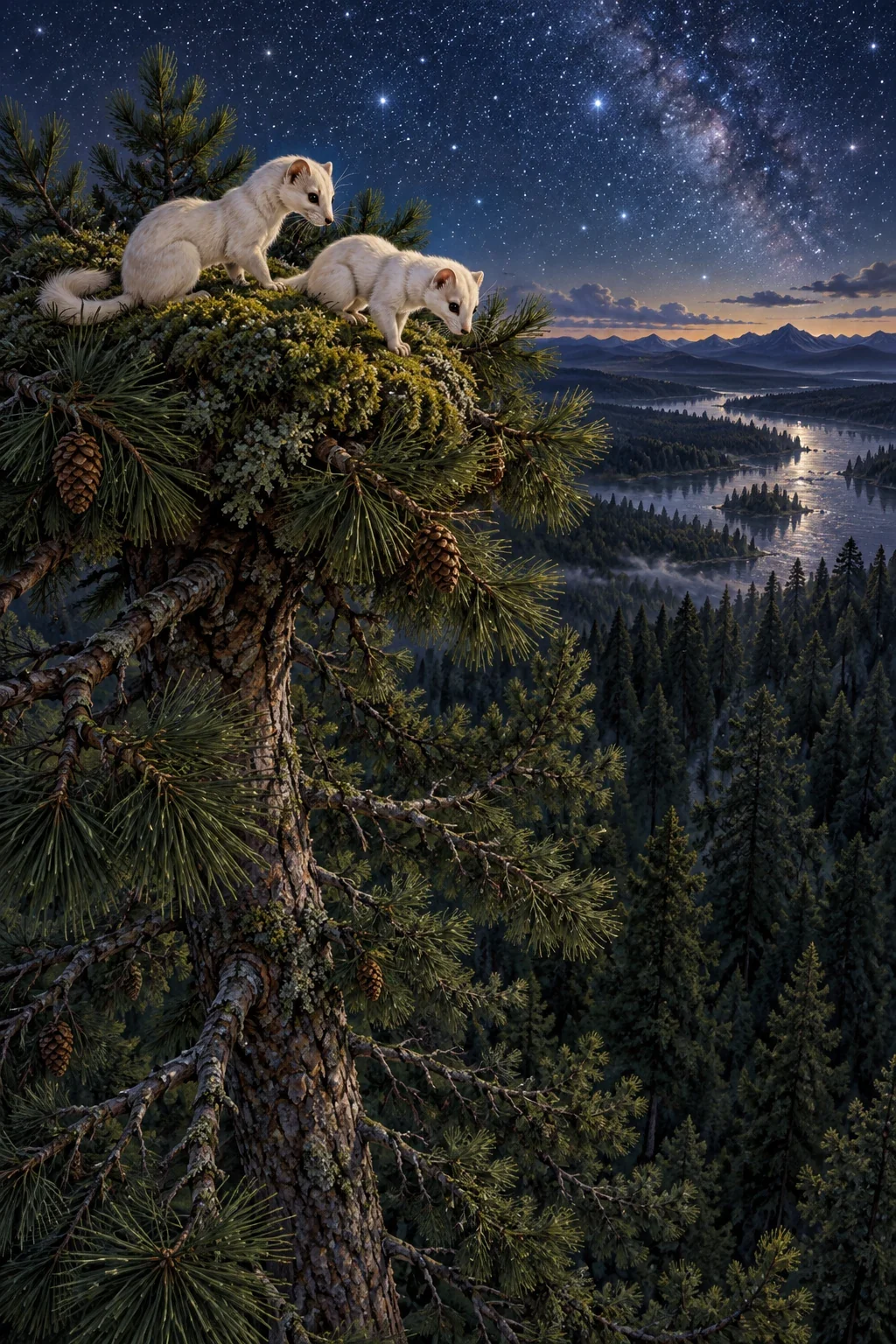
AI-generated interpretation of the transformed sisters’ treetop refuge in Ben Brooks’s Two Weasels account, translated by Rand. White weasels, moss, pine and stars follow the scene. Exact animal appearance, landscape, light and composition are imagined; not a natural-history portrait or ethnographic evidence.
AI-generated interpretation of the transformed sisters’ treetop refuge in Ben Brooks’s Two Weasels account, translated by Rand. White weasels, moss, pine and stars follow the scene. Exact animal appearance, landscape, light and composition are imagined; not a natural-history portrait or ethnographic evidence.
Overview
Two daughters of a widow, nicknamed Weasels because of their fair appearance, lose their way while digging ground-nuts. Looking at the stars, the elder chooses a large-eyed husband and the younger a small-eyed one. The stars hear them. One visitor appears as a splendid warrior; the other is an old man with sore, nearly closed eyes. They tell the sisters to remain still until the ground squirrels sing. When the girls look around, they are high in a pine on a moss bed, changed into weasels while retaining human understanding. Their wishes bring neither the expected marriages nor an easy way down.
Moose, Bear and Marten refuse their requests for rescue. Badger brings them down, intending to amuse himself by tormenting them. The elder delays him by asking him to retrieve her hair-string, knotted among the branches. While he unties it, the sisters prepare a false bridal lodge containing thorns, ants and hornets, then flee. Voices inside lure him from one painful encounter to another. At a river, Crane demands praise before stretching his neck into a bridge for the sisters. Badger’s sarcastic praise offends him; the bridge shakes and drops the pursuer into the rapids, leaving him dead on the shore.
The journey continues beyond that escape. In a deserted lodge the younger sister disrespects a neck-bone, provoking a mocking night-time disturbance. They are frightened but unharmed. A young man lets them cross the river on his bow without accepting their offer of marriage. Loon and Scapegrace then take them into a canoe. Loon misrepresents his origins to impress them, while his companion warns them against believing him. Among the sea-duck people the sisters marry two young chiefs. Loon’s attempt to attract sympathy by capsizing fails, and the women settle in their new homes.
The final episode follows their younger brother. Searching for them, he reaches Badger’s decaying body, which speaks and rises as a man. Badger claims he can lead him to his sisters, breaks his weapons and ferries him to a distant point opposite their actual home, where he abandons him. The account explicitly leaves the brother there; it supplies no reunion. Rand credits Ben Brooks of Falmouth, Nova Scotia, and says he read his English rendering back for correction. The attached comparison with a second star-wives version does not make that uncollated account part of this one. The collector’s judgments about antiquity and animal habits remain separate from Brooks’s narrated sequence.
Origins & earliest records
Rand, Legends of the Micmacs, taleXX, The Two Weasels, pp160–168. Named teller Ben Brooks of Falmouth, Nova Scotia; no recording date stated in the attached attribution. Helen L. Webster edited the posthumous1894 collection.
Records & interpretation
Retained historical English OCR, not an original Mi’kmaw-language transcript or present community-wide statement. The preface describes Rand writing English from remembered narration and notes, then reading it back, with later editorial changes.
Selected bibliography
Documented works and useful reading. This is not a list of every appearance.
- 01
Legends of the Micmacs, XX: The Two Weasels
Complete pp160–168, all attached notes and closing attribution; complete editorial prefacev–ix. LIII comparison cited through note only, not independently collated.
Family & connections
A source-supported family tree or inspiration record has not yet been compiled for this profile. Related reading below indicates a connection in subject matter, not a proven lineage or creative influence.
References
Sources supporting this profile. Linked pages have their own scope and editorial standards.
- Primary historical translated collectionRand1894, The Two WeaselsResearch access: 2026-10-27
Image credits
AI-generated illustrationAI-generated interpretation of the transformed sisters’ treetop refuge in Ben Brooks’s Two Weasels account, translated by Rand. White weasels, moss, pine and stars follow the scene. Exact animal appearance, landscape, light and composition are imagined; not a natural-history portrait or ethnographic evidence.
AI-generated interpretation of the transformed sisters’ treetop refuge in Ben Brooks’s Two Weasels account, translated by Rand. White weasels, moss, pine and stars follow the scene. Exact animal appearance, landscape, light and composition are imagined; not a natural-history portrait or ethnographic evidence.