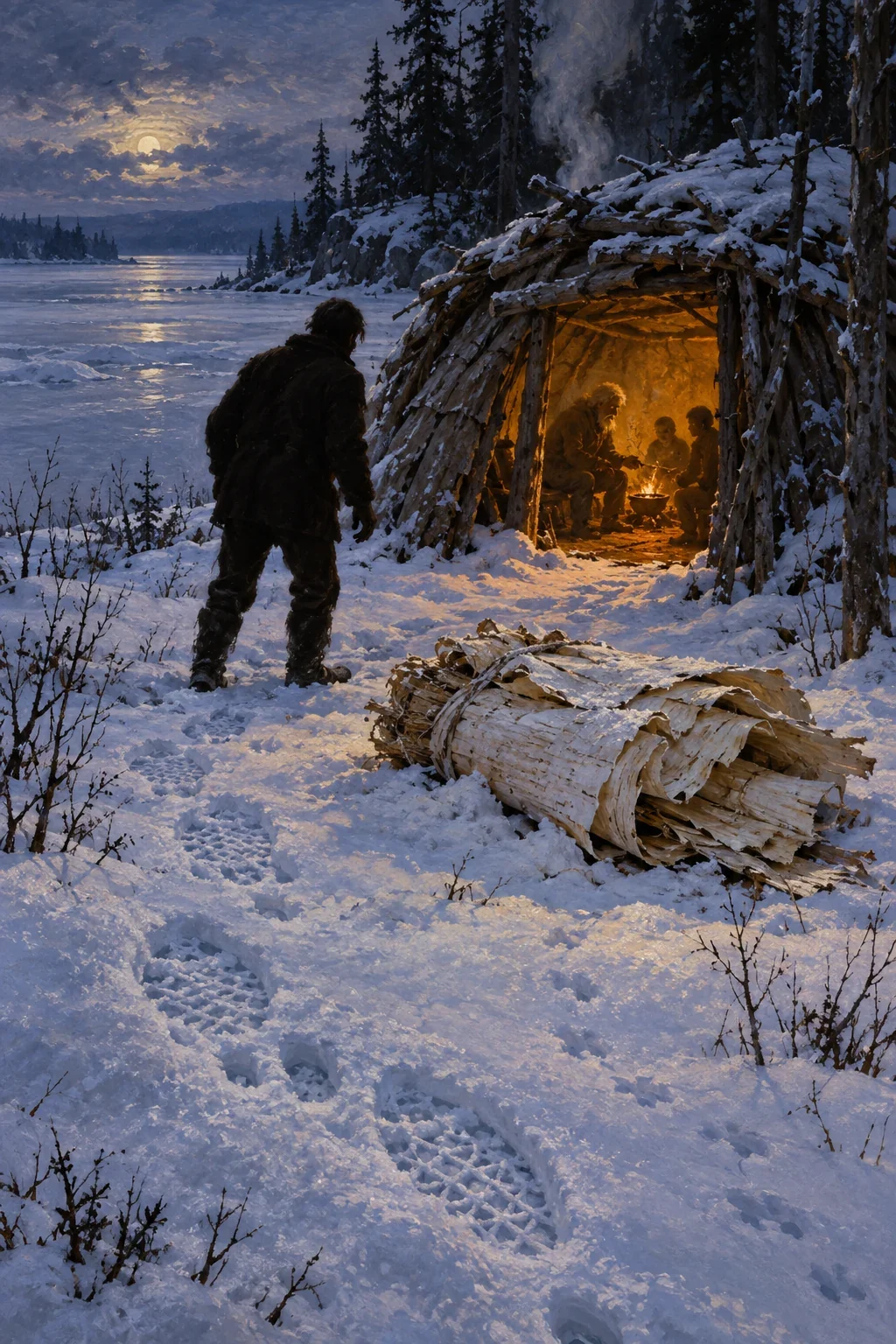
AI-generated contextual composite for Rand’s Beaver Magicians and the Big Fish. The uncanny winter lodge and poplar-bark bundle represent successive narrative moments: the bark is discovered at the visitor’s own home in the text. Their juxtaposition here, building geometry, faces, garments, light, terrain and tracks are imagined. No beaver-human hybrid or ethnographic reconstruction is claimed.
AI-generated contextual composite for Rand’s Beaver Magicians and the Big Fish. The uncanny winter lodge and poplar-bark bundle represent successive narrative moments: the bark is discovered at the visitor’s own home in the text. Their juxtaposition here, building geometry, faces, garments, light, terrain and tracks are imagined. No beaver-human hybrid or ethnographic reconstruction is claimed.
Overview
A village faces hunger in deep winter. Encouraged by his wife, a hunter follows unfamiliar snowshoe tracks to a lake and a smoking lodge. An old host lies beside a roasting caribou head; younger hunters return with meat, and the stranger shares their meal. Hearing about the shortage, the host orders a large pack prepared for him. At home the visitor sends his wife to fetch what he calls a small bundle. Opening it reveals poplar bark instead of meat. The telling first explains that his hosts were an old beaver and its descendants, whose food had appeared to him as human provisions.
The villagers take the encounter as a possible lead to actual game. Returning with the hunter, they kill a bear and carry it home before resuming the search. His own tracks remain, but the other tracks have disappeared. At the lake they find neither smoke nor lodge. The narrator now calls the host a wily magician who had played beaver and deceived his guest’s senses. These successive explanations are retained rather than resolved into a fixed body or an unquestioned species identity. Rand’s accompanying remarks about beaver families and the universal powers of magicians are commentary, not independent confirmation of the disappearing household.
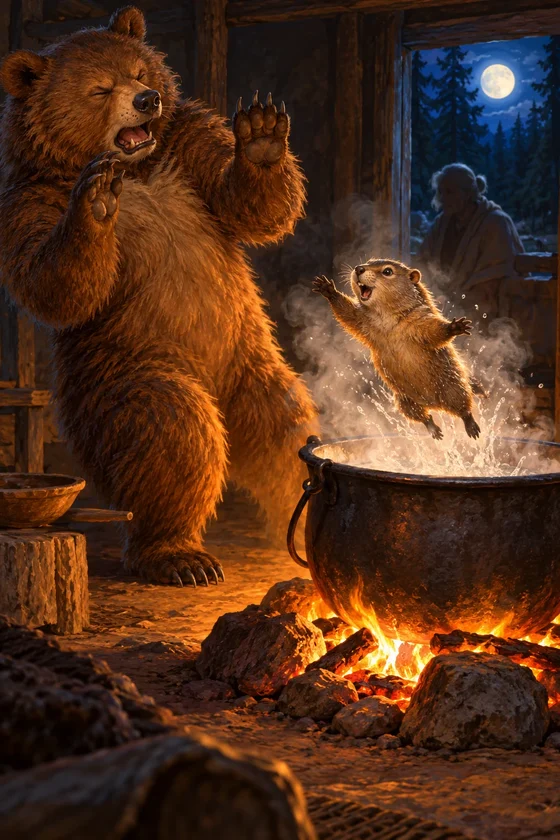
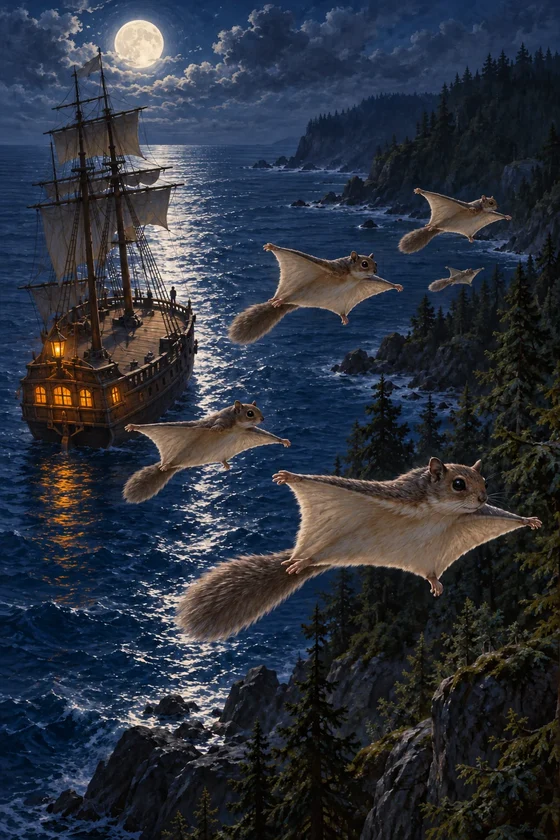
The account does not end with the failed hunt. Its human protagonist proposes looking for a whale, despite his companions’ objections. When the sea becomes calm, he goes ashore with a wind instrument instead of taking a canoe and spears. Others leave after waiting without success, but he keeps playing. A distant whale hears what resembles its mate’s cries, approaches and strands. The community cuts up the animal, preserves the blubber and distributes portions to neighbours. Food lasts through the rest of the season. That final relief contrasts with the apparent hospitality that supplied only bark; neither supernatural illusion nor the successful pipe should be mistaken for a documented method of hunting.
Origins & earliest records
Rand, Legends of the Micmacs, taleLXVI, The Beaver Magicians and the Big Fish, pp351–353. The selected unit names no individual narrator. The posthumous collection was edited by Helen L. Webster and published1894.
Records & interpretation
Complete historical English narrative and its attached note. The text shifts from beaver-family explanation to a magician playing beaver; no independent observation settles that ambiguity. Collector natural-history and medical assertions are not adopted.
Selected bibliography
Documented works and useful reading. This is not a list of every appearance.
- 01
Legends of the Micmacs, LXVI: The Beaver Magicians and the Big Fish
Complete pp351–353 including beaver-family note, disappearing-house episode and whale-piping ending; complete editorial prefacev–ix.
Family & connections
A source-supported family tree or inspiration record has not yet been compiled for this profile. Related reading below indicates a connection in subject matter, not a proven lineage or creative influence.
References
Sources supporting this profile. Linked pages have their own scope and editorial standards.
- Primary historical translated collectionRand1894, The Beaver Magicians and the Big FishResearch access: 2026-10-27
Image credits
AI-generated illustrationAI-generated contextual composite for Rand’s Beaver Magicians and the Big Fish. The uncanny winter lodge and poplar-bark bundle represent successive narrative moments: the bark is discovered at the visitor’s own home in the text. Their juxtaposition here, building geometry, faces, garments, light, terrain and tracks are imagined. No beaver-human hybrid or ethnographic reconstruction is claimed.
AI-generated contextual composite for Rand’s Beaver Magicians and the Big Fish. The uncanny winter lodge and poplar-bark bundle represent successive narrative moments: the bark is discovered at the visitor’s own home in the text. Their juxtaposition here, building geometry, faces, garments, light, terrain and tracks are imagined. No beaver-human hybrid or ethnographic reconstruction is claimed.