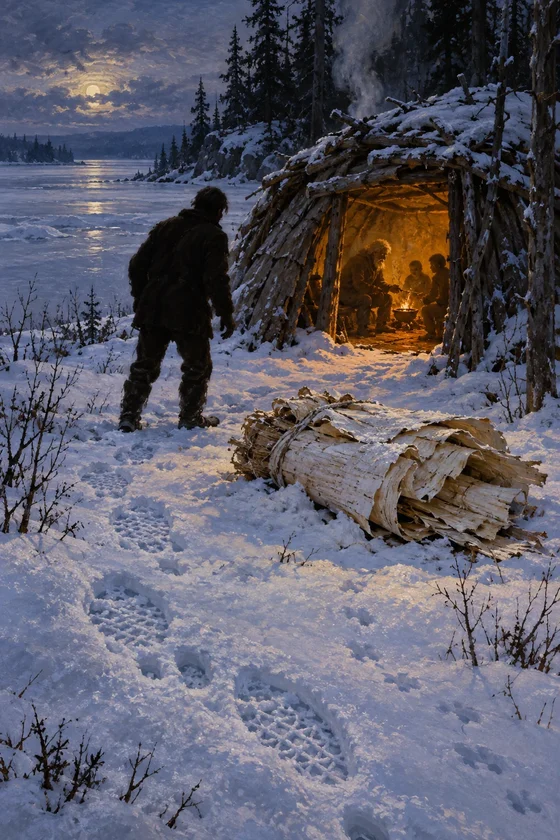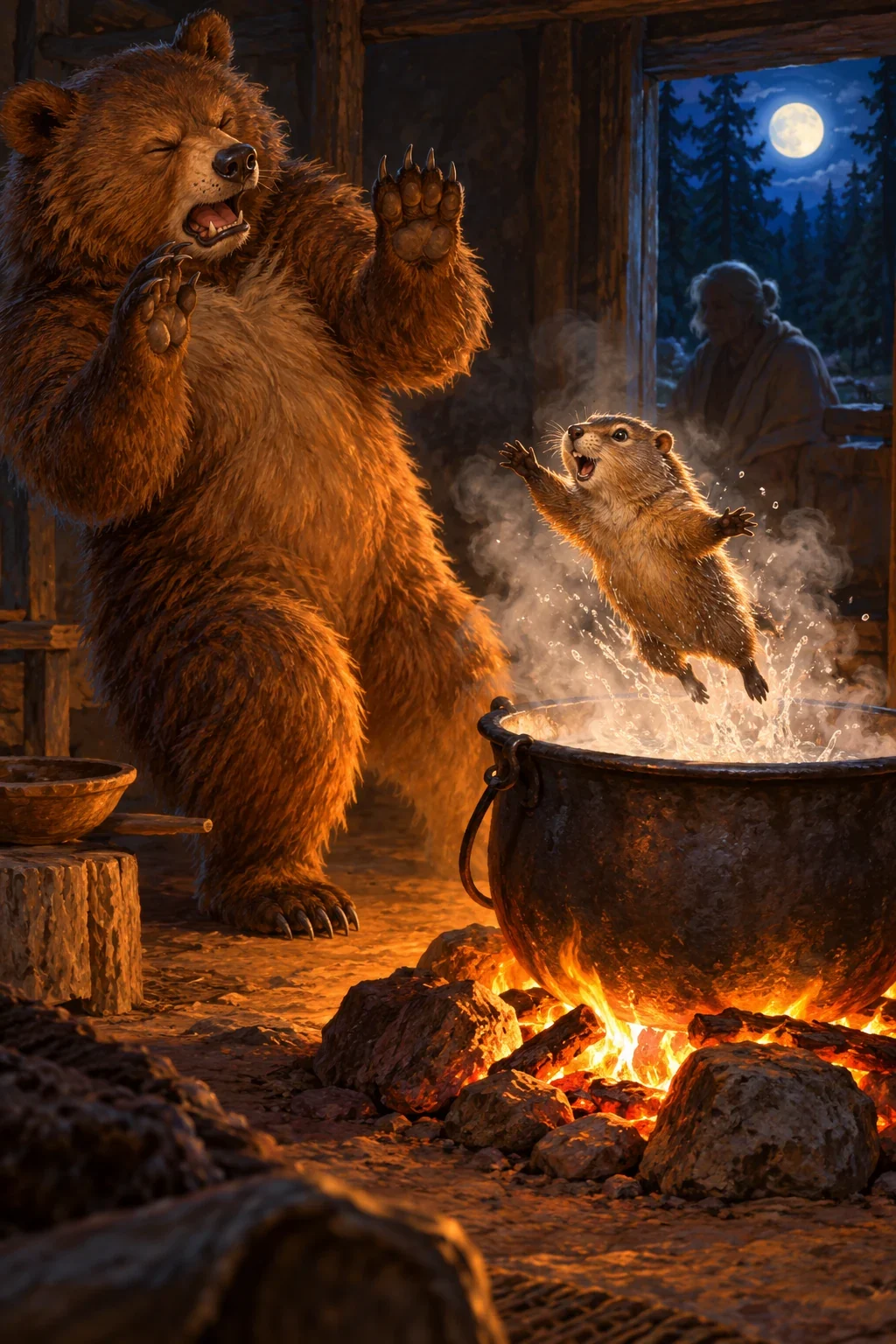
AI-generated interpretation of Woodchuck’s revival and kettle escape in Rand’s Bear-and-Woodchuck account. The revival and disturbance follow the story. Bear’s animal form, her companion’s face and wrap, kettle, shelter, lighting and exact appearances are imagined; the text shifts between old-woman and Bear descriptions. Not an ethnographic reconstruction or portrait.
AI-generated interpretation of Woodchuck’s revival and kettle escape in Rand’s Bear-and-Woodchuck account. The revival and disturbance follow the story. Bear’s animal form, her companion’s face and wrap, kettle, shelter, lighting and exact appearances are imagined; the text shifts between old-woman and Bear descriptions. Not an ethnographic reconstruction or portrait.
Overview
Two old women share an isolated household, doing their own hunting and gathering wood. Their comfortable winter routine is disturbed by Moonumkwech, translated as Woodchuck. Seeing them asleep beside the fire, he heats a stick and touches their feet in turn. Each blames the other for burning her. He enjoys the quarrel so much that he laughs until his sides split and he falls dead outside. The literal death turns an apparent figure of speech into an event within this telling.
Finding the body in the morning, the women prepare it for food. When the pieces begin boiling, Woodchuck returns to life, collects himself together and escapes from the kettle. Outside he retrieves his skin, described as a coat, puts it on and runs into the forest. His exit spills scalding water into the fire, throwing ashes into Bear’s eyes. The narrative now identifies one of the women as Mooin, or Bear. Her other companion remains unnamed; she should not be confused with the male Woodchuck who has just departed.
Unable to hunt, Bear relies on her housemate. That dependence brings a second injury to their relationship: the companion gives her small portions of the leanest meat while keeping better food available. Alone, Bear sharpens a knife and cuts across her eyes until her sight returns. This is an extraordinary narrated recovery, not an independently supported treatment. She can now see the fat meat hanging in the lodge. When her companion again serves the poor portion, Bear looks from that meat to the woman’s face.
The companion realises that Bear can see and fears her resentment. She quickly exchanges their dishes, claiming that she had accidentally served her own meal to Bear. The story ends with the women living harmoniously again, as they had before Woodchuck’s arrival. It neither punishes him further nor makes Bear pursue him. The restored domestic arrangement completes the account beyond the trickster’s spectacular escape. Rand’s short unit supplies no individual narrator, recording date or fixed physical design for its animal-person characters.
Origins & earliest records
Legends of the Micmacs, LVIII, Mooin and Moonumkwech (The Bear and the Woodchuck), pp334–335. Posthumous1894 collection translated by Silas Tertius Rand and edited by Helen L. Webster.
Records & interpretation
Complete historical English narrative in retained OCR; no original-language transcript or individual narrator supplied in this unit. Animal names and human domestic roles coexist within the story, without establishing a uniform anatomy or present-day spiritual account.
Selected bibliography
Documented works and useful reading. This is not a list of every appearance.
- 01
Legends of the Micmacs, LVIII: Mooin and Moonumkwech
Complete pp334–335 and all ending text; complete editorial prefacev–ix reused from retained source. No attached unit footnote present.
Family & connections
A source-supported family tree or inspiration record has not yet been compiled for this profile. Related reading below indicates a connection in subject matter, not a proven lineage or creative influence.
References
Sources supporting this profile. Linked pages have their own scope and editorial standards.
- Primary historical translated collectionRand1894, The Bear and the WoodchuckResearch access: 2026-10-27
Image credits
AI-generated illustrationAI-generated interpretation of Woodchuck’s revival and kettle escape in Rand’s Bear-and-Woodchuck account. The revival and disturbance follow the story. Bear’s animal form, her companion’s face and wrap, kettle, shelter, lighting and exact appearances are imagined; the text shifts between old-woman and Bear descriptions. Not an ethnographic reconstruction or portrait.
AI-generated interpretation of Woodchuck’s revival and kettle escape in Rand’s Bear-and-Woodchuck account. The revival and disturbance follow the story. Bear’s animal form, her companion’s face and wrap, kettle, shelter, lighting and exact appearances are imagined; the text shifts between old-woman and Bear descriptions. Not an ethnographic reconstruction or portrait.