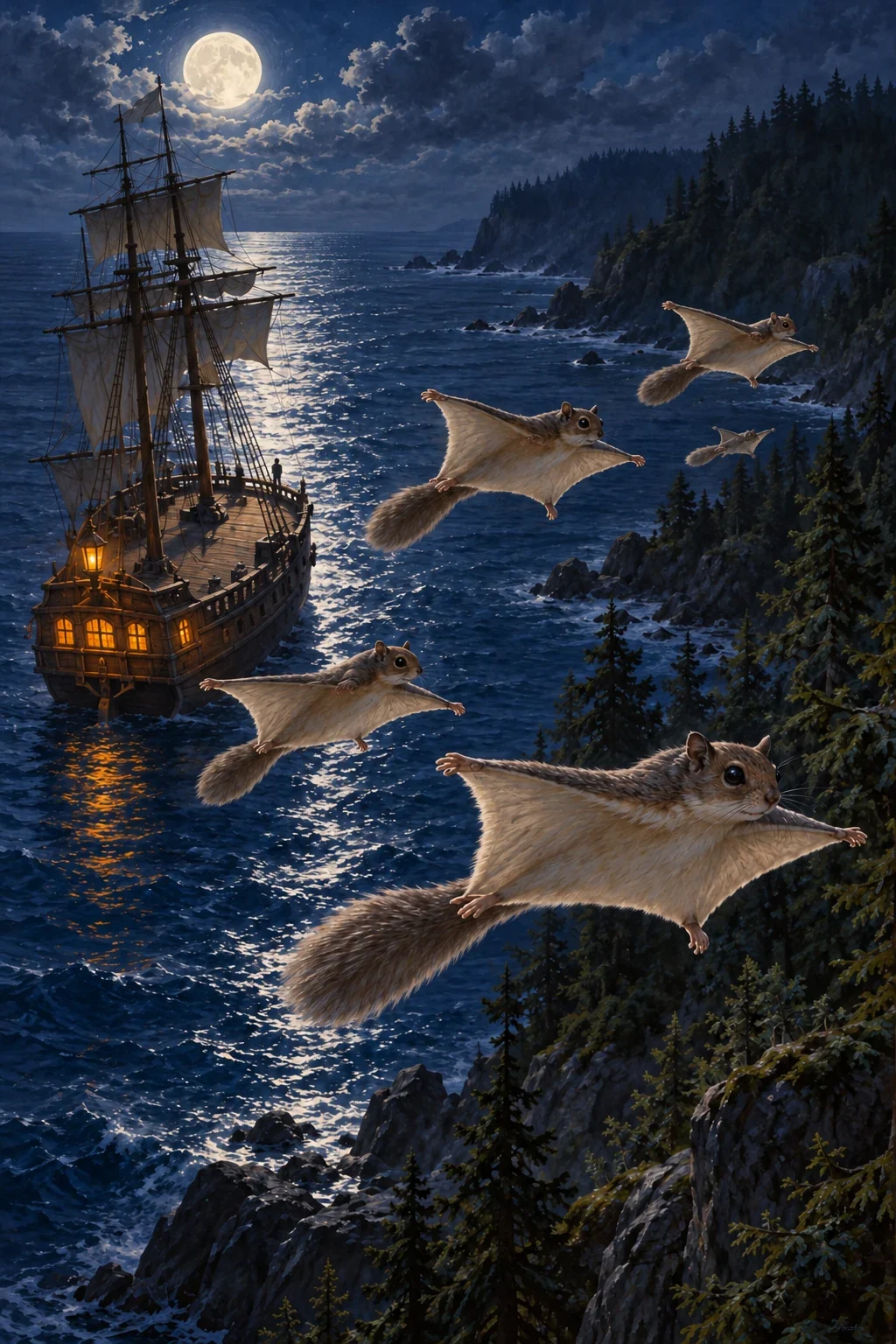
AI-generated interpretation of the Flying Squirrel crew leaving the ship in Rand’s account. Airborne departure, abandoned vessel and eventual return ashore follow the story. Animal forms, gliding membranes, number, exact ship and coast, passenger appearance and light are artistic choices for an animal-person narrative, not a historical or ethnographic reconstruction.
AI-generated interpretation of the Flying Squirrel crew leaving the ship in Rand’s account. Airborne departure, abandoned vessel and eventual return ashore follow the story. Animal forms, gliding membranes, number, exact ship and coast, passenger appearance and light are artistic choices for an animal-person narrative, not a historical or ethnographic reconstruction.
Overview
Two brothers visit a neighbouring community called Sakskadook, translated as Flying Squirrels. Few inhabitants appear during the day, but after sunset the town becomes busy with people climbing trees and sailing overhead. A question about whether they are magicians receives a different answer: they are Flying Squirrels. The chief’s son agrees to travel with the brothers after seven days. While they go around a lake, he crosses through the air to meet them on the far side. The narrative gives his unusual movement without explaining a transformation or specifying a precise human-animal body.
The three journey north towards a royal city. They secure permission to use the ruler’s guarded bridge, presenting their leader as a chief’s son and the others as servants. After settling in the city, they announce the arrival of a vessel crewed by Flying Squirrels. The ruler and his son admire it and agree to buy it. The same crew is hired for a pleasure voyage with the prince. The two brothers hold the sale price and wages ashore and wait in the woods, while the provisioned vessel leaves with its new passenger.
At night the sailors exploit their ability to travel through the air and abandon the ship. The prince wakes to find it without its crew, drifting with wind and waves. He and his party eventually reach land and make their way home. The sellers and sailors divide the proceeds and return to their own town. Their flight is central to the deception; it does not make them rescuers or establish that they return the money after the prince’s ordeal.
The ruler follows them, but a leading inhabitant has been warned of the pursuit in a dream. The community takes flight before he arrives, leaving an empty town and no trail that his party can follow. The pursuers return with their loss, which closes the account. Rand’s footnote about ordinary flying squirrels’ evening activity and nests is separate from the ship plot and dream warning. The selected unit names no individual teller, and its animal-person community is not evidence for the identity or conduct of a present-day human group.
Origins & earliest records
Rand, Legends of the Micmacs, LXXXI, The Flying Squirrel, pp428–430. Historical English collection published1894 and edited by Helen L. Webster; individual teller unnamed in this unit.
Records & interpretation
Complete historical narrative and attached collector footnote. Human social roles and airborne animal capacities coexist in this telling; no exact species, historical ship or modern community identification is established.
Selected bibliography
Documented works and useful reading. This is not a list of every appearance.
- 01
Legends of the Micmacs, LXXXI: The Flying Squirrel
Complete pp428–430, including evening-activity footnote and dream-warning ending; prefacev–ix.
Family & connections
A source-supported family tree or inspiration record has not yet been compiled for this profile. Related reading below indicates a connection in subject matter, not a proven lineage or creative influence.
References
Sources supporting this profile. Linked pages have their own scope and editorial standards.
- Primary historical translated collectionRand1894, The Flying SquirrelResearch access: 2026-10-27
Image credits
AI-generated illustrationAI-generated interpretation of the Flying Squirrel crew leaving the ship in Rand’s account. Airborne departure, abandoned vessel and eventual return ashore follow the story. Animal forms, gliding membranes, number, exact ship and coast, passenger appearance and light are artistic choices for an animal-person narrative, not a historical or ethnographic reconstruction.
AI-generated interpretation of the Flying Squirrel crew leaving the ship in Rand’s account. Airborne departure, abandoned vessel and eventual return ashore follow the story. Animal forms, gliding membranes, number, exact ship and coast, passenger appearance and light are artistic choices for an animal-person narrative, not a historical or ethnographic reconstruction.