A sourced illustration has not yet been added. This gap is included in the coverage record.
Overview
In the descendant account hosted by Rangitīkei College, Tū Ariki captures a shark near Whakatū and brings it home. The creature grows into Tūtaeporoporo. When its human companion is killed, it follows his scent to Whanganui, where its vengeance makes river travel dangerous: people and canoes disappear into its body. The narrative gives this violence a relationship and a cause, rather than treating the taniwha as a predator without a history.
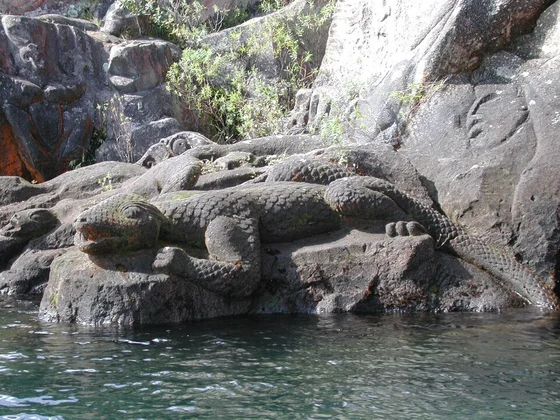
Te Aokehu confronts the danger by entering a fitted wooden enclosure that the taniwha swallows. Using the named blades Taitimu and Taiparoa, he attacks the creature from within. After the taniwha dies, Te Aokehu is released ashore. The swallowed victims are recovered and buried, while waka and taonga are taken from the belly; some belongings and parts of the taniwha are sent to families along the river as news of its defeat. Len Hetet's July 2025 Marton design framework interprets Tūtaeporoporo through white-pointer shark imagery, waterways and the lives taken in that revenge. This modern visual interpretation belongs to a particular community project; it supplies neither a universal taniwha anatomy nor an unrestricted image licence.
Origins & earliest records
The selected narrative is a public, school-hosted PDF presented from a descendant's perspective; its publication date is not established by its upload folder. An independently inspected design framework is dated July 2025. Both document continuing relationships with Tūtaeporoporo, rather than identifying an oral tradition's beginning.
Records & interpretation
The evidence consists of an attributed descendant narrative and Len Hetet's dated artistic framework. They bear witness to storytelling, community identity and visual interpretation. The shark-form description is part of these cultural accounts; neither the text nor the design establishes zoological evidence for a new animal.
Selected bibliography
Documented works and useful reading. This is not a list of every appearance.
- 01
A Story of Tutaeporoporo Taniwha
Public narrative hosted by Rangitīkei College; selected companionship, vengeance and Te Aokehu episodes. Ritual appendices are not reproduced.
- 02
Tutaeporoporo Kaitiaki Framework
Marton Streetscape Project, July 2025; PDF pages 1 and 3 establish authorship and artistic interpretation.
Family & connections
A source-supported family tree or inspiration record has not yet been compiled for this profile. Related reading below indicates a connection in subject matter, not a proven lineage or creative influence.
Encyclopedia background
An additional attributed reference, separate from the editorial profile above.
Read the open encyclopedia overview
In Māori mythology, taniwha (Māori pronunciation: [ˈtaniɸa]) are large supernatural beings that live in deep pools in rivers, dark caves, or in the sea, especially in places with dangerous currents or deceptive breakers (giant waves).
They may be considered highly respected kaitiaki (protective guardians) of people and places, or in some traditions as dangerous, predatory beings, which for example would kidnap women to have as wives.
Text from Wikipedia contributors, “Taniwha”. CC BY-SA 4.0. Extracted introduction; formatting changed. Retrieved 5 October 2026. The source article may have changed since retrieval.
References
Sources supporting this profile. Linked pages have their own scope and editorial standards.
- CommunityA Story of Tutaeporoporo TaniwhaResearch access: 2026-10-05
- CommunityLen Hetet: Tutaeporoporo Kaitiaki FrameworkResearch access: 2026-10-05
Image credits
A sourced illustration has not yet been added. This gap is included in the coverage record.