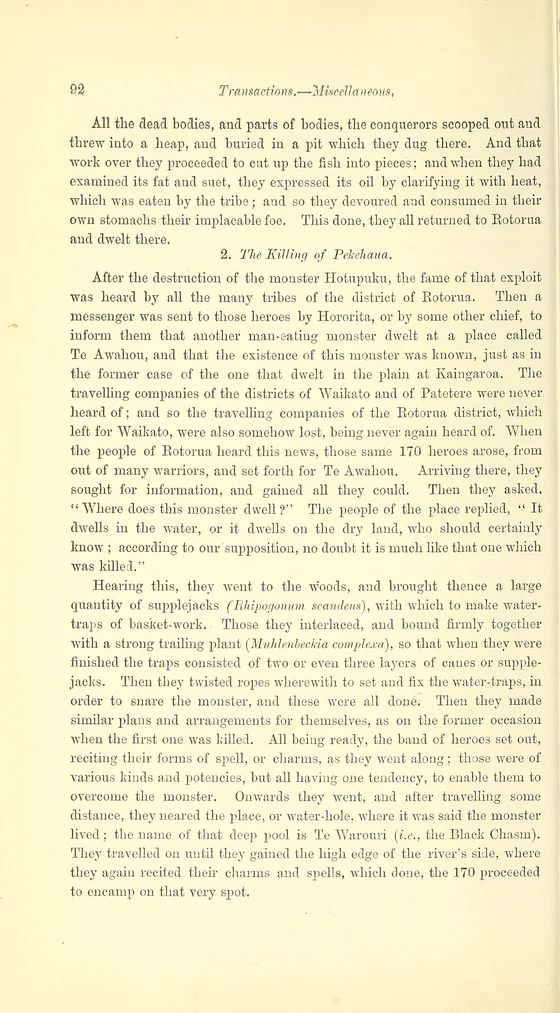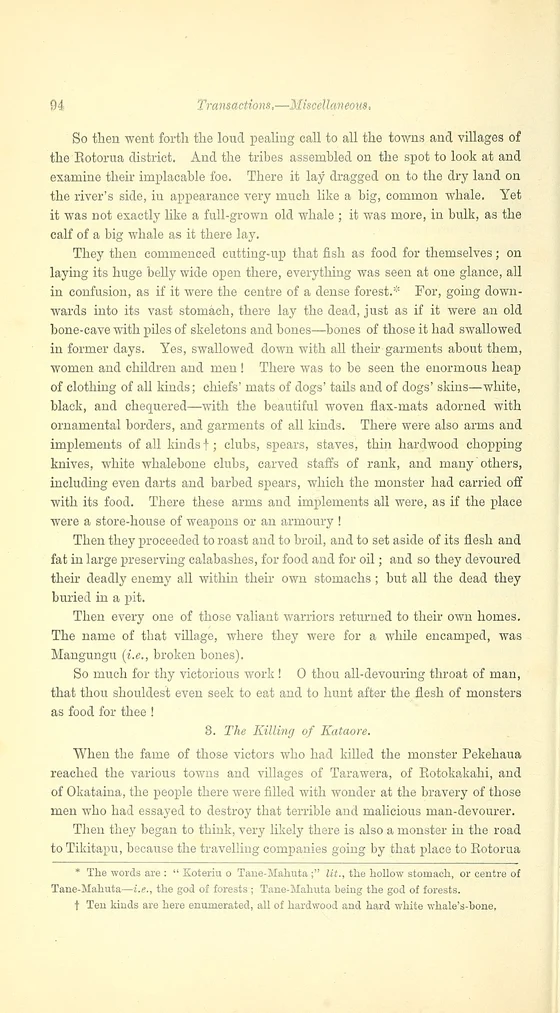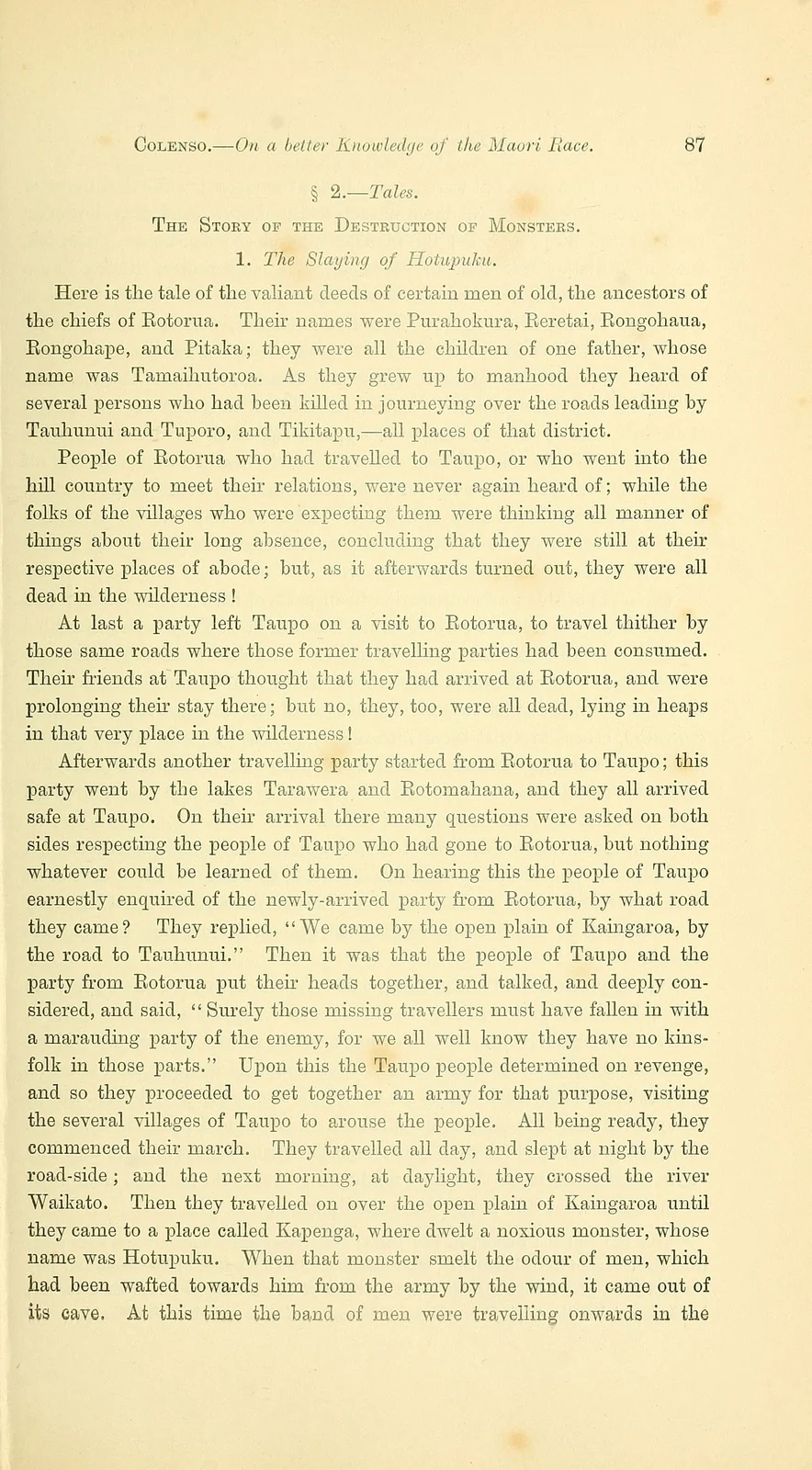
Hotu-puku monster narrative, historical printed text witness; documentary source-page facsimile
Primary text witness to Hotu-puku monster narrative in the 1878 edition. Documentary text facsimile, not creature artwork; historical terminology and collector interpretations belong to the original publication.
Overview
Colenso’s selected narrative begins with travellers disappearing between Taupō and Rotorua. A searching force encounters Hotupuku near Kapenga and initially mistakes the danger for an enemy war party. The being emerges from a cave, detects people by scent, and is described through the immense scale of a whale and the spiny appearance of a lizard. These comparisons establish narrative size and form without identifying an actual species.
The successful expedition depends on preparation, wind direction, decoys and a large rope snare. After the creature dies, its opened body reveals the remains and possessions of missing travellers, linking the communal loss to its capture. This is one named terrestrial taniwha and one collected slaying account; neither its hostility nor the expedition’s outcome defines all taniwha or all Māori relationships with them.
The published tale first names five sons of Tamaihutoroa among the Rotorua chiefs, but its action is collective. Reports exchanged between travellers reveal that parties assumed to be visiting relatives have never arrived. The first retaliatory force encounters the creature after the wind carries its human scent towards the cave; the ensuing rout explains why a later force of 170 changes its approach. They manufacture different forms of cabbage-tree-leaf rope and position a large snare before sending forward the provoking party.
The decoys pass through the prepared loops and retreat over successive hillocks. Hotupuku follows with mouth open and tongue extended, bringing its forelegs within the trap. The rope party tightens the snare around its middle, while armed men attack the tail and then alternate blows to the turning head. Ropes are secured to posts before their holders join the assault. The struggle continues until night, with death following constriction and repeated beating rather than one heroic swordstroke.
The next morning’s examination compares its scale with a sperm whale and its limbs, claws, tail, skin, scales and ridged crest with lizards. Colenso’s “fish” translation and his natural-history labels belong to the edition’s explanatory framing. The stomach contains people and a detailed array of their weapons, ornaments and garments. The victors remove and bury the victims before preparing the creature’s flesh and oil as food, then return to Rotorua. Recovery of the dead and possessions completes the communal losses described at the beginning.
Origins & earliest records
The selected account appears in William Colenso’s 1878 article, Contributions towards a better Knowledge of the Maori Race, §2.1, pp. 87–92. It is a dated colonial-era publication of Māori narrative material, not the origin of the oral tradition. Community-specific accounts may preserve different relationships and must be identified separately.
Records & interpretation
The cited collected narrative documents a named being’s representation and transmission within Māori traditions. It supplies textual evidence, not zoological proof. Public contemporary community accounts provide another kind of witness concerning continuing relationships with place and ancestry; these should not be displaced by a collector’s wording or merged with restricted knowledge.
In the literature
“In appearance, it was like a moving hill of earth!”
ArticleV, PartI, §2: The Story of the Destruction of Monsters / 1. The Slaying of Hotupuku; printedp88; paragraph beginning “Suddenly, however, the men looked up…” · William Colenso
Hotupuku terrifies the first party at Kapenga; its moving-hill appearance and spiny crest prompt a routed escape, after which170 warriors prepare cabbage-tree ropes rather than flax leaves.
“Its size was that of the sperm whale (paraoa).”
ArticleV, PartI, §2: The Story of the Destruction of Monsters / 1. The Slaying of Hotupuku; printedp91; paragraph beginning “large whale…” · William Colenso
The dead Hotupuku has a tuatara-like general form and sperm-whale size; opening its belly exposes victims with garments, ornaments and weapons, which are removed before victims are buried and the creature eaten (p92).
Selected bibliography
Documented works and useful reading. This is not a list of every appearance.
- 01
Contributions towards a better Knowledge of the Maori Race, Part I, §2.1, pp. 87–92
Transactions and Proceedings of the New Zealand Institute 11:77–106. Selected printed pages inspected in the primary PDF and compared with its OCR; colonial interpretation remains explicit.
- 02
Contributions towards a better Knowledge of the Maori Race, Part I: Legends, Myths, and Fables
Transactions and Proceedings of the New Zealand Institute, volume11 (annual volume1878), articleV, pp77–106; read12August1878. Exact selected printed pages checked in Archive facsimile; precise printing date not inferred from annual date.
Family & connections
A source-supported family tree or inspiration record has not yet been compiled for this profile. Related reading below indicates a connection in subject matter, not a proven lineage or creative influence.
Located primary passages
Specific passages supporting details in this entry, grouped by their published witness.
Contributions towards a better Knowledge of the Maori Race, Part I: Legends, Myths, and Fables
Transactions and Proceedings of the New Zealand Institute, volume11 (annual volume1878), articleV, pp77–106; read12August1878. Exact selected printed pages checked in Archive facsimile; precise printing date not inferred from annual date.
- Hotupuku terrifies the first party at Kapenga; its moving-hill appearance and spiny crest prompt a routed escape, after which170 warriors prepare cabbage-tree ropes rather than flax leaves.
- The decoy party leads Hotupuku into prepared rope nooses; coordinated pulling catches its belly, and warriors attack the tail and head until the beast dies (continued p90).
- The dead Hotupuku has a tuatara-like general form and sperm-whale size; opening its belly exposes victims with garments, ornaments and weapons, which are removed before victims are buried and the creature eaten (p92).
Colenso’s selected English translation, with his commentary and terminology distinguished from the narrative. Māori storytellers not individually identified in this article. Fish translates ika in Colenso’s stated broader sense; it does not establish literal fish taxonomy. Colonial comparative theories are not adopted.
References
Sources supporting this profile. Linked pages have their own scope and editorial standards.
- Primary textColenso 1878, §2.1, pp. 87–92 (primary volume OCR)Research access: 2026-10-05
Image credits
Historical text facsimileHotu-puku monster narrative, historical printed text witness; documentary source-page facsimile
Primary text witness to Hotu-puku monster narrative in the 1878 edition. Documentary text facsimile, not creature artwork; historical terminology and collector interpretations belong to the original publication.