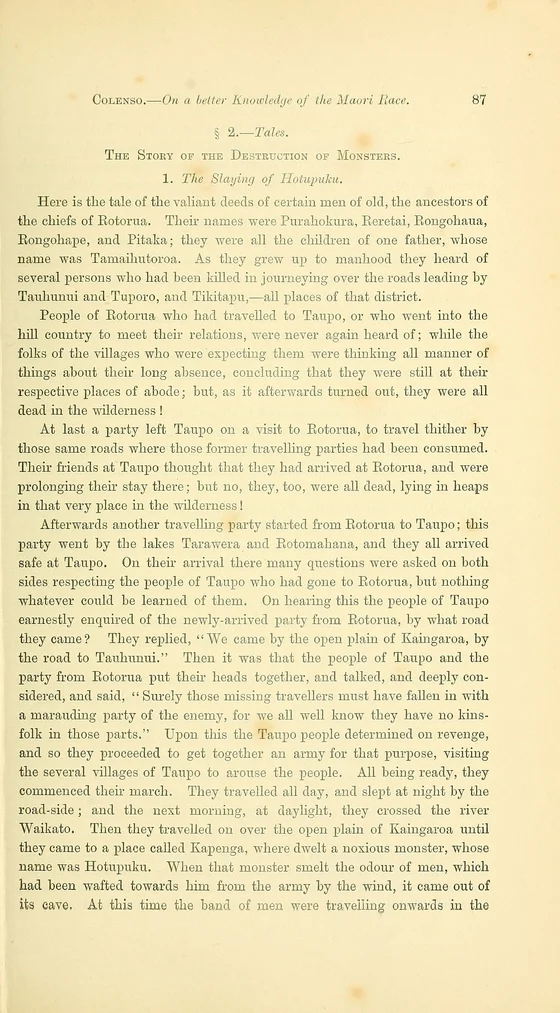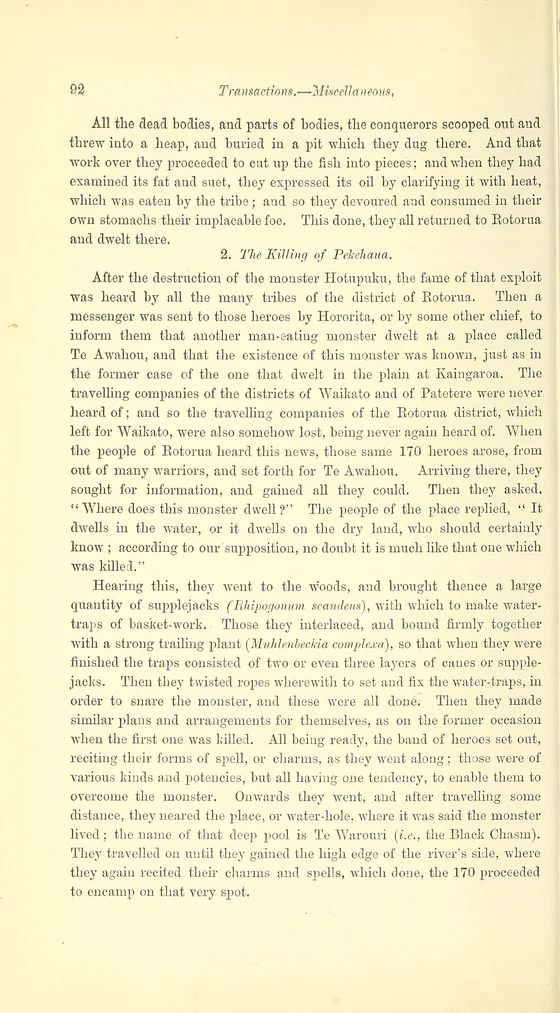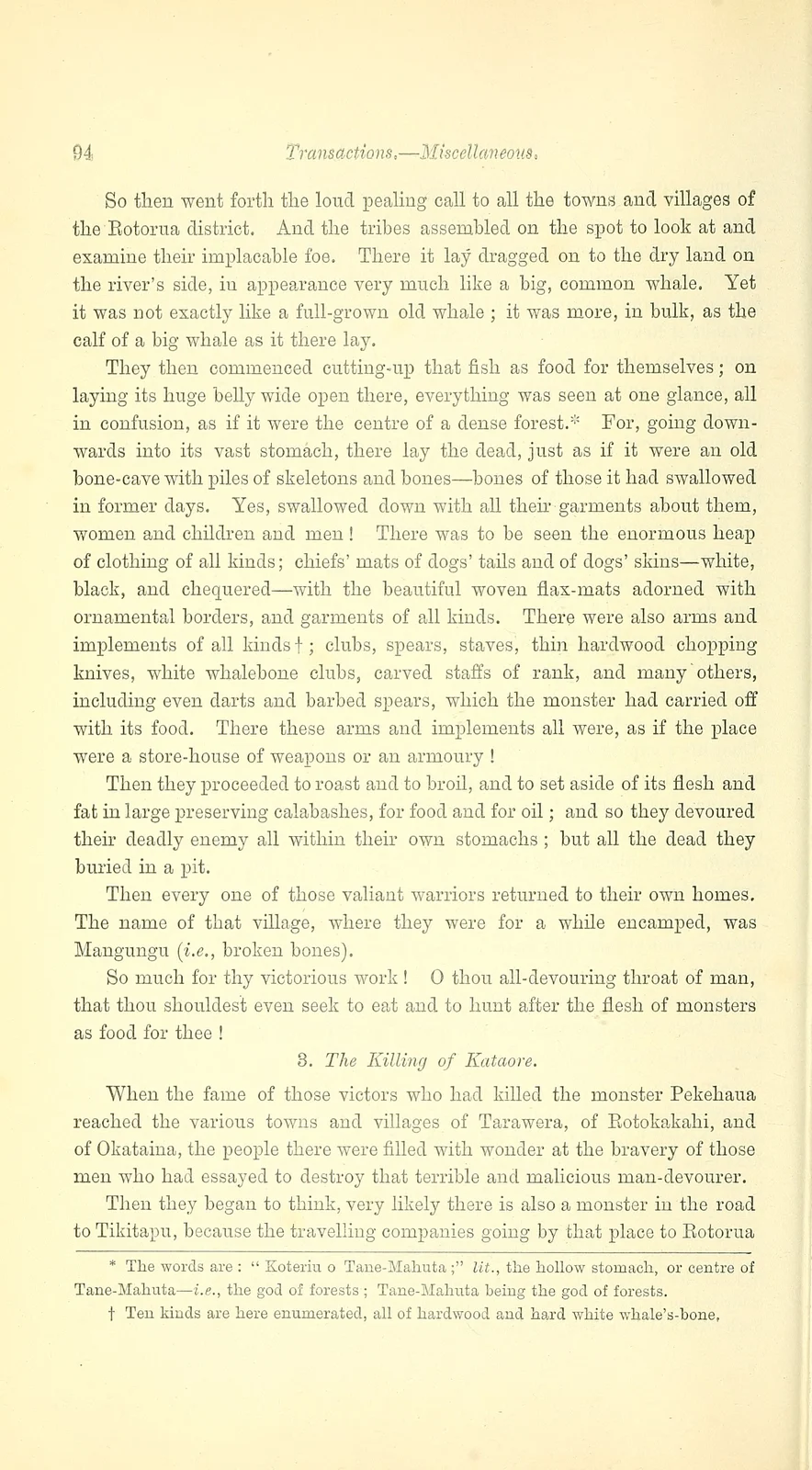
Kataore monster narrative, historical printed text witness; documentary source-page facsimile
Primary text witness to Kataore monster narrative in the 1878 edition. Documentary text facsimile, not creature artwork; historical terminology and collector interpretations belong to the original publication.
Overview
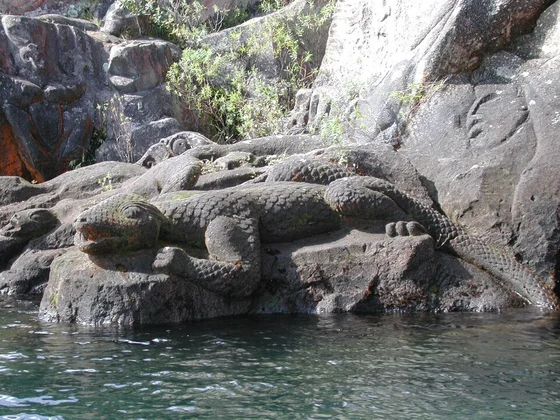
In Colenso’s selected account, disappearances near Tikitapu lead the successful taniwha-hunting party toward Moerangi. They locate Kataore in a cliff cave after initially searching the water. His immense eyes are described with luminous and greenstone comparisons, and ropes are used to draw him from the cave. The story associates his attacks with journeys by both land and canoe.
Kataore is also the cherished being of the chief Tangaroamihi, who provides food and mourns when he learns of the killing. The account ends with the death becoming a cause of continuing enmity rather than a simple celebration of victory. That relationship complicates the creature’s designation as an adversary: danger to some communities coexists with attachment elsewhere. The entry follows this published version without treating its judgements as universal.
The episode initially preserves uncertainty about the missing travellers: neighbours consider a dangerous being, hostile people and even Tangaroamihi himself. Different routes produce different results, with journeys through Okareka or Pareuru arriving safely. Tangaroamihi welcomes those seeking their relatives, while his fed companion remains quiet around familiar carers and attacks strangers after they leave. Colenso’s dog analogy is part of the collector’s presentation of this selective behaviour.
The 170 returning hunters first examine the lake. When their recitations produce no disturbance there, they turn towards the cliff; a roaring answer establishes the cave’s location. The creature’s spines and spear-like crest have become limp through the weakening recitations. Men approach while stroking its head and secure one rope around its neck and another below its forelegs. The party threads the ropes around trees, drags it from the perpendicular cliff, and pins it despite the lashing tail. Its death follows both beating and constriction; it is not simply killed at the moment of discovery.
The subsequent cutting-up yields swallowed people, clothing and weapons. Some bodies are divided, others whole; the narrator connects these differences with the creature’s mouth and inward breath. Canoe passengers could be swallowed with their vessel when Kataore entered the water. The dead are removed and buried, while the victors prepare the creature’s flesh as food. Tangaroamihi’s grief then becomes a source of war with those identified as Ngatitama. Colenso follows the story with speculative interpretations of the chief’s name; those are his concluding commentary, not another narrated encounter or proof of Kataore’s parentage.
Origins & earliest records
The selected account appears in William Colenso’s 1878 article, Contributions towards a better Knowledge of the Maori Race, §2.3, pp. 94–100. It is a dated colonial-era publication of Māori narrative material, not the origin of the oral tradition. Community-specific accounts may preserve different relationships and must be identified separately.
Records & interpretation
Colenso’s complete published §2.3 distinguishes the creature’s familiar carers from travelling strangers, narrates its restraint and death, and ends with Tangaroamihi’s grief and ensuing conflict. His closing name interpretations and zoological terminology are collector commentary. This is one colonial-era published witness, not a substitute for community-specific accounts.
In the literature
“as if clear shining greenstone were gleaming and scintillating”
ArticleV, PartI, §2: The Story of the Destruction of Monsters / 3. The Killing of Kataore; printedp98; paragraph beginning “There they saw that noxious beast…” · William Colenso
Its eyes shine like a full moon and greenstone; weakening spells make the spines flaccid, allowing neck and middle ropes to be secured and drawn around trees before the ensuing killing (p99).
“the heart of Tangaroamihi became overcast with gloom”
ArticleV, PartI, §2: The Story of the Destruction of Monsters / 3. The Killing of Kataore; printedp100; paragraph beginning “But when the news of this killing…” · William Colenso
The closing episode makes Tangaroamihi mourn his pet’s death and states that the killing becomes a continuing cause of intertribal enmity and war.
Selected bibliography
Documented works and useful reading. This is not a list of every appearance.
- 01
Contributions towards a better Knowledge of the Maori Race, Part I, §2.3, pp. 94–100
Transactions and Proceedings of the New Zealand Institute 11:77–106. Selected printed pages inspected in the primary PDF and compared with its OCR; colonial interpretation remains explicit.
- 02
Contributions towards a better Knowledge of the Maori Race, Part I: Legends, Myths, and Fables
Transactions and Proceedings of the New Zealand Institute, volume11 (annual volume1878), articleV, pp77–106; read12August1878. Exact selected printed pages checked in Archive facsimile; precise printing date not inferred from annual date.
Family & connections
A source-supported family tree or inspiration record has not yet been compiled for this profile. Related reading below indicates a connection in subject matter, not a proven lineage or creative influence.
Located primary passages
Specific passages supporting details in this entry, grouped by their published witness.
Contributions towards a better Knowledge of the Maori Race, Part I: Legends, Myths, and Fables
Transactions and Proceedings of the New Zealand Institute, volume11 (annual volume1878), articleV, pp77–106; read12August1878. Exact selected printed pages checked in Archive facsimile; precise printing date not inferred from annual date.
- Kataore knows Tangaroamihi and its feeders and behaves quietly toward them, but attacks unfamiliar travellers; this distinction lets its master initially believe it harmless.
- Its eyes shine like a full moon and greenstone; weakening spells make the spines flaccid, allowing neck and middle ropes to be secured and drawn around trees before the ensuing killing (p99).
- The closing episode makes Tangaroamihi mourn his pet’s death and states that the killing becomes a continuing cause of intertribal enmity and war.
Colenso’s selected English translation, with his commentary and terminology distinguished from the narrative. Māori storytellers not individually identified in this article. Fish translates ika in Colenso’s stated broader sense; it does not establish literal fish taxonomy. Colonial comparative theories are not adopted.
References
Sources supporting this profile. Linked pages have their own scope and editorial standards.
- Primary textColenso 1878, §2.3, pp. 94–100 (primary volume OCR)Research access: 2026-10-05
Image credits
Historical text facsimileKataore monster narrative, historical printed text witness; documentary source-page facsimile
Primary text witness to Kataore monster narrative in the 1878 edition. Documentary text facsimile, not creature artwork; historical terminology and collector interpretations belong to the original publication.