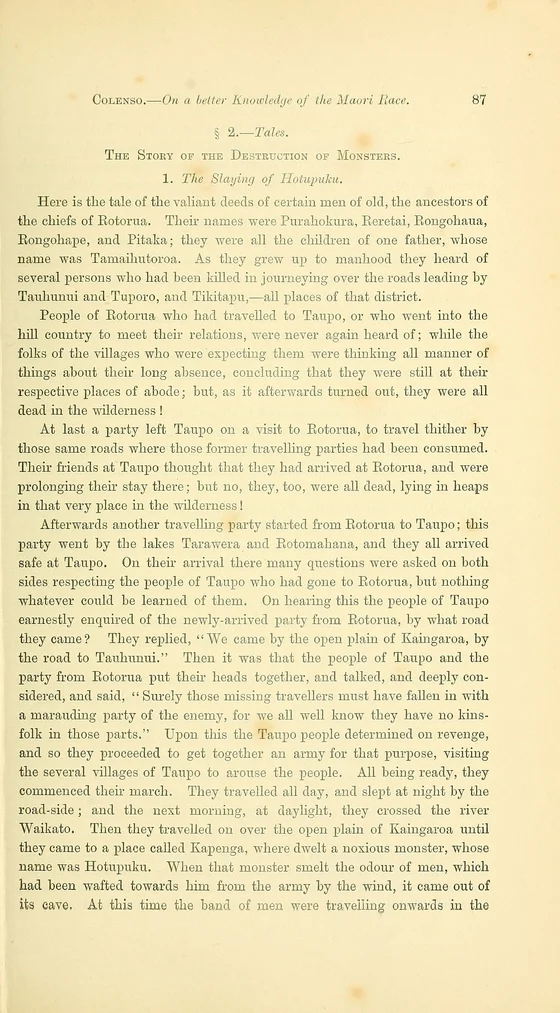
Peke-haua monster narrative, historical printed text witness; documentary source-page facsimile
Primary text witness to Peke-haua monster narrative in the 1878 edition. Documentary text facsimile, not creature artwork; historical terminology and collector interpretations belong to the original publication.
Overview
Public Ngāti Rangiwewehi-associated material identifies Pekehaua with Te Awahou as a protective presence and the river’s healing relationships. This living guardian account cannot be reduced to the predator of an older written version. In Colenso’s 1878 narrative, missing travellers prompt an expedition to a deep spring; Pītaka and companions descend with a weighted basket structure and secure the being before it is drawn upward.
The two accounts give the same named figure substantially different relationships to people. The profile therefore preserves their attribution and difference rather than manufacturing one consistent biography. The guardian understanding concerns community, water and continuing belonging, while the slaying account emphasises collective courage. Both are evidence for public narrative transmission; neither supplies a biological description or authorises outsider access to restricted cultural knowledge.
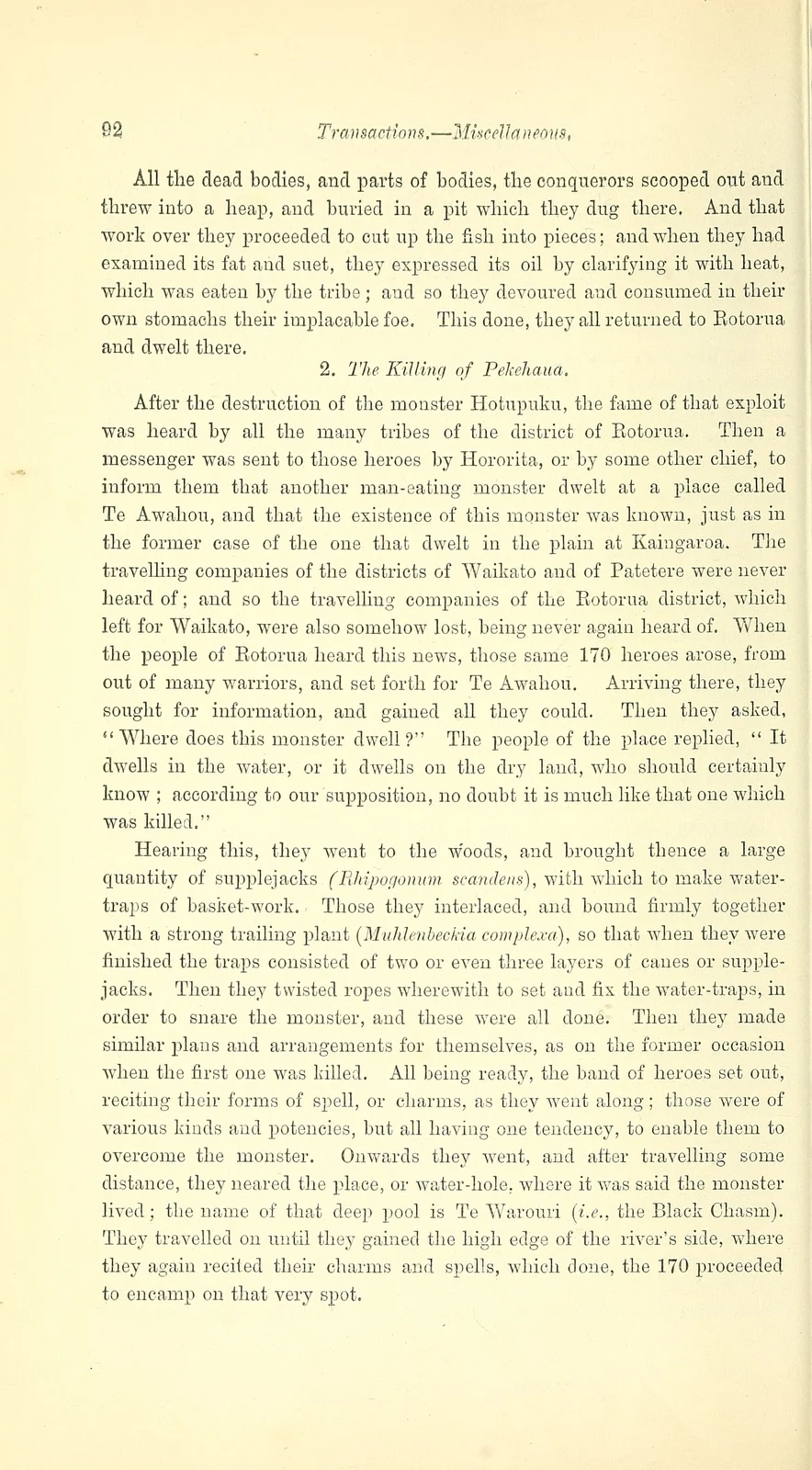
Within Colenso’s separately attributed account, the same 170 hunters who overcame Hotupuku travel to Te Awahou after another disappearance report. Local uncertainty initially leaves open whether the being lives in water or on land. They construct a layered supplejack basket structure with bound trailing stems, ropes, feather decoration and anchoring stones. Pītaka is selected to descend with companions into Te Warouri, the deep roaring spring. Those above maintain the recitations that the narrative credits with weakening the creature and supporting the subsequent heavy ascent.
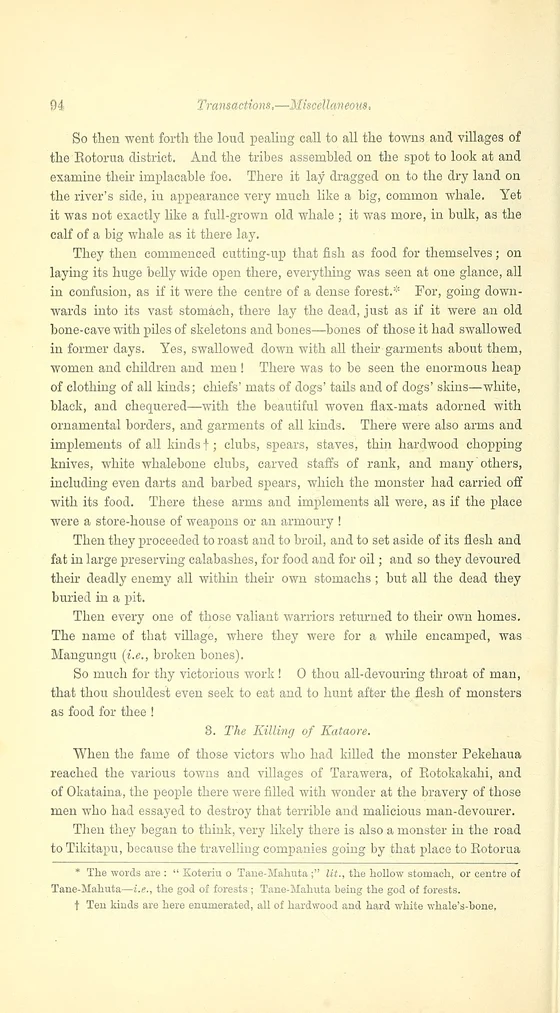
The creature’s spines and crest become limp before Pītaka approaches and fastens a rope, escaping behind it. A pull signals the waiting party, which raises both the divers and the captured being; they first reach the water surface and then draw it ashore. Blows to its jaws complete the attack. The later examination compares its bulk with a whale calf rather than an adult whale, and finds swallowed people with their garments and weapons inside. The victims are buried, while flesh, fat and oil are prepared for the victors. These actions belong to the 1878 slaying version and do not replace the public Ngāti Rangiwewehi guardian account stated above.
Origins & earliest records
The selected account appears in William Colenso’s 1878 article, Contributions towards a better Knowledge of the Maori Race, §2.2, pp. 92–94. It is a dated colonial-era publication of Māori narrative material, not the origin of the oral tradition. Community-specific accounts may preserve different relationships and must be identified separately.
Records & interpretation
The cited collected narrative documents a named being’s representation and transmission within Māori traditions. It supplies textual evidence, not zoological proof. Public contemporary community accounts provide another kind of witness concerning continuing relationships with place and ancestry; these should not be displaced by a collector’s wording or merged with restricted knowledge.
In the literature
“the name of that deep pool is Te Warouri”
ArticleV, PartI, §2: The Story of the Destruction of Monsters / 2. The Killing of Pekehaua; printedp92; paragraph beginning “Hearing this, they went to the woods…” · William Colenso
The170 returning heroes make layered supplejack basket traps, weighted and tied with ropes, and approach the deep TeWarouri pool; the following page describes Pikata’s descent and binding of Pekehaua while spells weaken it.
Selected bibliography
Documented works and useful reading. This is not a list of every appearance.
- 01
Contributions towards a better Knowledge of the Maori Race, Part I, §2.2, pp. 92–94
Transactions and Proceedings of the New Zealand Institute 11:77–106. Selected printed pages inspected in the primary PDF and compared with its OCR; colonial interpretation remains explicit.
- 02
Contributions towards a better Knowledge of the Maori Race, Part I: Legends, Myths, and Fables
Transactions and Proceedings of the New Zealand Institute, volume11 (annual volume1878), articleV, pp77–106; read12August1878. Exact selected printed pages checked in Archive facsimile; precise printing date not inferred from annual date.
Family & connections
A source-supported family tree or inspiration record has not yet been compiled for this profile. Related reading below indicates a connection in subject matter, not a proven lineage or creative influence.
Located primary passages
Specific passages supporting details in this entry, grouped by their published witness.
Contributions towards a better Knowledge of the Maori Race, Part I: Legends, Myths, and Fables
Transactions and Proceedings of the New Zealand Institute, volume11 (annual volume1878), articleV, pp77–106; read12August1878. Exact selected printed pages checked in Archive facsimile; precise printing date not inferred from annual date.
- The170 returning heroes make layered supplejack basket traps, weighted and tied with ropes, and approach the deep TeWarouri pool; the following page describes Pikata’s descent and binding of Pekehaua while spells weaken it.
- After the monster is hauled up and beaten, its opened stomach reveals victims with clothes and weapons; people bury the dead and preserve the monster’s flesh and oil, with Mangungu named as the camp.
Colenso’s selected English translation, with his commentary and terminology distinguished from the narrative. Māori storytellers not individually identified in this article. Fish translates ika in Colenso’s stated broader sense; it does not establish literal fish taxonomy. Colonial comparative theories are not adopted.
References
Sources supporting this profile. Linked pages have their own scope and editorial standards.
- Primary textColenso 1878, §2.2, pp. 92–94 (primary volume OCR)Research access: 2026-10-05
- CommunityGreat Te Arawa Stories: Pekehaua and the Awahou River — Ngāti Rangiwewehi accountResearch access: 2026-10-05
Image credits
Historical text facsimilePeke-haua monster narrative, historical printed text witness; documentary source-page facsimile
Primary text witness to Peke-haua monster narrative in the 1878 edition. Documentary text facsimile, not creature artwork; historical terminology and collector interpretations belong to the original publication.